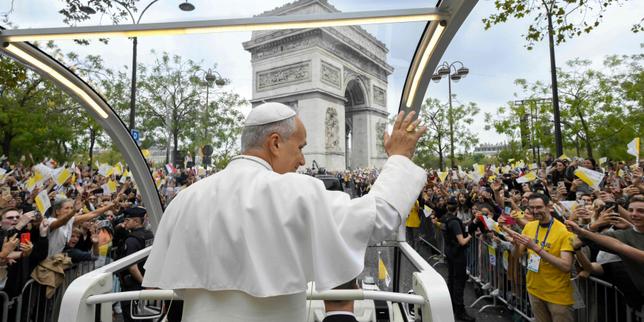
The rain over the Pyrenees does not fall so much as it drifts, a grey, heavy gauze that clings to the wool of coats and settles into the marrow of the stone. In Paris, the noise had been a physical presence. Sirens ricocheting off Haussmann facades, the dense, hurried breathing of millions, the immaculate flashbulbs catching the white of a cassock as Pope Leo XIV moved through the capital with the measured precision of a man walking across thin ice. Two days of statecraft, of diplomatic handshakes, of high-vaulted cathedrals echoing with polite applause and the quiet hum of an expectant city.
Then came the descent south.
By Sunday afternoon, the geography changed. The granite peaks closed in, indifferent and ancient. The noise of the boulevards gave way to the rushing roar of the Gave de Pau, a swollen river slicing past the grotto where millions for over a century and a half have come looking for miracles. But this weekend, the air in Lourdes carried a different texture. It was freighted with something heavier than faith, darker than the mountain mist.
Accountability.
Consider what happens when an institution built on eternity has to reckon with the broken finite bodies of its past.
For decades, the story of Lourdes was simple. It was a sanctuary for the afflicted, a place where wheelchairs lined up in the damp air, waiting for the healing waters to wash away the scars of disease and misfortune. Pilgrims came with folded hands and whispered rosaries, seeking redemption for private sins or relief for failing limbs. The narrative was clear: suffering met by divine grace.
Yet, as the papal motorcade wound its way toward the sanctuary grounds, the shadow stretching across the plaza was not cast by the basilica spires. It was cast by numbers. Cold, meticulous, devastating numbers compiled in commission reports that had laid bare decades of systemic rot. Hundreds of thousands of victims. Decades of silence protected by canon law and institutional self-preservation. When Leo XIV stepped out into the mountain air, he was not just arriving at a shrine of healing. He was stepping onto a crime scene.
The transition from Paris to Lourdes was a descent from the heights of political theater into the valley of human consequence. In Paris, the questions were about influence, secularism, the delicate dance between church and state in a republic fiercely protective of its laisicte. In Lourdes, the questions stripped away all diplomatic pretense. They were reduced to the trembling voice of a survivor standing in the rain, wondering if an apology spoken in a grotto could ever bridge a chasm dug forty years ago in the dark of a parish rectory.
Walk the esplanade at twilight, and you can feel the ghost of that institutional isolation. For generations, the church operated as a closed room. Inside, the air was incense and certainty. Outside, the world changed, grew louder, more demanding of transparency, less willing to accept the divine right of administrative secrecy. When the scandals broke—first in bursts, then in avalanches across Europe—the shock was not merely that crimes had been committed. It was that the machinery designed to comfort the broken had been used to shield the breakers.
The Pope knew this before he boarded the plane. Every step he took on French soil was shadowed by the quiet desperation of victims demanding something more durable than sorrow. Sorrow is cheap. Structural reform has a cost measured in institutional pride, legal exposure, and the shattering of old certainties.
In the sanctuary square, beneath the towering stone arches, stands a cross-section of humanity that defies easy categorization. There are the true believers, eyes closed, fingers sliding over smooth wooden beads, praying for the soul of the church as one might pray for a dying relative. But standing yards away are others. They wear no rosaries. They hold no candles. They watch the proceedings with a cold, analytical intensity born of betrayal. They are the survivors, and their families, and the advocates who spent decades banging their heads against cathedral doors that refused to open from the inside.
To understand the tension of this weekend, one must understand the anatomy of institutional grief. When a corporation fails, you audit the books, fire the board, and restructure. When a state fails, you vote out the government. But when a church—perceived by its faithful not as a human construct but as the very body of Christ on Earth—fails its most vulnerable, the grief is existential. It is not just anger at a bad actor; it is the vertigo of discovering that the floor you were standing on is built of ash.
Leo XIV’s predecessors had offered words. Condemnations, expressions of profound shame, promises of vigilance. Yet words, in the face of industrial-scale abuse and systematic cover-up, often sound like the rustle of dry leaves against a tomb. The challenge facing this papacy was whether symbolic gestures in holy places could translate into binding, irreversible justice.
As the evening service began, the candlelight flickered against thousands of upturned faces. The traditional hymns rose into the damp night air, haunting and ethereal, drifting up toward the silent mountains. For a moment, it was easy to slip back into the old comfort, to let the beauty of the liturgy smooth over the jagged edges of reality. But then a voice cut through the stillness—not from the pulpit, but from the crowd. A single, sharp shout of anguish that reminded everyone present why they were really here.
The Pope did not flinch. He paused, turned toward the sound, and bowed his head. It was a small gesture, almost imperceptible in the grand theater of papal visits, but in that quiet second, the weight of the institution shifted. It was an acknowledgment that the sanctuary is no longer a refuge from the world's judgment, but the exact place where judgment must be faced.
We are left with a profound paradox. The church in France is shrinking, its pews thinning out in rural villages, its cultural footprint fading under the relentless advance of secular modernity. Yet in the crucible of its worst crisis, it is being forced toward a strange and painful authenticity. Stripped of its historical dominance, reduced in numbers, it has nowhere left to hide behind political influence or social prestige.
The weekend in Lourdes did not solve the crisis. No single weekend could. The legal battles will grind on; the psychological scars of survivors will remain long after the papal plane has returned to Rome. But something shifted in the mist-shrouded valley. The silence that protected the guilty for generations was broken by the relentless pounding of the rain and the unyielding persistence of those who refused to let history be buried in consecrated ground.
The road out of Lourdes winds down through the foothills, following the grey rush of the river toward the open plains. Looking back from the train window, the basilica fades into the gathering dusk, a dark silhouette against the massive, unmoving wall of the Pyrenees. The mountains remain, indifferent to human frailty, to popes and scandals, to sorrow and song. But down below, in the quiet streets of the town, the people are walking back into the dark, carrying the weight of a reckoning that has only just begun.


