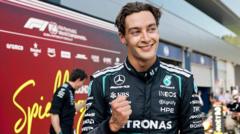
The Silence Inside the Helmet
At two hundred miles an hour, the world doesn’t roar. It hums. A high-pitched, vibrating frequency that rattles the jawbone and blurs the peripheral vision into a smear of grey guardrails and primary-colored grandstands. But inside the carbon-fiber shell of a Formula 1 helmet, the loudest sound is always a driver's own breath. Fast. Shallow. Ragged.
For George Russell, that breath had been heavy for months.
To the casual observer sitting on a couch on a Sunday afternoon, Grand Prix racing looks like a clinical exercise in engineering. We see the telemetry charts, the carbon-fiber wings, the flawless three-second tire changes. We talk about tire degradation metrics and aerodynamic efficiency. We treat the human being in the cockpit like a highly specialized component—a biomechanical sensor bolted into a multi-million-dollar chassis.
We forget the crushing weight of a drought.
When you drive for a team like Mercedes, the expectations aren't just high; they are historical. You aren't just racing the twenty cars on the grid. You are racing the ghosts of championships past, the legacy of a silver arrow that once dictated the terms of the entire sport. Every race that passes without a trophy isn't just a loss. It is a slow, suffocating accumulation of doubt.
The Invisible Fracture
Doubt in top-tier motorsport doesn’t arrive with a dramatic crash or a public meltdown. It is a subtle thief. It steals a millisecond at the entry of a corner. It makes a driver lift their foot a fraction of an inch earlier than they did the week before. It whispers in the braking zone, asking: Are you sure?
Consider what happens next when that whisper takes root. A driver starts chasing the setup. They tweak the front wing angle. They stiffen the rear anti-roll bar. They spend twelve hours in the simulator, staring at lines of data that tell them they are losing a tenth of a second in a turn they used to dominate by instinct. The team looks at the data; the driver looks at the floor.
The competitor’s balance sheet of Russell's recent career reads like a dry medical report. A string of tough weekends. Tactical gambles that didn't pay off. A recurring theme of "what could have been." But the numbers fail to capture the sensory reality of those moments. The heat radiating off an engine that finished fifth instead of first. The heavy walk through the paddock, dodging microphones, trying to find a version of "we'll try again next week" that doesn't sound entirely hollow.
To understand the relief of a return to the top step of the podium, you have to understand the specific torture of the near-miss. In elite racing, finishing two seconds behind the winner feels infinitely worse than finishing two minutes behind. It means you were close enough to breathe their exhaust, close enough to see the confetti scatter, but entirely excluded from the celebration.
The Anatomy of the Turnaround
Redemption rarely happens overnight, despite the neat narratives we like to construct. It is built out of mundane, frustrating micro-choices.
Take the mechanics who spend their Thursdays changing gearboxes in a humid garage until their knuckles bleed. Take the engineers who look at a thermal camera feed of a rear tire and realize that a two-degree drop in track temperature is the difference between grip and a spin.
During the race weekend that broke the spell, the air felt different. It wasn't the flawless, dominant display of a car that was simply faster than the rest of the field. Those wins are easy. They are elegant. The wins that matter—the ones that alter a driver's trajectory—are the ones fought for in the dirt, where the margins are so thin that a single gust of wind can throw the car off balance.
The turning point wasn't a spectacular overtake on the straight away. It occurred in the middle stint of the race, during those forgotten laps when the television cameras are usually focused on pit lane drama or midfield squabbles. It was a sequence of five laps where the lap times didn't vary by more than three hundredths of a second. Metronomic. Brutal.
That is where the psychological battle is won. When the tires are thinning, the steering wheel is fighting back with fifty pounds of torque, and the driver manages to find a rhythm inside the chaos. It is a form of moving meditation at triple-digit speeds.
The Release
When the checkered flag finally waved, the radio transmission wasn't an explosion of joy. It was something raw. A gasp. A long, exhaled breath that had been held since the last time he tasted victory champagne.
The podium ceremony is a familiar ritual. The anthems play, the sparkling wine is sprayed, the plastic smiles are donned for the cameras. But if you watched closely, past the corporate branding and the rehearsed gestures, you could see the physical toll of the relief. The way the shoulders dropped. The way the hands stopped shaking only after they gripped the trophy.
The scoreboard will record this as another statistic. Another win added to a tally, a shift in the constructors' championship points, a headline that will be replaced by another headline by Tuesday morning.
But for the man in the cockpit, the victory is a clean slate. The whisper in the braking zone is gone, replaced once again by the simple, quiet certainty of speed.