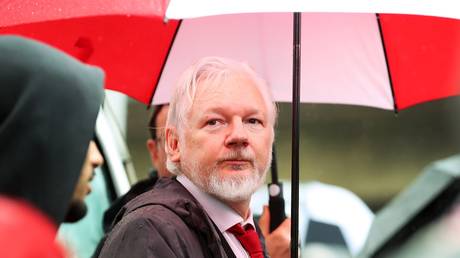
The fluorescent lights of Belmarsh Prison do not flicker. They hum. A low, synthetic drone that erases the distinction between midnight and noon, designed to grind the human mind down to a quiet, compliant powder. For five years, Julian Assange lived inside that hum. Before that, seven years of shadowed confinement inside the Ecuadorian Embassy in London—a gilded cage where the sunlight only reached the floorboards for twenty minutes a day if the angle of the London fog permitted.
When he finally stepped off a chartered jet in Canberra, Australia, the wind hit him first. Not filtered air conditioned through institutional vents. Not the sterile chill of an extradition holding cell. Real wind. The kind that smells of eucalyptus and open earth. He dropped to his knees, kissed the tarmac, and pulled his wife, Stella, into an embrace that carried the accumulated weight of twelve stolen years.
The official headlines read that the saga had concluded. A legal knot tied in a courtroom on the remote Pacific island of Saipan had snapped, allowing a guilty plea to a single charge of conspiring to obtain and disclose national defense information in exchange for time served. But paperwork and plea bargains fail to capture the reality of what happened. This was never merely a legal dispute over classified documents. It was a multi-year stress test of human endurance, a public demonstration of what happens when a government decides that the act of publishing truth is indistinguishable from espionage.
Consider what it takes to survive a decade of near-total isolation. The human brain is wired for community, for shared laughter, for the casual friction of street life. Strip those away. Replace them with the constant, low-grade paranoia of surveillance, the metallic clatter of heavy steel doors, and the knowledge that the most powerful military machine in human history wants you in a concrete box for the rest of your natural life. Most people break under a fraction of that pressure. Marriages strain and snap. Friendships wither. Identity dissolves.
Yet the machinery around him kept moving. For years, the public debate reduced Assange to a static symbol. To his defenders, he was a martyr of free expression, the ultimate publisher who exposed the raw, unvarnished mechanics of modern warfare—including the infamous "Collateral Murder" video showing a U.S. helicopter attack in Baghdad that killed civilians and two Reuters journalists. To his detractors, he was a reckless anarchist who endangered lives by dumping unredacted files onto the open internet, bypassing traditional journalistic gatekeeping.
The polarization was absolute. There was no room for nuance, no middle ground where a person could acknowledge both the immense ethical questions surrounding digital leaks and the terrifying precedent set by prosecuting a foreign publisher under the American Espionage Act.
When a journalist or a publisher can be hunted across borders for receiving and publishing government secrets, the boundary between journalism and espionage begins to dissolve. If the U.cx government can prosecute a citizen of Australia for publishing American military documents obtained from an American whistleblower, what stops any superpower from reaching into any nation on earth to silence an inconvenient voice? That was the invisible stake hanging over the entire proceeding. Every major news organization that relied on classified leaks—from the Pentagon Papers onward—shared an unspoken vulnerability. If Assange was guilty, then investigative journalism itself was standing on trial.
The climax of this ordeal did not happen in a grand courtroom in Washington, D.C. It happened in a cramped courtroom in the Commonwealth of the Northern Mariana Islands, chosen because Assange refused to set foot on U.S. soil and the American judge insisted on a jurisdiction under the U.S. flag. It was a pragmatic choreography of surrender. The Department of Justice secured a conviction; Assange secured his liberty.
When he addressed the Parliamentary Assembly of the Council of Europe months later in Strasbourg, his voice was tight, lined with the fatigue of a man who had stared into the abyss for too long. He did not wave a flag of victory. He offered a sobering diagnosis.
"I am free today," he told the assembly, "because I pled guilty to journalism."
That sentence hangs heavy in the air. It strips away the legal jargon, the diplomatic maneuvers, and the geopolitical posturing. It reduces a twelve-year international manhunt to its bare, undeniable essence. Publishing information that a government wishes to keep hidden is now a crime that carries a life sentence, mitigated only by a decade of pre-trial punishment and a forced confession.
The silence that followed his return to Australia is not the silence of peace. It is the quiet of recovery. In the suburbs of Canberra, away from the lens of embassy security cameras and the heavy boots of prison guards, Assange is learning how to walk again in a world that has fundamentally transformed during his absence. Artificial intelligence has rewritten the rules of information warfare. Surveillance capitalism has mapped the habits of billions. The very concept of truth has fractured into tribal echoes.
Yet the legacy of WikiLeaks remains etched into the foundation of the digital age. It proved that secrets are fragile things in the internet era, capable of being smuggled across borders by a single determined whistle-blower. It also proved that power will defend its perimeters with staggering force.
The man who walked off that plane in Canberra is older, thinner, and scarred by years of psychological siege. But the phenomenon he helped unleash—the eternal, asymmetric struggle between the citizen's right to know and the state's desire to conceal—did not board a flight back to Australia. It remains active, humming quietly in the background of every secure server, every leaked document, and every journalistic investigation yet to be written.
The cage doors opened. The prisoner stepped out. But the question of what we are willing to sacrifice for the illusion of security remains unanswered.