The sea does not care about your passport. It does not look at the stamp on the paper, nor does it ask for a visa before it pushes a wooden boat against the cold stones of the breakwater.
Stand on the northern edge of Africa, where the Spanish enclave of Ceuta carves a jagged footprint into Moroccan soil, and you can smell Europe. On a clear day, the lights of the mainland flicker across the water like fallen stars, close enough to touch in your mind, impossibly far away in reality. For months, the perimeter fence has been a monument to human persistence and political stubbornness. It is six meters high, topped with razor wire that gleams cruelly under the Mediterranean sun.
Then, the movement begins.
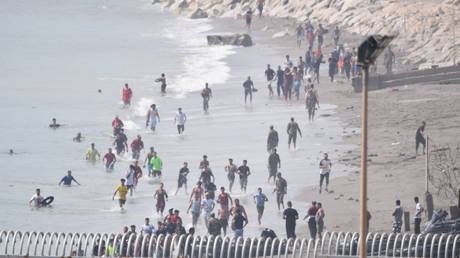
Al Jazeera cameras captured the shift, broadcasting the quiet exodus of migrants walking away from the enclave, stepping back into an uncertain horizon after enduring weeks of waiting, sleeping on flattened cardboard boxes, and watching the horizon for a sign of mercy that rarely arrived.
Silence. That is what follows the departure.
To understand what happened in Ceuta, you have to strip away the sterile language of policy briefings and border management. You have to look at the dust on the shoes of a young man from sub-Saharan Africa who spent his last savings on a ladder that never reached high enough.
Borders are not just lines drawn on maps by diplomats in air-conditioned rooms. They are living, breathing pressure valves. When economic despair collides with iron fences, something has to give. In Ceuta, that pressure manifested as thousands of people making a desperate dash across the border during diplomatic fractures between Spain and Morocco, turning a sleepy border town into the epicenter of a geopolitical chess match.
Consider what happens next. The cameras pack up. The journalists catch their flights back to Madrid or London. The international outrage softens into background noise. But the people who walked away from the enclave do not simply vanish into thin air.
(Note: While the specific individuals filmed by news crews remain anonymous to protect their safety, their trajectory follows a well-documented pattern of secondary migration, detention, or voluntary return, as tracked by humanitarian groups operating in the region.)
The geography of desperation is cruel. Ceuta is a tiny scrap of European Union territory surrounded entirely by Morocco and the sea. It is an anomaly of history, a remnant of the Reconquista, functioning as a magnet for anyone seeking an escape hatch from poverty, conflict, or climate collapse. When thousands surged across the border in past months, it triggered a humanitarian scramble. Red Cross tents sprouted overnight. Soldiers stood with shields, caught between the duty of state protection and the inescapable humanity of facing exhausted families.
And then, the pull receded. Whether driven by increased Moroccan security patrols, the sobering realization of the closed European interior, or sheer exhaustion, the exodus reversed. They left.
Why?
The answer is terrifyingly simple. Hope has an expiration date.
You can only stare at a wall for so long before your spirit begins to fracture. You can only sleep on asphalt for so many weeks before the body demands shelter, even if that shelter is back in the place you risked everything to flee. The departure from Ceuta was not a surrender of desire; it was a tactical retreat of the desperate.
We talk about migration statistics as if they are weather patterns. A high-pressure system moves in from the south; a cold front of legislation meets it at the border. We chart numbers on graphs, arguing over percentages and quotas in parliaments thousands of miles away.
We forget the blisters.
I remember talking to a man named Ibrahim—a hypothetical composite based on dozens of real accounts documented by human rights monitors in the region—who spent three days hiding in the brush near the Ceuta fence. His hands were calloused from construction work he could no longer find back home. He told me something that stayed in my bones: "A fence is just a piece of metal. But time is a blade."
He was right. Time is the real weapon of the border. Every day you spend waiting outside Europe is a day your savings drain, your family worries, and your youth slips through your fingers.
When Al Jazeera broadcasted the footage of migrants leaving the enclave, the narrative spun by politicians was predictable. Success, some cried, pointing to the declining numbers at the frontier. Order restored, others whispered, relieved that the political crisis had dipped below the media threshold.
They are looking at the wrong thing.
The departure of migrants from Ceuta is not a victory for border security. It is a symptom of a systemic failure that continues to fester out of sight. It means that the fortress held, yes. But it also means that the human cost was simply pushed underground, hidden away in safe houses, desert routes, or the bottom of the sea.
The friction between the Global South and the Global North is the defining tension of our century. Climate change will accelerate it. Economic inequality will widen it. No amount of razor wire or diplomatic posturing can permanently hold back the tide of human movement when staying put means certain death or perpetual hunger.
Ceuta is a mirror. When we look into it, we do not see a border town in North Africa. We see the fractures of our own global conscience.
The dust settles on the empty streets of the enclave. The guards lower their shields. The media moves on to the next breaking crisis. But out there, in the quiet spaces between nations, the next journey is already being planned, step by agonizing step.