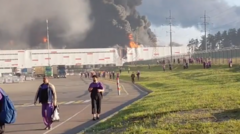
The overnight synchronized drone strikes on the Wildberries fulfillment centers in Kotovsk and Elektrostal expose a structural shift in modern asymmetric warfare: the integration of large-scale commercial retail infrastructure into state-level military supply chains and their subsequent categorization as high-value interdiction targets. Rather than isolated incidents of collateral destruction, these strikes demonstrate a systematic effort to disrupt the distribution nodes that channel dual-use microelectronics and sanctioned components into defensive production lines. Commercial e-commerce hubs possess structural advantages for covert military supply chains, but they simultaneously introduce severe systemic vulnerabilities when subjected to targeted kinetic interdiction.
The Dual-Use Logistical Framework
The utilization of commercial retail networks by state apparatuses for military logistics operates on a simple principle: hiding high-value, low-volume components within massive volumes of civilian consumer freight. Mega-warehouses, such as the 188,000-square-meter facility in Elektrostal, process hundreds of thousands of individual parcels daily. This extreme operational volume provides a highly effective obfuscation layer for the movement of restricted items, including semiconductors, navigation sensors, and drone guidance components.
Three primary operational vectors explain why commercial fulfillment networks are integrated into military supply operations:
- Velocity and Scale of Anonymized Routing: E-commerce platforms rely on decentralized, algorithmic routing systems designed to maximize speed and minimize friction. High-velocity cross-docking operations make it difficult for standard regulatory oversight or intelligence tracking to isolate individual anomalies within the macro-flow of civilian goods.
- Decentralized Node Redundancy: A nationwide network of fulfillment hubs creates an organic, distributed logistics matrix. If one node experiences a bottleneck, automated inventory management systems reroute cargo through adjacent fulfillment nodes, making the supply chain highly flexible against conventional bureaucratic or economic blockades.
- Exploitation of Last-Mile Delivery Channels: The integration of commercial transport fleets allows military logistics personnel to exploit civilian transit corridors. Interspersing critical component deliveries within standard commercial routes reduces the signature of military supply movements, complicating the target acquisition process for adversarial intelligence services.
This integration, however, converts these commercial entities into viable military objectives under the laws of armed conflict, provided the facilities contribute effectively to military action and their destruction offers a definite military advantage. The targeted strikes confirm that Ukrainian intelligence identified these specific hubs as critical bottlenecks for the flow of sanctioned navigation equipment and drone sub-components.
The Vulnerability Profile of Mega-Fulfillment Centers
While e-commerce infrastructure excels at optimizing throughput, its architectural and operational designs render it highly vulnerable to kinetic attacks. Commercial warehouses are optimized for cost-efficiency, spatial utilization, and rapid internal movement, which directly compromises their physical survivability.
Structural Flaws and Fire Dynamics
Fulfillment centers are typically constructed as vast, open-plan steel frame structures with minimal internal firewalls to allow unimpeded automated sorting systems and forklift traffic. The presence of highly combustible packaging materials—such as cardboard boxes, plastic wrap, and protective foam—creates an exceptionally high fire load density. When a kinetic impact occurs, the structural integrity of the steel frame degrades rapidly under extreme heat, leading to premature roof collapses that trap heat and accelerate the destruction of the contents.
Concentration of Asset Risk
The economic efficiency of modern e-commerce depends on high spatial concentration. By aggregating inventory into regional mega-hubs, operators minimize holding costs and optimize long-haul transport economics. This high concentration creates an asymmetric opportunity for an attacker. A single low-cost long-range uncrewed aerial vehicle (UAV) can cause catastrophic damage to billions of rubles worth of inventory and high-capital sorting machinery. The Elektrostal facility strike demonstrates this vulnerability: a single operational sector failure can compromise the processing capability of an entire regional economic zone.
Interruption of Algorithmic Management
Physical damage to a fulfillment center extends far beyond the destroyed inventory. Modern hubs operate via complex Warehouse Management Systems (WMS) tied to automated guided vehicles (AGVs), sorting conveyor matrices, and automated storage and retrieval systems (ASRS). A localized fire or structural collapse destroys the physical infrastructure while desynchronizing the digital inventory tracking data. Re-establishing the accuracy of a disrupted WMS across a damaged network requires significant time and manual labor, creating long-term operational friction that outlasts the immediate physical cleanup.
Quantification of Interdiction Economics
Evaluating the strategic utility of these strikes requires an examination of the cost-exchange ratio and the broader economic friction imposed on the targeted state's industrial base.
[Attacker Input: Low-Cost UAV Fleet] ---> (Kinetic Interdiction) ---> [Target Node: Mega-Warehouse]
                                                                                |
                                     +------------------------------------------+------------------------------------------+
                                     |                                          |                                          |
                        [Physical Asset Loss]                     [Supply Chain Friction]                    [Labor Deficit & Risk Premium]
                        - Inventory Destruction                   - WMS Desynchronization                     - Direct Casualties
                        - Automated Machinery Ruin                - Component Delivery Delays                 - Increased Insurance Rates
                        - Structural Steel Collapse               - Rerouting Inefficiencies                  - Labor Shortages & Relocation
The financial metrics of these attacks favor the attacking force. A standard long-range strike drone utilizing cheap guidance mechanisms and a modest payload requires a minimal capital investment, often under $50,000. In contrast, the defensive cost function and the direct material losses of the target are orders of magnitude higher:
- Direct Capital Asset Replacement: Rebuilding a modern, automated fulfillment center requires substantial capital investment, made more difficult by international sanctions that restrict access to foreign-made specialized sorting electronics and conveyor components.
- Inventory Replacement and Delays: The destruction of specialized, sanctioned components creates an immediate supply vacuum. Because these items cannot be easily re-ordered on the open market, replacing them requires activating convoluted, multi-tiered smuggling networks, which increases both the lead time and the acquisition premium.
- Air Defense Misallocation: To safeguard vital logistics nodes, defensive forces must deploy valuable surface-to-air missile systems and electronic warfare units away from the active front lines. This forces tactical commanders to choose between protecting front-line military formations or safeguarding domestic economic infrastructure.
The human element introduces another operational constraint. The deaths of seven night-shift workers in Kotovsk and the wounding of dozens of others across multiple facilities create an immediate labor risk premium. Commercial fulfillment networks rely on low-cost, high-turnover shift labor. When these facilities become kinetic targets, operators must implement higher wage premiums to retain staff, face severe labor shortages, or invest heavily in passive defense measures like blast walls and reinforced employee shelters. This increases the baseline operational expenditure of the entire retail sector.
Network Cascade Effects and Supply Bottlenecks
The disruption of key logistical nodes produces non-linear cascade effects across the broader economic and military ecosystem. A fulfillment center does not operate in isolation; it is a critical transition point in a complex supply network.
When a primary node like Elektrostal is removed from the network, the incoming freight must be diverted to secondary hubs. These secondary facilities are rarely configured to handle the sudden inflation of volume, leading to immediate yard congestion, prolonged truck turnaround times, and a general deceleration of shipment velocities. In a military context, a delay of even 48 to 72 hours in the delivery of a batch of navigation sensors can halt the assembly line of an entire drone production facility.
This delay creates a bullwhip effect. The manufacturing sector responds to supply uncertainty by hoarding components, which artificially inflates demand and causes further distortion throughout the procurement network. The state's military industrial base is forced to shift from an efficient "just-in-time" logistics model to a highly inefficient "just-in-case" model, tying up scarce capital in stagnant inventory and reducing the overall agility of its defense production.
Operational Limitations of Warehouse Interdiction
Despite the clear tactical successes of the Kotovsk and Elektrostal strikes, using kinetic interdiction against commercial logistics structures has distinct limitations that prevent it from being a definitive solution to supply chain subversion:
- Rapid Adaptability of Distributed Networks: Commercial e-commerce giants are fundamentally built to survive disruptions. The algorithmic nature of their logistics engines allows them to reconfigure routing protocols rapidly. If a mega-hub is destroyed, the network can fragment its operations into dozens of smaller, improvised cross-docking locations that are too small to justify the deployment of long-range strike assets.
- Intelligence Decay: Identifying which civilian facilities are actively storing military components requires continuous, high-fidelity intelligence. Supply nodes can be shifted within days; a warehouse utilized for drone components this week may return to shipping purely civilian household goods the next. Targeting facilities based on outdated intelligence carries the risk of wasting precision strike assets on low-value civilian targets.
- Political and Kinetic Escalation: Striking deep within domestic territory using weaponized drones invites proportional counter-escalation against the attacker's own energy and logistics networks. The strategic benefit of disrupting a component supply line must always be balanced against the defensive burden of protecting domestic infrastructure from retaliatory strikes.
Strategic Forecast for Logistical Security
The integration of commercial e-commerce platforms into state military supply chains is an irreversible trend driven by the realities of modern industrial procurement. As long as military hardware relies heavily on dual-use commercial off-the-shelf (COTS) components, the distribution networks designed for civilian commerce will remain an attractive vehicle for covert state logistics.
Consequently, fulfillment infrastructure must transition from purely commercial design priorities to a framework that balances efficiency with survivability. Future mega-warehouses built within strike range will likely incorporate passive defense measures, such as structural compartmentalization, heavy internal blast walls, and redundant, localized power grids.
For attacking forces, the priority will shift toward refining multi-sensor intelligence integration to track high-value components in real time as they transit through these commercial webs. The ultimate metric of success in these campaigns is not the physical destruction of brick-and-mortar warehouses, but the continuous injection of friction, delay, and unpredictability into the adversary's military production schedule. The conflict will increasingly be fought in the tension between automated commercial throughput and precision kinetic interdiction.