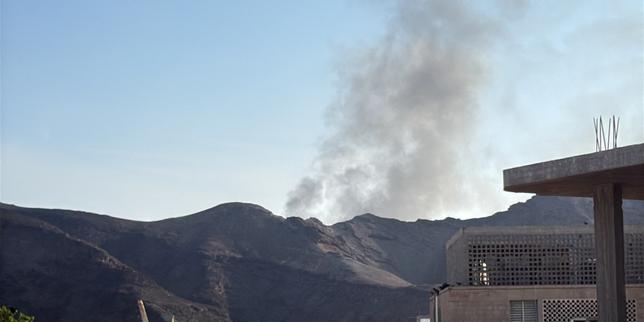
Dust. That is the first thing you notice when a convoy pulls out of the coastal scrubland near Mocha. It does not settle. It hangs in the salt-heavy air like a yellow curtain, coating the inside of your throat, clinging to the grease on rifle bolts, and blinding the rear-view mirrors of armored pickups turning east toward Aden.
Wait. For another perspective, check out: this related article.
Listen to the silence that follows the engines.
For years, the stretch of coastline bordering the Bab Al-Mandab Strait—a name that translates from Arabic with chilling accuracy as the Gate of Tears—was held together by a fragile, sun-baked bargain. Yemeni government forces and their allied factions stood watch over one of the most critical maritime chokepoints on earth. Now, those same troops are packing up their mortars, loading their ammunition crates, and redeploying eastward toward Aden, the interim capital suddenly staring down a renewed, suffocating threat from Houthi forces. Related insight on the subject has been provided by USA Today.
On a military briefing map, this looks like a clean tactical adjustment. Arrows shift from a narrow strip of coastal desert to a dense urban peninsula. Logistics officers nod. Analysts file their reports.
Out here, in the heat where the Red Sea squeezes into the Gulf of Aden, it feels less like a maneuver and more like watching the lock on a vault swing open while the guards run to put out a fire in the lobby.
The Architecture of a Chokepoint
To understand why a troop movement in southern Yemen should keep a factory manager in Rotterdam or a nurse in Toronto awake at night, you have to picture the geography. Think of global maritime trade not as a vast, limitless ocean, but as the circulatory system of a human body. The Pacific and Indian Oceans are the great chambers of the heart, pumping raw materials, microchips, grain, and crude oil toward the markets of Europe and North America.
The Bab Al-Mandab Strait is the carotid artery.
At its narrowest point, between Yemen on the Arabian Peninsula and Djibouti on the Horn of Africa, this waterway is barely eighteen miles wide. An island called Perim slices that channel in two, leaving shipping lanes so tight that massive container vessels must thread the needle in single file. Before the regional security crisis began escalating in late 2023, roughly twelve percent of all global trade—and nearly thirty percent of global container traffic—passed through this exact corridor every single year. Over six million barrels of oil flowed past these dry volcanic hills every single day.
When I first stood on a concrete pier overlooking the approaches to the strait years ago, the sheer scale of the traffic seemed permanent, almost geological. Super-tankers moved across the horizon like slow-moving islands of steel. Local fishermen in wooden skiffs bobbed in their wake, hauling up kingfish while billions of dollars in consumer electronics and crude oil glided silently two miles away. You got the distinct, deceptive impression that the world's supply chain was too big to break.
It is not too big. It is merely stretched thin.
And right now, the men who kept the eastern shore of that artery from collapsing into total chaos are being pulled away because Aden itself is gasping for air.
A Hypothetical Morning on the Waterfront
Consider a hypothetical scenario, grounded entirely in the realities of how this conflict grinds down ordinary lives.
Picture Tariq, a thirty-four-year-old crane operator at the Port of Aden. Before the war fractured Yemen in 2014, Tariq’s father worked the same docks, unloading timber from Malaysia and wheat from Ukraine. Today, Tariq wakes up at four in the morning not to an alarm clock, but to the distant thud of artillery echoing off the jagged volcanic craters that surround the city.
His wife, Samira, boils water over a propane burner, stretching a bag of flour that has doubled in price since last winter. She does not read geopolitical risk assessments. She does not care about maritime insurance premiums in London. She cares that when the frontline shifts closer to Aden’s northern perimeter, the checkpoints multiply, the water trucks stop running on schedule, and the hospital in Crater district runs out of insulin.
When Tariq walks to the port, he sees the armored technicals rolling in from the west—dust-caked Toyota Land Cruisers mounted with heavy machine guns, carrying soldiers who were stationed near Bab Al-Mandab forty-eight hours ago. Part of him feels a rush of relief. Aden is his home. When Houthi forces push toward the southern stronghold, every rifle barrel defending the city perimeter feels like a reprieve for his children.
Yet as Tariq climbs the steel ladder into his crane cab, looking out over the half-empty berths of Aden’s harbor, a colder realization sets in. Those soldiers did not materialize out of thin air. They were pulled off the western coast. Every truck parked at a checkpoint in Aden is a truck no longer patrolling the smuggling routes, launching sites, and coastal ridges overlooking the Gate of Tears.
Tariq is trapped in an impossible equation. Save the city, and you surrender the sea. Guard the sea, and you watch the city burn.
Why Aden Cannot Be Allowed to Fall
To grasp why the Yemeni government—formally known as the Presidential Leadership Council, an uneasy coalition of anti-Houthi factions—made the agonizing choice to thin its coastal defenses, you have to understand what Aden represents.
Since Houthi forces seized the historic capital of Sanaa in 2014, Aden has functioned as the fractured nation’s provisional seat of government. It is more than a collection of ministries and port facilities. It is the symbolic and administrative anchor preventing total Houthi hegemony over the entire western half of Yemen.
History offers a grim warning about what happens when port cities on the Arabian Peninsula become besieged islands. During the brutal battles for Hodeidah and Taiz, frontlines froze into meat grinders where civilians paid the price in famine and cholera. Aden’s geography makes it uniquely vulnerable. The city sits on a cluster of rocky peninsulas jutting into the Gulf of Aden, connected to the mainland by narrow causeways and coastal roads. If hostile forces sever those arteries, Aden does not just lose territory. It becomes a trap.
Over recent months, Houthi military pressure along the southern and eastern fronts has intensified. Armed with battle-hardened infantry, extensive drone networks, and ballistic missile stockpiles that have repeatedly defied international interception efforts, the Houthis have probed the weak seams between rival anti-Houthi militias.
The government forces stationed near Bab Al-Mandab—many of them hardened fighters from the Giants Brigades and allied coastal defense units—represent some of the most disciplined, well-equipped combat troops available to the anti-Houthi coalition. Leaving them parked along a quiet stretch of Red Sea coast while Aden’s perimeter buckled was military suicide.
So the order went out. Pack the gear. Fuel the trucks. Head east.
The Mechanics of an Invisible Tax
What happens next?
Look beyond the sandstorms of southern Yemen to the quiet glow of trading screens in Singapore, London, and New York. When security deteriorates along the Bab Al-Mandab corridor, the impact does not announce itself with a single dramatic explosion. It arrives like a slow leak in a tire.
Shipping companies are allergic to two things: sunken hulls and uninsurable risk. Even before this latest troop redeployment, Houthi drone and missile attacks in the Red Sea forced major maritime carriers—giants like Maersk, MSC, and Hapag-Lloyd—to reroute hundreds of vessels around the southern tip of Africa via the Cape of Good Hope.
That detour adds roughly ten to fourteen days to a single voyage between Asia and Europe.
Think about what fourteen extra days at sea actually means in physical terms. A container ship burns tens of thousands of dollars in bunker fuel every single day it stays underway. Multiply that across an entire global fleet, and you have instantly vaporized millions of tons of shipping capacity. Containers sit on docks in Shanghai waiting for vessels that are stuck rounding South Africa. European automakers pause assembly lines because specialized gaskets and wiring harnesses are delayed off the coast of Namibia.
And then there is war-risk insurance. Before the Red Sea crisis escalated, insuring a hundred-million-dollar vessel for a transit through Bab Al-Mandab cost a tiny fraction of a percent of the hull's value. At the height of the attacks, those premiums surged tenfold, adding hundreds of thousands of dollars to a single passage.
By pulling ground forces away from the eastern shore of the strait to reinforce Aden, the Yemeni government is inadvertently widening the operational breathing room for Houthi coastal units. Without persistent ground patrols, mobile radar, and coastal interdiction teams watching the coves and wadis along the strait, moving anti-ship missiles, naval mines, and explosive-laden drone boats closer to the water becomes infinitely easier.
You will not see a headline tomorrow morning saying that the troop movement in Yemen raised the price of your winter coat or delayed a shipment of hospital supplies. The connection is invisible. It hides inside freight surcharges, supplier delays, and three-percent price adjustments quietly passed along at the checkout counter.
Yet the causal chain is unbroken. A soldier steps out of a trench overlooking the Gate of Tears, and six weeks later, a supply chain manager in Chicago wonders why container rates just spiked again.
The Fractured Shield
I will be honest with you: anyone who claims to know exactly how the internal politics of anti-Houthi forces will play out over the next six months is guessing. The coalition defending southern Yemen is a labyrinth of competing loyalties, tribal grievances, and rival foreign backers.
On paper, they share a common enemy in the Houthis. On the ground, the reality is far messier.
The anti-Houthi camp includes forces loyal to the internationally recognized government alongside the Southern Transitional Council, a powerful separatist movement that wants to restore South Yemen as an independent state—just as it existed prior to 1990. These factions have fought the Houthis together, and they have also turned their guns on each other in the streets of Aden.
When troops redeploy from Bab Al-Mandab toward Aden, local commanders watch every convoy with narrowed eyes. Is this purely a defensive reinforcement against an imminent Houthi offensive? Or is it also a quiet realignment of power inside the southern capital itself?
In Yemen, military geography is never purely tactical. Every brigade carries political weight. Moving thousands of fighters shifts the balance of leverage in backroom negotiations in Riyadh and Abu Dhabi just as surely as it shifts firepower on the battlefield.
That ambiguity is what makes this moment so dangerous. War thrives on miscalculation. When a defensive force is stretched between protecting a vital international waterway and securing its own political survival in Aden, cracks open up. And the Houthis have spent a decade proving they are masters at exploiting every crack their enemies leave exposed.
The Illusion of Distance
We have a habit, especially in the West, of treating conflicts like Yemen’s as tragic, self-contained fires burning on the far edge of the map. We read brief wire dispatches about troop movements, glance at names like Bab Al-Mandab and Aden, and turn the page toward issues that feel closer to home.
That distance is an illusion built on cheap diesel and calm seas.
For seventy years, the modern global economy operated on an unspoken assumption: that someone, somewhere, would always keep the chokepoints open. We built just-in-time manufacturing systems with zero inventory buffers because we assumed ships would always glide through eighteen-mile straits on schedule. We forgot that freedom of navigation is not a law of nature. It is a fragile political achievement maintained by exhausted men standing in the dust with rifles, radar sets, and fragile supply lines of their own.
Look back at the Suez Crisis of 1956, or the Tanker War in the Persian Gulf during the 1980s. Every generation has to relearn the same hard lesson: you cannot divorce the stability of global commerce from the desperation of the people living along its shorelines.
Yemen is the poorest nation in the Arab world. Millions of its citizens survive on humanitarian aid that shrinks every year as donor fatigue sets in. Its currency has collapsed. Its infrastructure lies in ruins. Yet by sheer accident of geography, this shattered country sits astride the windpipe of global trade.
Expecting underpaid, overstretched Yemeni fighters to permanently secure a vital international shipping lane while their own provisional capital faces encirclement is like asking a man whose house is on fire to stand outside and direct neighborhood traffic.
Sunset Over the Strait
Back in Aden, as the afternoon sun drops toward the Arabian Sea, the heat finally begins to break. Down by the water in Tawahi district, families still gather along the seawall, buying roasted corn and sweet tea from street vendors while cargo cranes stand motionless against an orange sky.
Twenty miles to the north, along the desert approaches, newly arrived soldiers from the western coast are digging fresh earthen berms into the gravel. They unload crates of ammunition, set up mortar tubes, and string camouflage netting over their trucks before night falls.
And a hundred miles to the west, where the Red Sea narrows into the Gate of Tears, the wind blows unhindered across empty watchposts. Out in the dark water, the navigation lights of a lone bulk carrier blink steadily in the distance, steaming south toward the open ocean, passing silent hills where nobody is standing guard anymore.