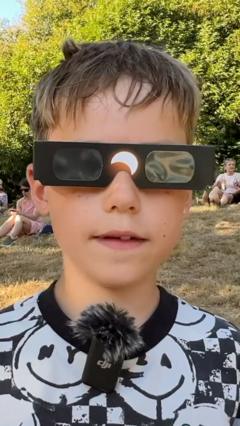
Darkness fell at two o'clock in the afternoon. Streetlights flickered on. The temperature dropped sharply. Cwrt-Rheol primary school pupil Toby Cooper stood frozen, staring straight up at the midday night sky with protective glasses clamped tight to his face. Total solar eclipses do not happen every day. When they do, they catch adults off guard. Kids? They just experience pure, unfiltered awe.
I've watched plenty of cosmic events through a telescope lens, but nothing beats seeing a child witness celestial mechanics firsthand. Most people treat a solar eclipse like a minor traffic delay or a cool excuse to leave the office early. They glance up for three seconds, snap a blurry photo on an outdated phone, and walk away. They miss the real point entirely.
What We Misunderstand About Youth and Astronomy
Kids don't need complex astrophysics lectures to feel the weight of the universe. They need permission to look up. When a historic eclipse sweeps across the map, adults get stressed. We worry about cloud cover. We panic about ISO certification labels on cheap paper glasses. We turn a rare astronomical alignment into a logistical headache.
Toby didn't care about the logistics. He cared about the shadow.
Astronomers note that totality alters animal behavior, but human behavior shifts just as wildly. Grown-ups turn into anxious chaperones. We bark orders about eye safety. We obsess over camera settings. We forget to breathe. Meanwhile, an eight-year-old kid handles the sudden twilight with absolute calm. It's humbling.
Think back to the last major alignment. Did you actually watch the corona shimmer, or did you spend ten minutes trying to get Instagram to focus? We sabotage our own moments of wonder.
The Science of Sudden Darkness
Let's look at what actually happens during totality. The moon lines up precisely between Earth and the sun. For a few fleeting minutes, day becomes night.
- The solar corona becomes visible.
- Planets pop out in the afternoon sky.
- The horizon glows with a weird, sunset-orange ring.
Try explaining that to a second-grader. Books fall flat. Diagrams on a whiteboard fail. But stand outside when the shadow cone hits at two thousand miles per hour, and the lesson sticks forever. Toby didn't read about orbital mechanics in a dusty textbook that afternoon. He felt the planet shift beneath his sneakers.
Most educational frameworks rely on memorization. Pass the test. Forget the facts. Real curiosity works differently. It starts with a gasp.
Why These Rare Alignments Still Matter
We live in a hyper-optimized world. Every second of our day gets tracked, monetized, or scheduled. A total solar eclipse ruins productivity. It forces the whole grid to pause. Traffic slows down. Factories quiet, even briefly. People spill out onto driveways and school yards.
That shared pause is rare.
When an eight-year-old watches the sun vanish, they join a line of humanity stretching back thousands of years. Ancient civilizations thought dragons were eating the sun. We know about axial tilts and elliptical orbits. Yet the emotional jolt remains identical. Fear mixes with absolute delight.
If you missed the last big shadow sweep, don't wait for the next local window to care about space. Astronomy isn't a niche hobby for nerds in basements. It's the ultimate reality check. It reminds us we're riding a tiny blue rock through a very big, very cold void.
How to Share the Next Cosmic Event Without Ruining It
Stop overcomplicating things. If you have kids, nieces, nephews, or neighborhood kids around for the next big alignment, throw away the rulebook.
- Buy certified safety glasses early. Don't scramble the morning of the event.
- Put the phone down. Seriously. The internet already has ten thousand professional photos of the corona.
- Let children lead the reaction. If they want to scream, let them scream. If they want to stand in absolute silence, match their quiet.
- Talk about gravity and orbits after the emotional peak, not during it.
Toby Cooper went back to school the next day with a story most adults will spend decades forgetting. He watched the day break its promise. He saw the stars come out at lunch.
Plan your next outdoor excursion around the calendar, not your inbox. Find an open field. Bring a pair of glasses. Shut your phone off. Let yourself feel as small as an eight-year-old standing beneath a stolen sun.


