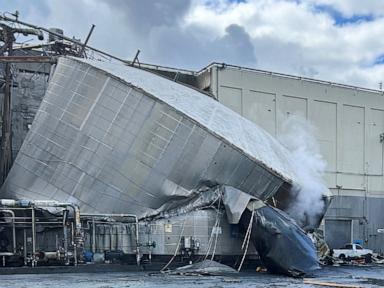
A massive chemical tank holding nearly a million gallons of a highly corrosive liquid imploded and collapsed Tuesday morning at the Nippon Dynawave Packaging Co. mill in Longview, Washington. The catastrophe killed at least one worker, Gilbert Bernal, an electrician known in his local church group as the guy who was always there to help. Nine other workers remain unaccounted for, and local officials have delivered the grim reality that there is no hope of finding survivors.
This isn't just a localized tragedy. It's a massive mass casualty scene that exposes the hidden, volatile risks baked into the infrastructure of our industrial towns.
Emergency crews faced a horrifying scene at 7:19 a.m. when the industrial tank buckled. What followed was an immediate shift from a rescue operation to a grim recovery effort. The sheer scale of the disaster stunned local officials. Early reports completely underestimated the scope, initially stating the tank held 80,000 gallons. That number was later drastically corrected to roughly 900,000 gallons. That's enough highly caustic chemical brew to fill an Olympic-sized swimming pool one and a half times.
The Danger of White Liquor and Unstable Structures
The substance inside the tank wasn't just water or standard industrial runoff. It was white liquor. If you don't work in the pulp and paper industry, you probably have no idea what that means. White liquor is a heavy-duty mixture consisting mainly of sodium hydroxide and sodium sulfide. Mill operators mix it with intense heat to dissolve the bonds in wood, breaking it down to create the pulp needed for kraft paper, heavy packaging, and shopping bags.
It's incredibly toxic and highly corrosive. When the tank imploded, it didn't just spill; it flashed across the site, causing severe chemical burns and horrific inhalation injuries to those nearby. Nine people were rushed to hospitals in Longview and Vancouver, Washington, with injuries ranging from minor to critical. Four of the most severely injured had to be flown immediately to the Legacy Oregon Burn Center in Portland. Even one of the responding firefighters suffered injuries trying to manage the chaotic scene.
Right now, the physical recovery of the missing workers is completely stalled. Cowlitz Fire and Rescue Chief Scott Goldstein made it clear that emergency responders are facing an absolute logistical nightmare. The massive circular tank didn't just split open; it buckled violently on one side and remains fundamentally unstable.
An estimated 90,000 gallons of the corrosive mixture are still trapped inside the compromised, leaning structure. Because of the lingering danger of an additional collapse or further chemical bursts, recovery teams are strictly restricted to working during daylight hours. They literally have to reinforce the structure before they can even attempt to bring out the missing victims.
A Community Left Waiting in the Dark
Longview is a tight-knit city of about 40,000 residents built along the Columbia River. It has been a timber and paper hub since its founding in the 1920s. Everyone here knows someone who works at the mill. The facility employs around 1,000 people, making it an economic anchor for the region.
But while the community gathered for an emotional park vigil on Tuesday night, lighting candles and leaning on each other for support, anger and confusion began bubbling to the surface.
During a Tuesday evening press conference packed with regional politicians—including Governor Bob Ferguson, Senator Patty Murray, and Representative Marie Gluesenkamp Perez—not a single representative from Nippon Dynawave Packaging Co. stepped up to speak to the public. The silence from the corporate side was deafening. Two distraught parents actually interrupted the end of the press conference, visually shaken, shouting that their two sons worked inside the facility and they still hadn't received a single phone call or update from the company.
While the parent company, Japan-based Nippon Paper Group, eventually issued a written statement expressing condolences to the families, the lack of immediate, transparent communication on the ground has left families feeling utterly abandoned during the worst moments of their lives.
Regulators are Already Looking at past Violations
Predictably, the questions are shifting toward how an industrial asset of this size simply implodes without warning. Investigators say it's way too early to pinpoint the mechanical or structural root cause, but a look at the facility's safety tracking record reveals some friction.
State labor records show that the Washington Department of Labor and Industries has fined Nippon Dynawave a total of $3,400 for three separate health and safety violations since the start of 2021. Those specific fines were minor, involving things like employees missing required fall protection gear on elevated platforms.
More concerning, however, are two distinct safety complaints filed against the company very recently, on March 4 and May 6. State regulators clarified on social media that those open complaints were technically unrelated to the specific tank that collapsed. One complaint was an anonymous tip regarding a faulty valve on a completely different vat.
Even if those specific complaints didn't cause this week's collapse, they paint a picture of a facility under ongoing scrutiny. A massive industrial tank doesn't just implode because of a bad day. It happens because of structural fatigue, vacuum failures, or hidden corrosion that went unnoticed or unaddressed.
The Broader Reality of Chemical Hazards
This disaster didn't happen in a vacuum. It was actually the second major West Coast chemical scare in a matter of days, following a major chemical tank incident at a Southern California aerospace plant that forced thousands of residents to evacuate their homes.
According to data compiled by a coalition of environmental justice organizations, more than 40 people died in the United States between January 2021 and late 2023 due to hazardous chemical incidents. These industrial accidents aren't rare anomalies; they are persistent risks in communities that live alongside heavy manufacturing.
Right now, the state's Department of Ecology has teams stationed at a drainage ditch near the Longview mill to evaluate the environmental fallout of the white liquor runoff. While local authorities insist there is no immediate chemical threat to the broader public, the long-term ecological and community impact is going to linger for years.
If you run an industrial operation, manage commercial infrastructure, or work in a high-hazard environment, you can't treat this as just another news headline. Use this moment to review your own safety protocols.
- Audit all bulk storage vats: Don't just check for outward leaks. Demand internal structural integrity tests and acoustic emissions testing to find hidden wall thinning.
- Review vacuum relief systems: Implosions happen when pressure differentials go wrong. Ensure your vent lines and vacuum breaker valves are clear, functional, and sized correctly for the volume of liquid being moved.
- Force strict contractor tracking: Know exactly who is on-site, where they are stationed, and what hot work or electrical tasks are happening around high-risk vessels at any given minute.
- Overhaul your family communication plan: Don't wait for a crisis to figure out how to notify next of kin. If your facility has a mass casualty event, you need a dedicated liaison handling family updates immediately, not hours after the politicians finish their speeches.
The recovery process in Longview is going to be slow, painful, and dangerous. As investigators slowly piece together the mechanical failures that destroyed the Nippon Dynawave tank, the rest of the industrial sector needs to start auditing their own containment systems before the next disaster strikes.


