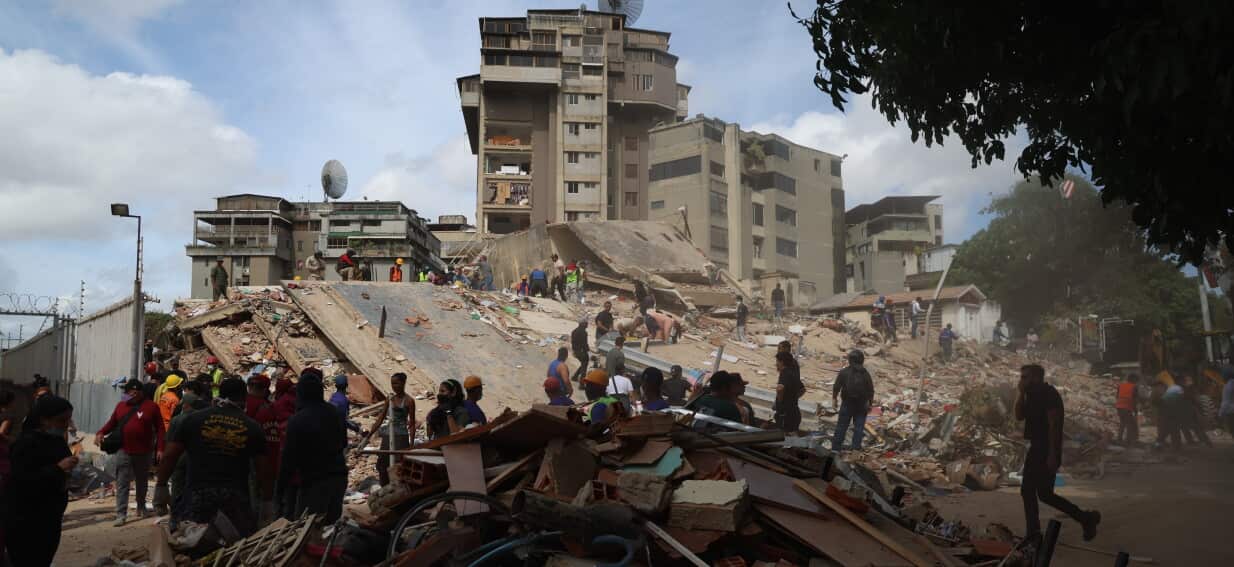
The sequence of a magnitude 7.2 foreshock followed 39 seconds later by a magnitude 7.5 mainshock near Yaracuy state on June 24, 2026, presents more than a severe humanitarian emergency. It exposes a systemic, structural compounding of risk within a state already undergoing acute administrative transition and capital starvation. The United States Geological Survey estimates the immediate economic impact between 1% and 7% of Venezuela's gross domestic product, translating to a fiscal shock between $1.1 billion and $7.8 billion against an estimated 2026 GDP of $111.3 billion.
Standard disaster frameworks routinely fail to model the reality of these twin events. They analyze seismic damage through a singular shock lens, ignoring the cumulative degradation of non-ductile structural systems and the paralyzing effects of concurrent administrative transitions. To understand the long-term trajectory of Venezuela’s recovery under its current interim government, analysts must evaluate the catastrophe through quantified infrastructural thresholds and economic mechanisms rather than generalized observations.
The Cumulative Failure Mechanism of Non-Ductile Concrete
The primary driver of the structural failure observed across the Caracas metropolitan area and San Felipe is the rapid-succession fatigue of non-ductile concrete infrastructure. Buildings constructed prior to the implementation of modern seismic codes in the early 1970s lack the necessary steel reinforcement distribution to absorb and dissipate kinetic energy.
The physical destruction followed a two-stage structural collapse mechanism:
- The Foreshock Elastic Limit Strain: The 7.2 magnitude foreshock micro-fractured internal concrete matrices and induced permanent deformation in structural columns. While many of these buildings remained standing immediately after the first tremor, their lateral load-bearing capacity was drastically compromised.
- The Mainshock Pancaking Trigger: When the 7.5 magnitude mainshock struck 39 seconds later—releasing roughly three times the seismic energy of the initial event—it encountered structures already stripped of their elastic safety margins. This caused instantaneous shear failure in columns, leading to vertical collapse or "pancaking."
More than 250 buildings collapsed entirely, and over 3,000 households faced immediate displacement. This structural vulnerability correlates directly with poverty metrics. Data from Andrés Bello Catholic University shows that approximately 10% of the population inhabited structurally unsafe dwellings prior to the event. The geography of informal settlements on hilly, unstable terrain around Caracas and San Felipe compounded the mechanical failures by triggering widespread ground liquefaction and lateral landslides.
The Macroeconomic Cost Function and Sovereign Bottlenecks
The fiscal reality of rebuilding cannot be met through standard municipal budgets or existing national reserves. The economic damage intersects with an unhedged state balance sheet, a banking sector crippled by historical hyperinflation, and limited international credit access.
The sovereign recovery equation is constrained by three critical bottlenecks:
Sovereign Liquidity Deficit
The interim administration led by Delcy Rodríguez announced the mobilization of a $200 million International Monetary Fund facility to address immediate hospital, housing, and infrastructure recovery. Comparing this capital injection against the lower-bound USGS damage estimate of $1.1 billion reveals an immediate funding gap of $900 million. The upper-bound gap exceeds $7.6 billion. Without deep international credit access or the restructuring of global sanctions, the state lacks the liquidity required to clear debris and safely reconstruct transport arteries.
Capital Inflow Restrictions
While the energy sector remains the primary engine of Venezuelan fiscal revenue, it cannot immediately bridge the recovery deficit. Major international operators—including Chevron, Shell, and Repsol—reported that core production facilities and export terminals near Lake Maracaibo escaped catastrophic structural failure. However, the domestic downstream sector suffered disruptions. The Morón petrochemical complex experienced crude leakage from a storage tank, forcing a temporary shutdown. Even with continuous oil operations, the conversion of energy revenue into liquid reconstruction funds is delayed by remaining compliance requirements and debt-settlement frameworks negotiated with the United States.
The Long-Tail Discount of Disasters
Empirical research demonstrates that standard disaster metrics undercount the structural suppression of long-term economic growth. When a major seismic event hits a highly vulnerable economy, the per capita GDP remains persistently below pre-shock trend lines for years. Capital that would otherwise fund productivity enhancements is permanently diverted into basic asset replacement.
The Logistical Cascading Effect
The immediate operational challenge for recovery teams is not merely localized building destruction, but the systemic failure of interconnected public utilities. The disruption of one node triggers a compounding shutdown across adjacent networks.
[Seismic Rupture]
       │
       ├──► [Power Grid Disruption] ──► [Water Pumping System Failure] ──► [Sanitation Breakdown]
       │
       └──► [Transport Link Damage] ──► [Supply Chain Bottlenecks] ────► [Delayed Emergency Response]
The closure of Simón Bolívar International Airport due to structural damage halted the immediate air bridge for international search-and-rescue teams and specialized equipment. This logistical failure was exacerbated by a near-total drop in regional telecommunications and widespread electrical grid blackouts.
The loss of power immediately severed the water supply network. Venezuelan municipal water distribution relies heavily on electric pumping stations; without grid stability, hospitals already operating under severe resource constraints were stripped of running water. This utility collapse occurred during ambient regional temperatures fluctuating between 32°C and 35°C, accelerating the risk of heat stress, waterborne vectors, and the rapid degradation of public health conditions in dense urban settlements.
The Strategic Reconstruction Play
Rebuilding a compromised urban ecosystem under severe capital constraints requires a shift away from ad-hoc emergency allocation toward a highly structured, phased resource deployment model.
- Enact Selective Parametric Triggers: Future international aid and sovereign debt instruments must be tied directly to parametric triggers—such as specified spectral acceleration metrics or USGS-verified magnitudes—to ensure instantaneous capital release without waiting for prolonged damage assessments.
- Mandate Localized Seismic Retrofitting: Immediate building permits must reject non-ductile concrete designs. Reconstruction funding must be conditioned on the integration of ductile detailing, including closely spaced steel hoops in concrete columns to handle shear stress during aftershocks.
- Decentralize Critical Utility Infrastructure: To break the cascading failure chain, critical facilities like hospitals and water treatment hubs must be decoupled from the centralized national power grid via localized solar-plus-storage microgrids capable of autonomous operation.
The survival of Venezuela's fragile economic stabilization depends entirely on whether the state can transition from immediate emergency triage to a structured, institutionalized risk mitigation framework before continuous aftershocks permanently compromise the country's remaining productive assets.