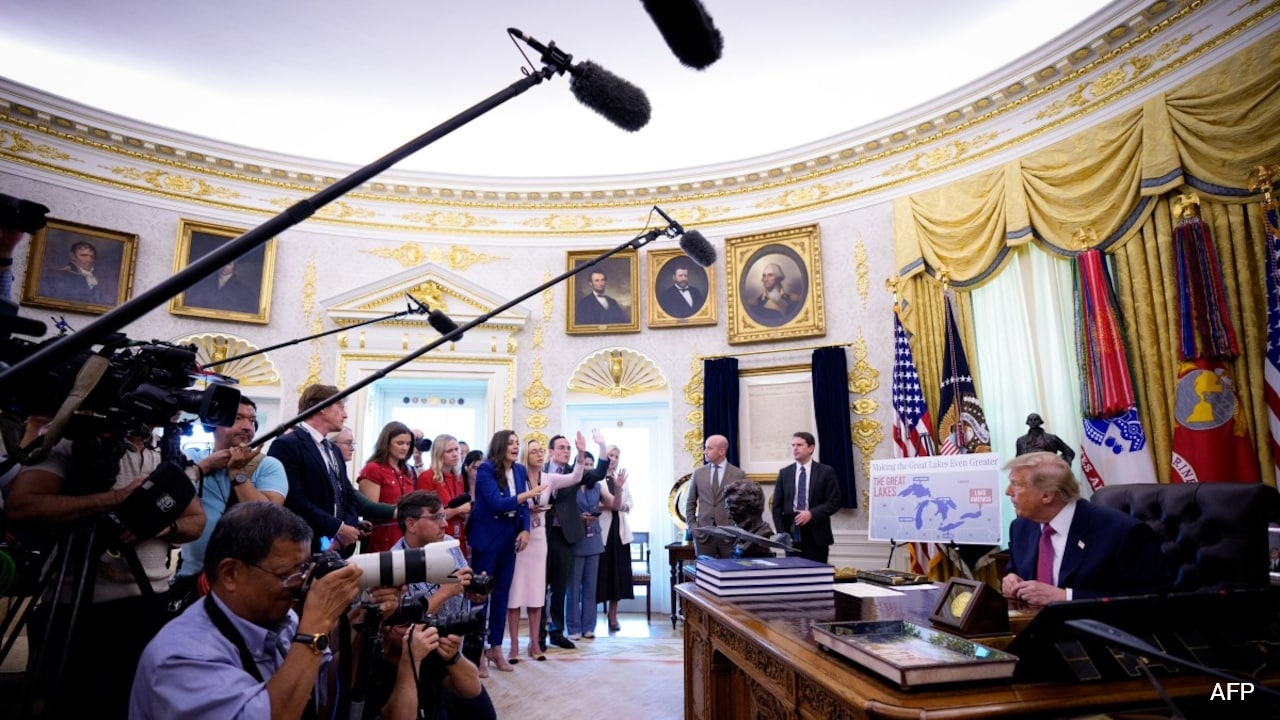
The coffee in the basement press bullpen of the White House always tastes a little bit of old copper and institutional anxiety. It is a flavor seasoned by decades of late nights, half
The Velvet Wall Around the Press Room
news Also making news in related news: Inside the Dundee Student Housing Collapse That Left Hundreds Stranded.
The fluorescent hum of the West Wing briefing room has always carried a specific kind of electricity. It is a nervous, caffeinated energy, born of proximity to power and the mutual understanding that every word spoken from that raised podium ripples outward into the world within seconds. Reporters lean forward, tape recorders click, and pens scratch furiously against paper. For decades, that room operated under a rough, unwritten contract: the press asks the hard questions, and the administration answers them—or dodges them, or spins them, but crucially, remains in the room.
Then the geometry of that contract shifted. Further information regarding the matter are detailed by BBC News.
Picture a cold afternoon in February 2017. Outside, the Washington winter clings to the stone facades with a sharp bite. Inside the White House, a tight knot of journalists from major outlets—networks and publications that had spent months tracking the turbulence of a new presidency—realized they were standing on the wrong side of a velvet rope. CNN, Politico, the New York Times, and the Los Angeles Times were told they were not on the list. Smaller, more sympathetic outlets were waved through into the office of then-Press Secretary Sean Spicer for an informal, off-camera gaggle. The traditional briefing room stood empty, lights dimmed, while the inner circle shrank.
It was called an informal briefing. It felt like an eviction.
To understand why that moment matters, we have to look past the immediate political theater and examine the anatomy of access. Power, by its very nature, seeks a frictionless environment. When a leader steps into the public square, they invite scrutiny. They open themselves up to the raised eyebrow, the pointed query, the inconvenient statistic that complicates a carefully curated narrative. But what happens when the leader decides the friction is too high?
Imagine running a kitchen where the health inspector is required by law to taste the soup. If the inspector finds salt levels too high or a cooler running too warm, they write it down. The cook might curse under their breath, wipe their brow, and adjust the burners. The friction is annoying, but it keeps the restaurant from poisoning the customers. Now imagine the cook simply locking the back door. The inspector stands outside, rattling the handle while the kitchen inside continues to cook in secret, unchecked by outside eyes.
When the White House blocks specific news organizations, the doors of that kitchen are locked.
The rationale offered at the time was familiar: pushback against what the administration termed unfair reporting and fabricated narratives. Every political administration harbors a deep, visceral resentment of the press corps. It is as old as the republic itself. Thomas Jefferson famously wrote that if he had to choose between a government without newspapers or newspapers without a government, he would not hesitate a moment to prefer the latter. Yet that same Jefferson spent much of his presidency railing against the scurrilous attacks of the partisan gazettes of his day. The tension is baked into the architecture of democracy. It is meant to be uncomfortable.
Yet, there is a vast gulf between complaining about coverage and fundamentally altering the mechanics of accountability.
Consider the ripple effect on the public imagination. When citizens watch reporters get shut out of a room, they do not see a tactical political maneuver. They see a retreat. They see a government building walls not just against journalists, but against the questions those journalists carry on behalf of millions of readers who cannot fit into the folding chairs of the West Wing.
Think of the lone reporter sitting at a kitchen table in Ohio or Oregon, scrolling through feeds on a cracked phone screen, trying to figure out if the healthcare policy being debated in Washington will cover their mother's insulin. That reporter relies on the pool report, the live feed, the stubborn journalist who refuses to back down when an evasive answer is tossed their way. When that stubborn journalist is barred from the room, the distance between power and the people widens. The silence grows louder.
History offers a stern warning about what happens when the press corps is curated rather than tolerated. In closed societies, information flows in one direction, smooth and unblemished by doubt. Propaganda replaces dialogue. But America was built on a different premise—one that assumes citizens are adults capable of handling the messy, brawling reality of a free press.
When the Trump administration drew that line in the sand in 2017, they were not just disciplining a handful of outlets. They were testing a boundary. They were asking a fundamental question: How much control can an executive exert over the mirror in which the nation sees itself?
The answer is still being written. Every time an administration—left or right, past or present—decides that a question is illegitimate because the questioner is unwelcome, the mirror cracks just a little bit more.
Step back into that briefing room for a moment. Imagine the empty chairs. Imagine the silence where the sharp, cross-examining voices used to live. The lights might be turned back on eventually, the cameras might roll again, and the daily dance of politics will resume its frantic rhythm. But the memory of the locked door lingers. It reminds us that democracy is not a monument carved in granite. It is a fragile, breathing thing, sustained only by the willingness to let the uncomfortable questions stay in the room.