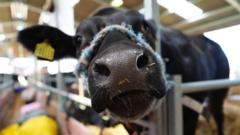
Agricultural exhibitions function as centralized mixing vessels for regional livestock, transforming static farming communities into high-density nodes of biological exchange. When an epizootic threat emerges, public health authorities and show committees face a distinct optimization problem: balancing the economic utility of live exhibition against the exponential transmission risk of a notifiable pathogen. Recent decisions by agricultural show organizers to exclude cattle and sheep from competition represent a textbook exercise in biosecurity triage. To understand why these bans occur, one must analyze the transmission mechanics, the operational cost functions, and the systemic consequences of vector-borne and contact diseases like bluetongue and bovine tuberculosis within regional agricultural markets.
The Transmission Matrix: Vectors Versus Direct Contact
Pathogen dissemination at agricultural gatherings typically follows two distinct epidemiological tracks. Direct-contact diseases, such as bovine tuberculosis, rely on physical proximity, shared housing, and contaminated soil or feed troughs. Vector-borne diseases, such as bluetongue virus, operate through intermediate agents—in this case, biting midges of the genus Culicoides.
When a region experiences a suspected or confirmed outbreak, the presence of susceptible ruminants at a public exhibition alters the local epidemiological landscape in three ways:
- Concentration Density: Animals from dozens of disparate herds are brought into a confined spatial perimeter, drastically increasing contact rates per unit of time.
- Vector Amplification: Outdoor showgrounds situated in rural valleys often feature high vector populations. Susceptible livestock act as mobile feeding stations, increasing viral replication rates within local midge populations.
- Geographic Dispersal: Exhibitors transport animals across county and national lines. A single infected, asymptomatic animal returning from a show introduces the pathogen into a previously naive herd dozens of miles away.
Excluding cattle and sheep neutralizes the primary amplification hosts. Without susceptible ruminants present on the showground, the transmission chain breaks at the point of aggregation, preventing the event from acting as a regional dissemination hub.
The Cost Function of Preventive Restrictions
Implementing a livestock ban imposes immediate, measurable financial losses on organizers, breeders, and local vendors, yet these costs must be weighed against the catastrophic downside risks of an uncontrolled outbreak.
The economic equation governing a livestock ban consists of fixed losses balanced against variable risk mitigation:
- Exhibitor Capital Depreciation: Pedigree breeders invest heavily in feeding, grooming, and conditioning animals specifically for the summer show circuit. Canceling classes for cattle and sheep eliminates the immediate opportunity to validate genetic lines, secure championship titles, and command higher prices at subsequent livestock auctions.
- Event Revenue Compression: Agricultural shows rely on gate receipts, entry fees, and sponsorship tiers tied to livestock entries. Restricting cloven-hoofed animals compresses revenue streams, forcing organizers to pivot toward alternative attractions like equine events, craft tents, and machinery displays to maintain attendance.
- Sanitary Compliance Expenditure: Veterinary consultations, liaison with regulatory bodies such as the Animal and Plant Health Agency, and communication campaigns require upfront capital allocation even when livestock classes are canceled.
The alternative—permitting animals to attend during an active disease threat—introduces severe tail risk. A single widespread quarantine order on participating farms can result in mandatory culls, movement restrictions spanning months, and export market closures worth millions of pounds. From a risk-management perspective, voluntary or mandated exclusion acts as a cheap insurance policy against total industry lockdown.
Operational Adaptation and Supply Chain Resilience
When livestock classes are abruptly canceled, the structural integrity of the event depends on supply chain elasticity. Organizers cannot simply close their gates without incurring permanent institutional decay; an agricultural show that skips a year often struggles to recover community momentum and vendor commitments.
Successful adaptation requires decoupling the concept of the "agricultural show" from the physical presence of cattle and sheep. Organizers have begun experimenting with structural alternatives to preserve engagement:
- Digital Substitution: Implementing on-farm judging where independent veterinarians or judges evaluate animals via standardized video and photographic submissions prior to the event date. These scores are then tallied and displayed publicly during the traditional show window.
- Diversification of Attractions: Expanding non-ruminant livestock participation—such as poultry, pigs, or equines where epidemiological risk profiles differ—alongside enhanced commercial trade stalls and educational agriculture exhibits.
- Supply Chain Reallocation: Shifting spatial footprints to accommodate larger craft, food, and machinery exhibits, capturing alternative consumer spending demographics to offset the loss of livestock-dependent agricultural tourists.
These adaptations highlight a fundamental shift in event planning: resilience now requires modular operational architectures that can rapidly shed high-risk components without collapsing the entire commercial framework.
Strategic Outlook and Biosecurity Forecasting
The frequency of vector-borne and infectious disease disruptions is inextricably linked to shifting environmental variables, including climatic warming that expands the habitable zones for vectors like biting midges. As atmospheric temperatures rise, northern agricultural regions experience longer vector activity windows, making historical seasonal assumptions obsolete.
Future biosecurity protocols will increasingly rely on real-time genomic surveillance and rapid diagnostic testing deployed directly at farm gates rather than broad, reactive event cancellations. Until decentralized diagnostic infrastructure matures across the agricultural sector, preemptive bans on cattle and sheep will remain the primary administrative instrument for disease containment. Show committees must transition from ad-hoc emergency responses to standardized risk-tiering frameworks, establishing predetermined threshold triggers for livestock exclusion weeks before an event opens its gates.


