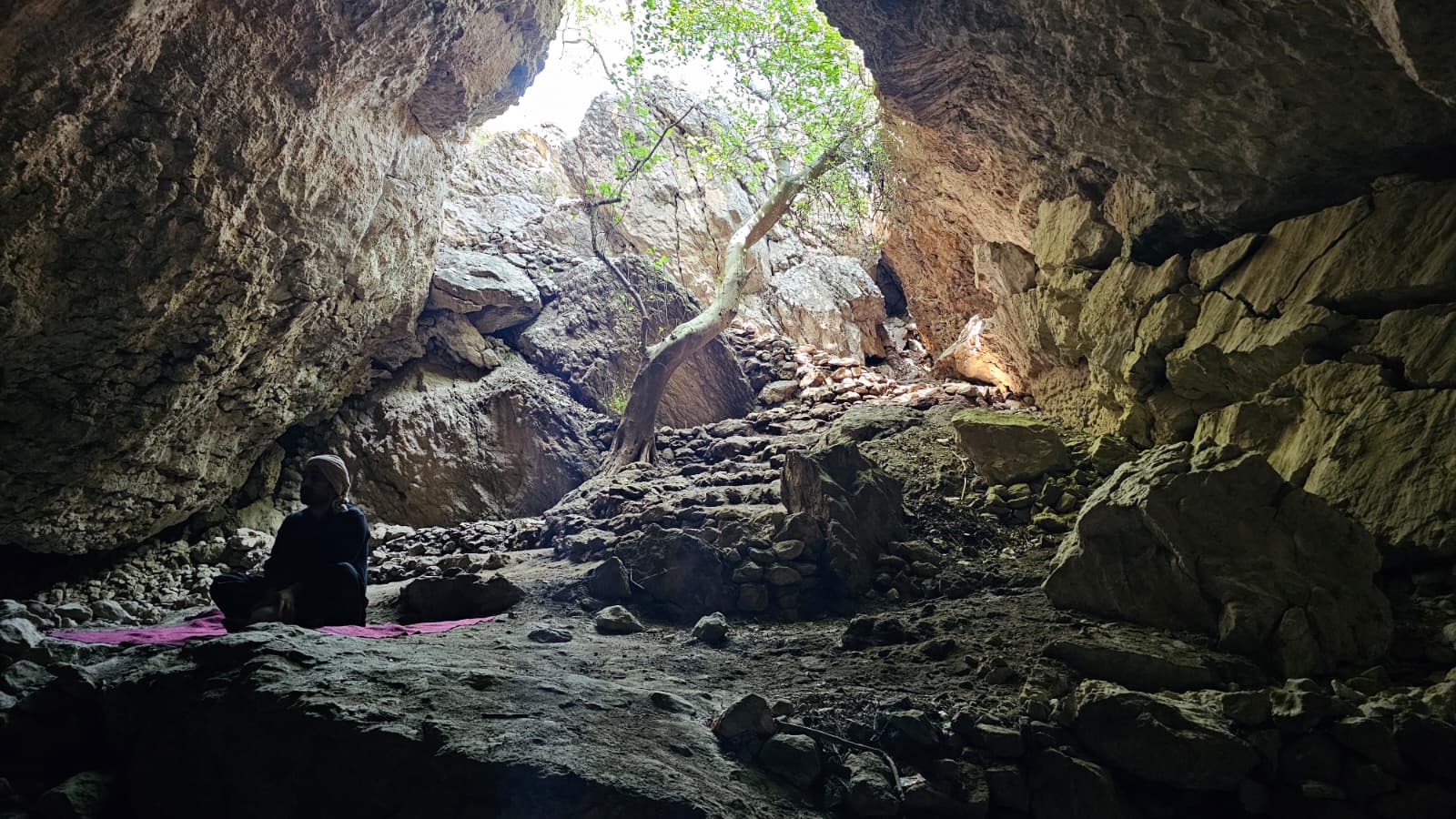
In the jagged, sun-scorched terrain of the Salt Range near Chakwal, a small opening in the earth marks the spot where the 13th-century Sufi saint Baba Farid Ganjshakar is said to have spent forty days in solitary meditation. This site, known as a Chilla Gah, serves as more than just a historical footnote. It is the epicenter of a localized spiritual economy that is currently struggling to balance ancient asceticism with the aggressive demands of modern religious tourism. While the surface narrative often focuses on the mystical peace of the cave, the reality on the ground reveals a complex struggle for historical preservation against a backdrop of environmental neglect and institutional indifference.
The cave itself is a modest limestone aperture. It sits within a landscape that feels older than time, yet the encroachment of poorly planned infrastructure and the debris of thousands of annual visitors have begun to choke the very serenity that pilgrims travel hundreds of miles to find. To understand why this specific cave matters, one must look past the simple folklore and examine the mechanics of Sufi tradition in Pakistan, where the physical "presence" of a saint's memory acts as a powerful social and political anchor.
The Physicality of the Sacred
The Chilla Gah of Baba Farid is not a monument built of marble or gold. Its power lies in its raw, subterranean isolation. This is the site of the Chilla-i-Ma'kus, the ritual where a practitioner remains suspended or isolated to achieve a higher state of consciousness. For the devotee, the cave is a portal. For the historian, it is a rare surviving link to the Chishti Order’s foundational years in the Indian subcontinent.
Most visitors arrive expecting a polished heritage site. They are instead met with a rugged reality. The path to the cave involves navigating steep, uneven terrain that remains largely unmaintained. This lack of development is a double-edged sword. On one hand, it preserves the ascetic atmosphere that Baba Farid championed. On the other, the absence of waste management systems means the surrounding hillsides are frequently littered with plastic and ceremonial detritus. The "peace" of the cave is increasingly interrupted by the logistical chaos of its popularity.
The local administration and the Auqaf Department, which oversees religious properties, have historically treated these rural sites with a "benign neglect" approach. This isn't necessarily due to a lack of interest, but rather a chronic shortage of funding and a tendency to prioritize high-profile urban shrines like Data Darbar in Lahore. Consequently, the Chilla Gah at Chakwal exists in a state of suspended animation, protected by its devotees but vulnerable to the elements.
The Economy of the Grave
Beneath the spiritual fervor lies a hard-nosed economic reality. The village nearest to the cave has transformed into a service hub for pilgrims. Small stalls selling rose petals, incense, and cheap printed hagiographies line the approach. This is the "shrine economy," a vital source of income for a region where industrial opportunities are scarce and the soil is too salty for high-yield farming.
However, this economy is precarious. It relies entirely on the perceived sanctity of the site. If the cave becomes too commercialized, it loses its "authentic" ascetic appeal. If it remains too desolate, it cannot support the volume of visitors required to sustain the local vendors. We are seeing a slow-motion collision between traditional devotion and the "Instagram-friendly" travel culture that demands accessibility and visual polish.
Local guides often recount tales of the saint’s miracles to keep the interest of the younger, more skeptical generation. They speak of how the ground stayed cool in the blistering heat or how the saint’s presence still lingers in the scent of the air. These stories are the currency of the site. Without them, the cave is just a hole in the Salt Range. With them, it is a destination that defies the logic of the modern, secular world.
Environmental Decay in the Salt Range
The Salt Range is one of the most geologically significant areas in the world, containing records of the Earth's history spanning millions of years. The Chilla Gah is tucked into this sensitive ecosystem. The influx of vehicles and the resulting carbon footprint are not just a nuisance; they are actively degrading the limestone structures of the region.
The groundwater in Chakwal has long been a point of contention. Excessive pumping for the needs of transient pilgrim populations has put a strain on the local aquifers. In a region where every drop of water is precious, the seasonal spikes in population lead to localized water crises. The irony is stark. A saint who preached simplicity and the preservation of life is now the unwitting focal point of a process that strains the very environment he inhabited.
There is also the issue of "renovation." Frequently, well-meaning devotees will fund the tiling or painting of ancient stone surfaces. While intended as an act of merit (Sadaqah Jariyah), these modern interventions often trap moisture within the original stone, leading to accelerated erosion and the loss of historical textures. The lack of a centralized conservation strategy means that the cave is being "loved to death" by its own followers.
The Struggle for the Narrative
Sufism in Pakistan is currently at a crossroads. On one side, there is the reformist pressure to move away from shrine-based devotion, which some view as an accretion to the faith. On the other, there is the state’s desire to use Sufism as a "soft power" tool to project an image of moderation and peace. The Chilla Gah of Baba Farid in Chakwal is a pawn in this larger ideological game.
When a high-ranking official or a foreign dignitary visits the site, the area is briefly cleaned, and the "peaceful Sufi" narrative is polished for the cameras. Once the motorcade leaves, the systemic issues remain. The local community is left to manage the friction between these two worlds. They must cater to the devout who want a miracle and the tourist who wants a photo, all while living in an area that the government seems to have forgotten.
The power of the site does not come from its architecture, because there is none. It comes from the silence. But as the road to the cave becomes more traveled, that silence is being sold off in pieces. The roar of motorbikes and the crackle of loudspeakers from nearby villages are the new soundtracks of the Salt Range.
The Hidden Archives of Chakwal
What is often missed by the casual observer is the oral history maintained by the keepers of the site. These families have lived in the shadow of the Chilla Gah for generations. They possess a lineage of knowledge that isn't found in textbooks. They can point to specific rock formations that were mentioned in poems from the 14th century, and they understand the seasonal shifts of the wind that once guided the saint's meditation.
This intangible heritage is the most at-risk element of the site. As the younger generation moves to the cities for work, the chain of oral transmission is breaking. The stories are being replaced by standardized, "safe" versions of history sanctioned by the state. We are losing the grit and the nuance of the local legend in favor of a sanitized tourist experience.
The site also suffers from a lack of archaeological mapping. There are likely surrounding structures—cells where the saint’s disciples might have stayed or ancient water catchment systems—that have yet to be formally identified. Every year that passes without a professional survey is a year where more of this history is buried under modern debris or lost to the shifting sands of the Salt Range.
Redefining the Pilgrim Experience
If the Chilla Gah is to survive as anything more than a curiosity, the approach to "religious tourism" in Pakistan needs a radical overhaul. It cannot just be about building a better road. It must be about creating an ecosystem where the site is preserved, the environment is protected, and the local community is empowered to be more than just roadside hawkers.
The current model is extractive. Visitors come, they consume the spiritual aura of the site, they leave their waste, and they return home. There is very little reinvestment into the actual preservation of the cave. A self-sustaining model would involve a modest entry fee or a dedicated conservation fund, managed locally, to ensure that the limestone does not crumble and the paths remain safe.
Furthermore, there is a desperate need for educational signage that goes beyond "Please do not litter." The history of the Salt Range, the geology of the cave, and the specific teachings of Baba Farid regarding the environment should be at the forefront of the visitor experience. People need to understand that the cave is not just a place of prayer, but a testament to a specific way of living in harmony with a harsh landscape.
The Fragility of Memory
The Chilla Gah of Baba Farid is a reminder of a time when the search for truth required physical hardship and deep silence. Today, we attempt to find that same truth through the lens of a smartphone, filtered and framed for an audience. The cave persists, but it is under siege by the very people who claim to cherish it.
The limestone walls are cold and damp, smelling of ancient earth and the smoke of countless oil lamps. This is the sensory reality of the site. It is uncomfortable. It is dark. It is demanding. As we continue to develop the area, we must ask ourselves what we are willing to lose in exchange for convenience. If we pave over the ruggedness, we pave over the very essence of why Baba Farid chose this spot in the first place.
The future of the Chilla Gah rests on our ability to value the "unseen." It is not about the visible monuments, but the invisible thread of history that connects a 13th-century mystic to a 21st-century pilgrim. Protecting that thread requires more than just reverence; it requires a cold, hard look at the logistics of preservation and the ethics of tourism.
The silence of the Salt Range is no longer a given. It is a resource that must be actively defended. Without it, the cave is just a hole, and the journey is just a drive. The real challenge is not getting to the cave, but ensuring that once you arrive, there is still something left to hear.
Stop treating these sites as static museums. They are living, breathing parts of a cultural geography that is currently under immense pressure. If you visit the Chilla Gah, go for the silence, but stay for the realization that its preservation is a duty, not just a photo opportunity.