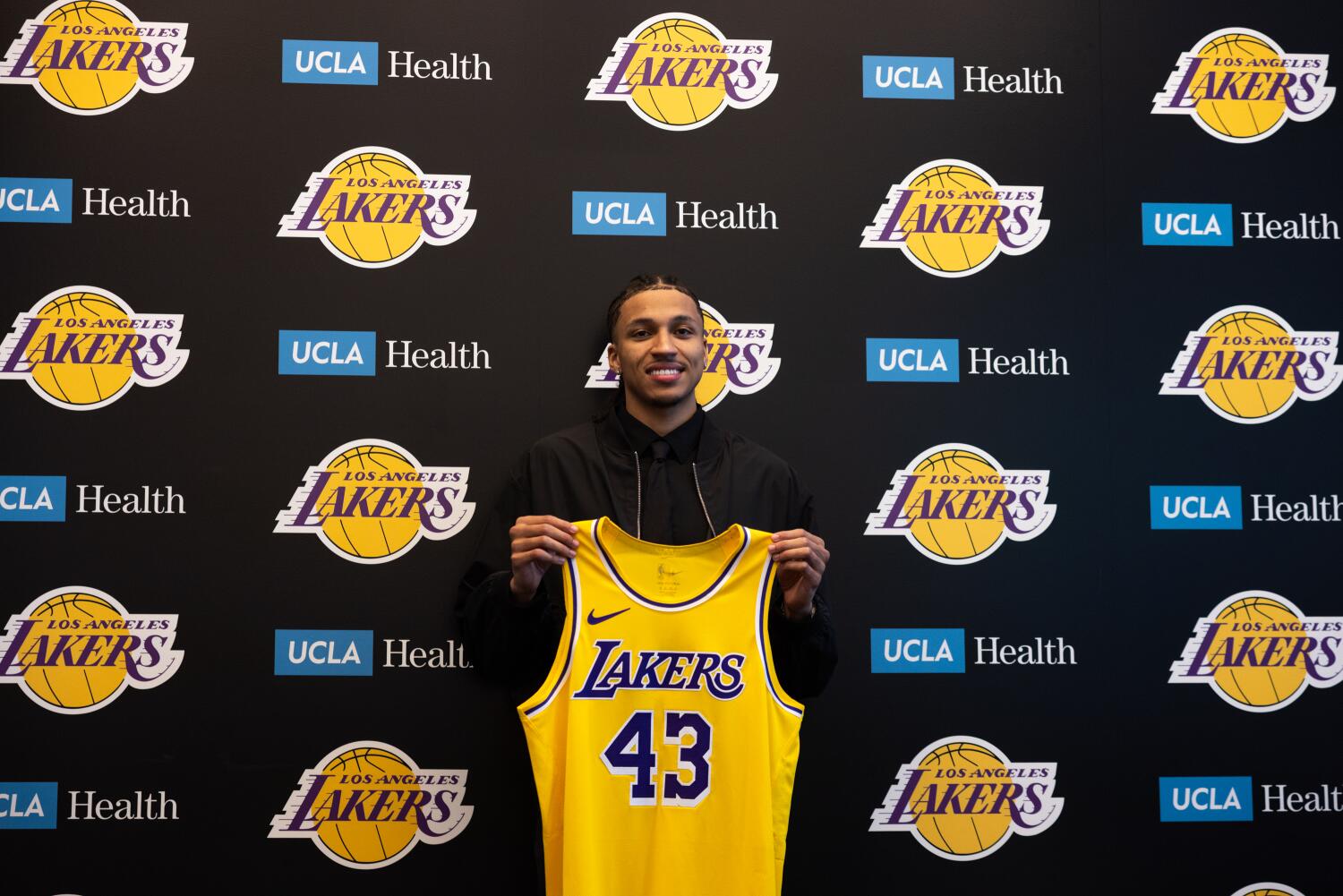
The execution of a first-round rookie scale contract represents the most valuable cost-control mechanism available under the current National Basketball Association Collective Bargaining Agreement. When the Los Angeles Lakers finalized the rookie contract for first-round selection Cameron Carr, the transaction extended far beyond a standard roster addition. It activated a highly structured four-year financial asset designed to maximize on-court production relative to a fixed cap hit. In an era defined by restrictive second-apron penalties, optimizing the performance-to-cost ratio of first-round selections determines whether a franchise can sustain a championship-caliber roster or face institutional stagnation.
Understanding the strategic implications of this signing requires moving past superficial sports journalism regarding player potential. The reality must be analyzed through the mechanics of the NBA salary cap, the structural parameters of the rookie wage scale, and the tactical deployment of young assets within modern defensive and offensive systems.
The Mechanics of the First Round Rookie Scale
The financial framework governing Cameron Carr’s contract is non-negotiable, dictated entirely by the NBA rookie wage scale tied to his specific draft slot. First-round contracts are structurally fixed for the first two seasons, followed by team options for the third and fourth years.
Teams almost universally sign first-round picks to 120% of the base scale amount, which represents the maximum allowable under CBA guidelines. This structural rigidity transforms the player asset into a predictable financial variable over a four-year horizon.
The Four-Year Cap Projection
The structure of the contract breaks down into distinct financial phases:
- Year 1 (Guaranteed): Base rookie scale entry point at 120% of the slot value.
- Year 2 (Guaranteed): Standard statutory increase based on the established CBA scale.
- Year 3 (Team Option): Exercised during the second year, dictating a percentage increase over Year 2.
- Year 4 (Team Option): Exercised during the third year, dictating a percentage increase over Year 3.
This multi-year visibility provides the front office with a definitive cost function. Unlike veteran free agents whose cap hits fluctuate based on market bidding, Carr’s salary remains insulated from inflationary cap spikes. If the salary cap increases by the maximum 10% annually due to new media rights revenue, the real-world value of a fixed rookie scale contract appreciates significantly. The contract becomes cheaper in relative terms as a percentage of the total salary cap space.
The Opportunity Cost of the Draft Slot
Securing a player in the first round carries an immediate opportunity cost represented by the cap hold allocated to the draft position. The moment the draft order is locked, the slot commands a cap hold equivalent to 120% of the scale value. Signing the player converts this dead cap hold into active roster salary.
The strategic efficiency of this conversion depends on the player's capacity to outperform the contract value within the first 24 months. If a rookie provides production equivalent to a veteran exception player while earning the baseline rookie scale, the franchise captures positive economic variance.
Tax Apron Deflection and Roster Construction Strategy
The modern NBA team-building environment is dictated by two highly punitive lines above the luxury tax threshold: the first apron and the second apron. For a high-payroll franchise like the Lakers, managing total salary allocation is an exercise in risk mitigation.
[Total Team Salary]
   ├──> Tax Threshold (Luxury Tax Trigger)
   ├──> First Apron (Hard Cap / Trade Restrictions)
   └──> Second Apron (Frozen Draft Picks / Free Agency Bans)
Surpassing the second apron eliminates the taxpayer mid-level exception, freezes the ability to aggregate salaries in trades, and threatens to move future first-round draft picks to the end of the round. Within this restrictive matrix, cheap rookie contracts act as essential counterweights to maximum veteran extensions.
High-Value Production vs. Minimum Scale Contracts
To build a sustainable roster around maximum-salaried superstars, a front office must fill out the remaining roster spots using two primary mechanisms: veteran minimum contracts or rookie scale contracts.
While veteran minimum contracts offer flexibility, they present a distinct operational limitation. Veteran minimum players are typically declining assets with established performance ceilings and defensive liabilities. Conversely, a first-round rookie presents an upward development trajectory.
The financial efficiency of Carr’s contract rests on this trajectory. The baseline expectation for a player earning this specific scale value is minimal positive contribution to winning percentage. If Carr develops into a rotation-grade defender who shoots above league average from the perimeter, his contract yields massive surplus value. This surplus value provides the front office with the financial breathing room required to maintain high-priced star talent without breaching the second apron.
Structural Flexibilities in Future Trades
A signed first-round rookie contract possesses structural utility in the trade market that differs fundamentally from an unsigned draft pick.
- Unsigned Draft Picks: Hold a salary matching value of zero in trade calculations.
- Signed Rookies: Carry an active outgoing salary matching component equal to their cap hit after the standard 30-day post-signing trade restriction expires.
This distinction is vital for a team operating near the tax aprons. Because high-tax teams cannot take back more salary than they send out, having cost-controlled, mid-tier rookie salaries available for aggregation is crucial for matching matching wages in mid-season acquisitions. Carr's contract serves as both a development project and a liquid financial instrument.
Tactical Integration and On-Court Expected Value
The financial optimization of the contract cannot occur in a vacuum; it requires direct translation to on-court efficiency. Modern analytical frameworks measure player value through metrics like Estimated Plus-Minus (EPM), Box Plus-Minus (BPM), and Value Over Replacement Player (VORP). For a rookie scale asset to achieve a positive ROI, the coaching staff must deploy the player in roles that minimize negative variance while accelerating developmental milestones.
Perimeter Trajectory and Spacing Efficiency
In the modern offensive scheme, non-star players must provide high-efficiency floor spacing. For a young wing player, the primary benchmark for rotational viability is the catch-and-shoot three-point percentage.
The standard developmental arc for a first-round selection requires transitioning from high-usage collegiate option to low-usage, high-efficiency spacing asset. If Carr can sustain a converted three-point percentage above 36% on low-dribble possessions, the offensive spacing integrity is maintained. This efficiency directly impacts the operational freedom of the team’s high-usage creators by preventing defensive help schemes from sagging into the paint.
The Defensive Floor as a Rotational Imperative
While offensive variance can be hidden through scheme design, defensive liability cannot. Opposing coaching staffs systematically target young players through pick-and-roll switches and isolation mismatches.
The realization of Carr’s contract value relies heavily on meeting specific defensive performance metrics:
- Defensive Rotation Rotations: Executing weak-side help schemes within designated time thresholds to eliminate open corner spot-ups.
- Screen Navigation Closeouts: Minimizing the separation distance created by off-ball screens to contest perimeter attempts without fouling.
- Contest Rate and Defended Field Goal Percentage (DFG%): Reducing the opponent's shooting efficiency relative to their seasonal average when acting as the primary defender.
A failure to meet these defensive baselines renders a rookie unplayable in high-leverage situations, regardless of offensive upside. When a first-round pick cannot enter the rotation due to defensive deficiencies, the contract becomes dead weight on the salary cap, forcing the franchise to expend further assets to acquire short-term veteran fixes.
Structural Risks and Asset Depreciation
No investment strategy is devoid of downside risk. The structural permanence of the first-round rookie scale means that if a player fails to develop, the team remains anchored to the cap hit for the mandatory guaranteed period.
The Threat of Development Stagnation
The primary risk factor is the stagnation of skill acquisition. If a player fails to master complex NBA defensive schemes or struggles with the speed of game transitions during their first 24 months, their market value depreciates rapidly.
Unlike a veteran on a short-term contract who can be waived with minimal long-term cap implications, a first-round pick carries guaranteed money that occupies valuable cap space. Waiving a failing first-round pick requires either absorbing the remaining guaranteed cap hit over multiple seasons via the stretch provision or bundling draft capital to incentivize another franchise to take on the salary.
The Team Option Decision Matrix
The true inflection point for the value of this contract occurs in October of the player's second season, when the front office must decide whether to exercise the third-year team option. This decision must be made well before the third season begins, forcing the organization to operate on predictive modeling rather than complete data sets.
[Year 1 Performance] ──> [Year 2 October] ──> Decision: Exercise Year 3 Option?
                                                ├──> YES: Lock in guaranteed salary
                                                └──> NO: Asset becomes unrestricted agent
Declining the option signals a definitive asset failure, rendering the initial draft capital spent a sunk cost. Exercising the option commits the franchise to future salary obligations that could restrict mid-season roster adjustments. This timeline demands accurate internal scouting systems capable of distinguishing between temporary rookie adjustments and structural developmental ceilings.
Strategic Forecast and Long-Term Value Realization
The acquisition and signing of Cameron Carr must be viewed as a calculated multi-year optimization play. The Lakers have positioned themselves to extract maximum value from a fixed cost structure during a period when veteran acquisition costs are higher than ever before.
Over the next 24 months, the trajectory of this contract will be determined by Carr’s ability to achieve specific performance thresholds. The baseline objective is for Carr to emerge as a reliable option in a nine-man rotational structure by his second season. Achieving this benchmark ensures that the Lakers capture a net positive return on their salary allocation.
The strategic play for the front office is clear: mandate a developmental program focused exclusively on low-turnover perimeter spacing and high-intensity point-of-attack defense. By restricting Carr's initial on-court responsibilities to high-probability actions, the organization can insulate the rookie from high-turnover scenarios while building the defensive habits necessary to sustain postseason basketball. If successful, this contract will provide the foundational value required to keep the franchise competitive within the strict confines of the modern tax environment.