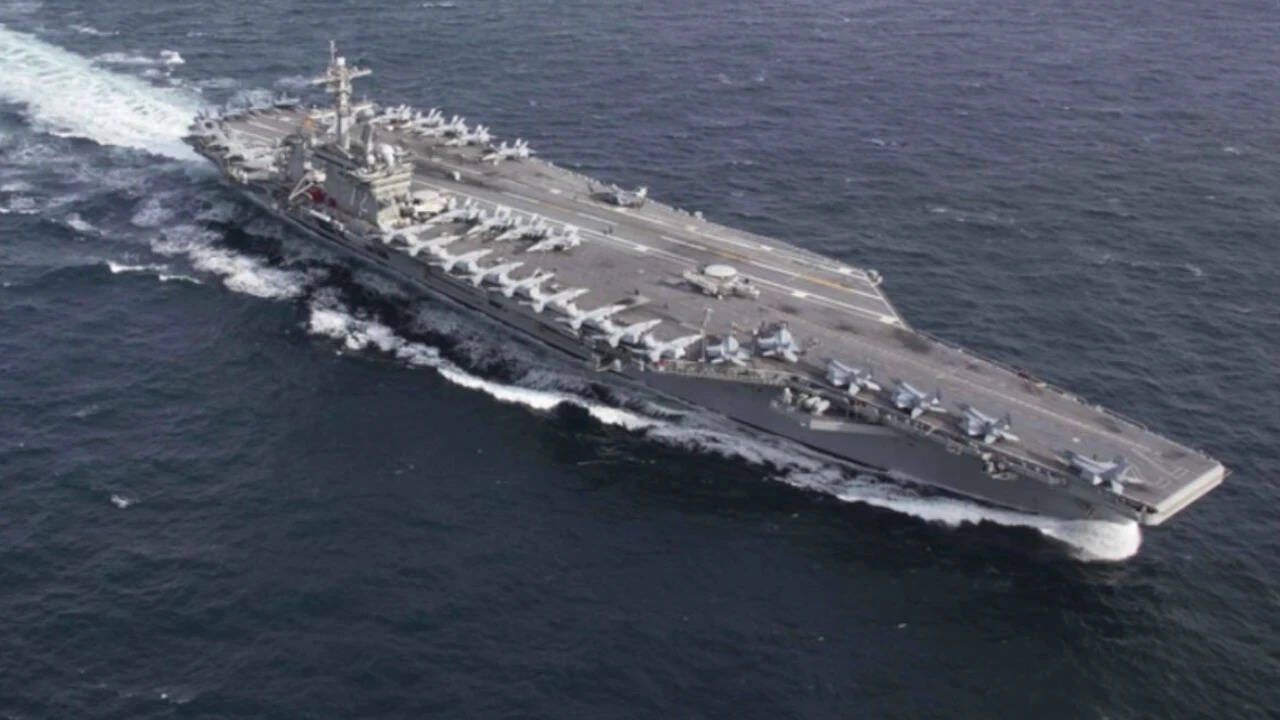
The gray bulk of the USS Abraham Lincoln sliding past Singapore early Sunday morning marked the end of a modern-day endurance nightmare for the United States Navy. After more than 250 days at sea without a single port call, the nuclear-powered aircraft carrier began its long, limping journey back to the United States. Official press releases prefer to focus on operational tempo, combat sorties, and ordnance dropped against Iranian targets. They talk about numbers. They do not talk about the cost of keeping five thousand sailors and Marines trapped inside a floating steel box under relentless operational pressure for nearly nine months.
The numbers associated with this deployment defy standard naval practice. Operating continuously since leaving San Diego, the carrier strike group logged over 266 days away from home port, spending more than 200 of those days directly inside a high-threat combat zone. Aircraft from its deck flew upward of 10,000 sorties, discharging roughly 1.5 million pounds of ordnance. This is not routine presence-building. This is war footing stretched to the absolute limit of mechanical endurance and human psychology. When a multi-billion-dollar warship spends over eight consecutive months without touching a pier, cracks inevitably appear. Those cracks are no longer confined to the engineering spaces. They are structural, institutional, and deeply human.
The Cost of Endless Extensions
Modern naval deployment cycles are built on a fragile mathematical fiction. The inter-deployment training cycle assumes a predictable rotation of maintenance, workups, deployment, and stand-down. When geopolitical crises shatter that timeline, the first asset sacrificed is always crew stability. The conflict with Iran fundamentally rewrote the operational calendar, trapping the Lincoln crew in an endless loop of extension.
What happens to a floating city when its supply lines fray and its infrastructure breaks down? Sailors aboard the Lincoln and their families back home began describing a reality far removed from Pentagon talking points. Reports filtered out detailing intermittent shortages of fresh food, failing sanitation systems, backed-up toilets, and degraded water plants. When you are working twelve-hour shifts in a sweltering combat environment, a broken sanitation system is not an inconvenience. It is a psychological breaking point.
The Pentagon pushed back hard against descriptions of crisis. Defense Secretary Pete Hegseth dismissed reports of deteriorating conditions as completely misrepresented, while acting Navy Secretary Hung Cao praised the crew for meeting every mission requirement despite being pushed to their limits. Yet, defensive press statements cannot alter the arithmetic of exhaustion. When young sailors are cut off from shore leave for more than two hundred days, institutional resilience evaporates.
Beyond the Horizon of Mental Health
The human toll of the Lincoln deployment extends far beyond broken plumbing or missed mail calls. Extended isolation inside a combat theater creates an invisible pressure chamber. While military leadership has repeatedly insisted that medical and mental health professionals remain fully accessible to the crew, public scrutiny intensified following multiple reports of sailors going overboard and suicide attempts during the transit.
Consider the case of individual families left behind. The public narrative shifted abruptly when stories emerged of sailors like Joshua Aviles, working grueling twelve-hour shifts for over 250 days without a break, only to receive news of family crises thousands of miles away that they were powerless to address. The disconnect between the abstract glory of high-intensity maritime combat and the grinding, day-to-day despair of an extended deployment exposes a profound empathy gap within the defense establishment.
Naval planners treat personnel as interchangeable components of a global force projection machine. Human beings do not function like gas turbines. They require physical grounding, psychological decompression, and temporal separation from combat environments to maintain cognitive stability. Depriving a crew of these necessities for over eight months yields predictable pathologies: cratered morale, clinical burnout, and an erosion of the trust that underpins military service.
The Strain on Aging Infrastructure
The human element is only half the equation. The Lincoln itself is a Nimitz-class carrier, a magnificent engineering achievement that belongs to an aging generation of surface combatants. These ships require intensive, round-the-clock maintenance that is fundamentally impossible to execute properly while running a high-tempo combat campaign in a contested theater.
When a carrier stays at sea indefinitely, preventive maintenance transforms into reactive triage. Systems designed for decades of service are pushed past their design thresholds. Pumps fail, electrical grids experience chronic overloads, and corrosion runs rampant in humid marine environments without the benefit of dry-dock interventions. The replacement carrier, the Japan-based USS George Washington, has finally arrived to relieve the pressure in the region, but the underlying systemic rot remains unaddressed.
The United States Navy is attempting to maintain a global superpower footprint with a fleet size that cannot sustain it without breaking its people. Every time a carrier deployment is extended to bridge a strategic gap, the service borrows against its future readiness. Experienced petty officers and skilled technicians vote with their feet, refusing to re-enlist into a system that treats continuous deployment as a standard operating procedure.
As the Lincoln makes its scheduled port stop in Thailand for much-needed rest and recovery before completing its trek back to the United States, the leadership in Washington must confront an uncomfortable truth. Sailing past Singapore represents a physical return home, but it also signals a strategic retreat from reality. You can drive a ship and its crew past the breaking point, but eventually, the bill comes due.