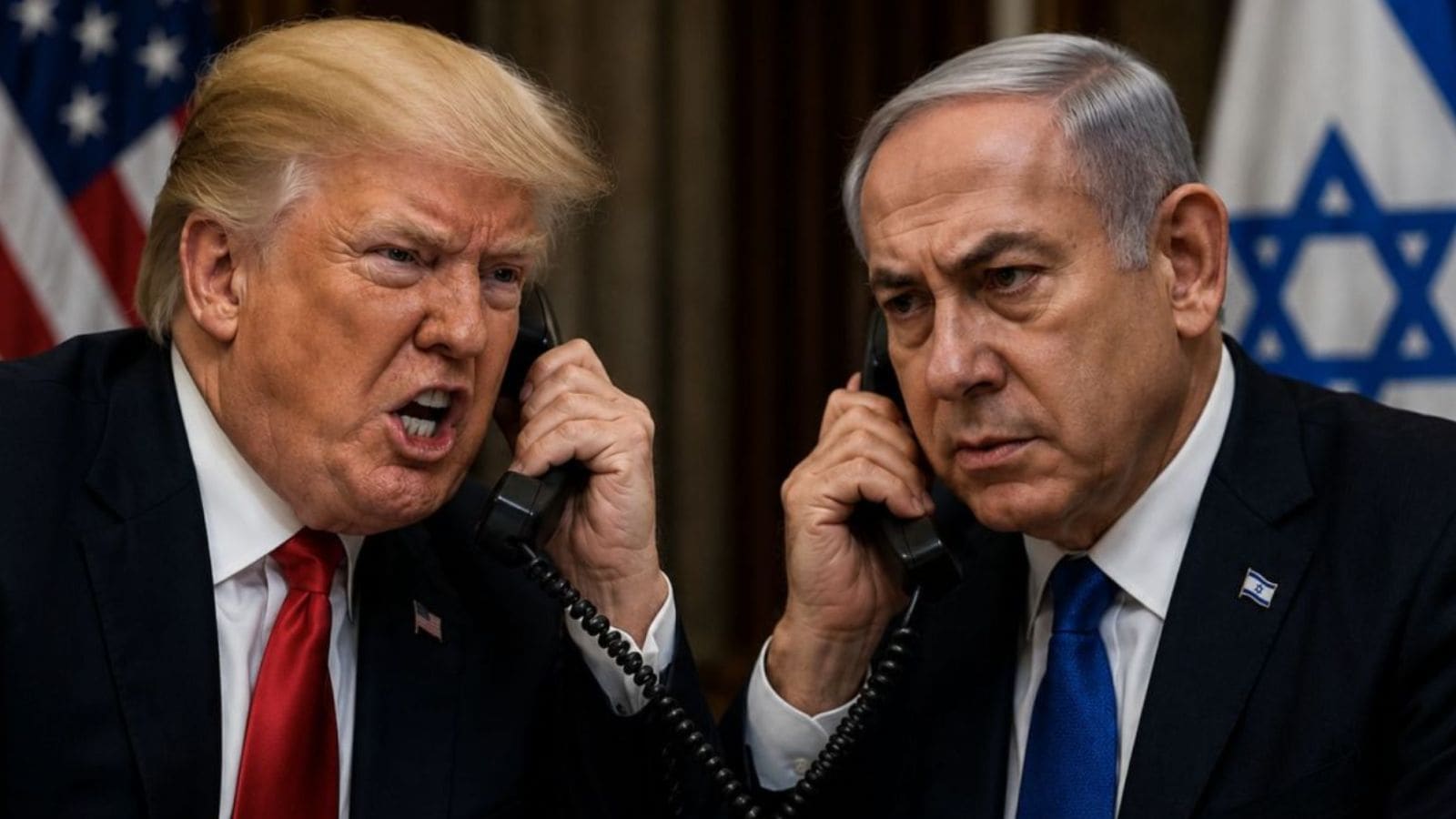
The mainstream political press is currently obsessed with a fantasy. They look at Donald Trump’s latest blunt warnings to Benjamin Netanyahu—demanding the Israeli Prime Minister fall in line and accept an impending US-Iran peace deal—and they see a fundamental shift in geopolitics. They see a president flexing supreme executive muscle to force a historic realignment.
They are reading the script upside down.
The lazy consensus among foreign policy pundits is that Washington can simply bully Jerusalem into submission, sign a piece of paper with Tehran, and walk away with a stabilized Middle East. This narrative assumes that international relations operate like a reality television show where the loudest boss gets compliance.
It ignores the structural realities of the Persian Gulf, the domestic survival mechanics of the Israeli coalition, and the fundamental nature of Iranian proxy warfare. Trump isn't forcing a peace deal because a permanent, comprehensive peace deal with the current theological regime in Tehran is a structural impossibility. Instead, we are witnessing a masterclass in strategic leverage, public posturing, and coercive diplomacy where the stated goal is entirely different from the actual objective.
The Myth of the Force-Fed Peace
Pundits love the drama of a superpower dictating terms to its client state. The headline "Trump warns Netanyahu he has 'no choice'" sells papers because it frames complex geopolitical friction as a simple clash of egos.
But look at the underlying mechanics. Israel’s security doctrine is not a variable that changes based on who occupies the Oval Office. No Israeli prime minister—whether it is Netanyahu, a centrist challenger, or a left-wing coalition leader—can accept a US-Iran agreement that allows Tehran to maintain a breakout nuclear capability or continue funding its regional proxy network. To do so would be political and existential suicide.
The conventional analysis assumes Washington holds all the cards because of military aid and diplomatic cover at the United Nations. I have watched analysts for two decades overestimate America's ability to micro-manage Israeli defense decisions. When a state faces what it perceives as an existential threat, foreign leverage liquefies. Israel has repeatedly demonstrated that it will execute unilateral kinetic actions—such as the targeted strikes on Iranian nuclear infrastructure or proxy leadership—regardless of Washington's red lines.
Trump understands this dynamic better than the critics give him credit for. The public theater of telling Netanyahu he has "no choice" isn't designed to force an impossible capitulation. It is designed to do two things:
- Create a public buffer that shields Washington from the blowback of inevitable regional escalation.
- Force Tehran to the negotiating table under the false impression that Washington is willing to restrain its most aggressive ally.
Deconstructing the Iranian Deal Mechanism
To understand why the mainstream media’s interpretation is flawed, we have to look at what a "peace deal" with Iran actually means. The institutional memory of the foreign policy establishment is still trapped in the framework of the 2015 Joint Comprehensive Plan of Action (JCPOA). They believe the problem was simply the specific metrics of the uranium enrichment caps or the timeline of the sunset clauses.
The real flaw is much deeper. The Iranian regime’s legitimacy is ideologically rooted in its position as the vanguard of an anti-Western, anti-Zionist axis. The Islamic Revolutionary Guard Corps (IRGC) does not operate like a traditional state military; it runs an expeditionary franchise model.
Imagine a corporate entity where the regional branches are completely decentralized but rely on the parent company for capital and branding. Even if the diplomats in Geneva sign a treaty restricting formal state-to-state aggression, the franchise network—Hezbollah in Lebanon, the Houthis in Yemen, and various militias in Iraq—continues to operate. The regime cannot dismantle this network without dismantling its own internal security apparatus and ideological justification for existence.
Therefore, any Western diplomatic strategy that treats Iran as a Westphalian state looking for a standard peace treaty is fundamentally broken. Trump’s strategy isn't to achieve a harmonious regional equilibrium. It is an aggressive play to impose economic and psychological stress on Tehran to extract temporary, transactional concessions while maintaining maximum theater for his domestic base.
The PAA Fallacy: What the Public Gets Wrong
If you look at the questions people ask about this geopolitical standoff, the premises are almost always inverted.
Can the US force Israel to stop a war?
No. The United States can delay shipments of specific precision-guided munitions or alter diplomatic voting patterns in international bodies. However, Israel possesses a massive domestic defense manufacturing capability and sufficient stockpiles to conduct prolonged operations. More importantly, the psychological driver within the Israeli electorate after recent regional conflicts makes compliance with foreign-imposed ceasefires a non-starter if regional threats remain active.
Will an economic deal stop Iran from getting a nuclear weapon?
Paper agreements do not alter long-term strategic imperatives. For Tehran, a nuclear deterrent is the ultimate insurance policy against regime change—a lesson they learned vividly by watching the fates of Muammar Gaddafi in Libya and Saddam Hussein in Iraq. Economic relief via sanctioned oil sales provides temporary breathing room for their collapsing domestic economy, but it will never buy the permanent abandonment of their nuclear ambitions.
The Cost of the Contrarian Reality
There is a distinct downside to acknowledging this reality. Admitting that a comprehensive US-Iran peace deal is an illusion means accepting that the Middle East will remain in a state of managed instability or low-intensity conflict for the foreseeable future. It forces policymakers to abandon the comfortable lie of a "grand bargain" and instead focus on the grinding, unglamorous work of deterrence, interdiction, and localized containment.
Western leaders hate this because it doesn't offer a clean victory lap or a signing ceremony on the White House lawn. It requires continuous expenditure of political capital and military readiness with no defined end date.
But chasing the illusion of a total diplomatic breakthrough is far more dangerous. It leads to concessions that unfreeze billions of dollars in assets for Tehran, which are inevitably funneled back into the IRGC’s regional destabilization budget, all while buying a few months of cosmetic compliance.
The Strategic Reality Behind the Noise
Strip away the frantic commentary and the breathless cables from Jerusalem and Washington. The reality of the Trump-Netanyahu dynamic is not an ideological split; it is a calculated division of labor.
By publicly demanding that Israel accept a deal, Trump establishes his credentials as a dealmaker and signaling to regional powers that he is not writing a blank check for unlimited war. This gives him the geopolitical leverage to demand massive concessions from Iran just to get to the table.
Concurrently, Netanyahu’s public pushback allows the Israeli leader to maintain his domestic coalition's support, proving to his right flank that he will stand up to Washington to protect national security. It is a choreographed dance where both actors know exactly where the stage ends.
The media will continue to report on this as a crisis of alliance, a breakdown in communication, or a heavy-handed ultimatum. They will keep waiting for the historic peace treaty that solves the region's ancient animosities with a single pen stroke.
They will keep waiting forever. The structure of the region does not allow for it, the domestic politics of the nations involved forbid it, and the man holding the pen knows that the threat of the deal is always infinitely more useful than the deal itself.