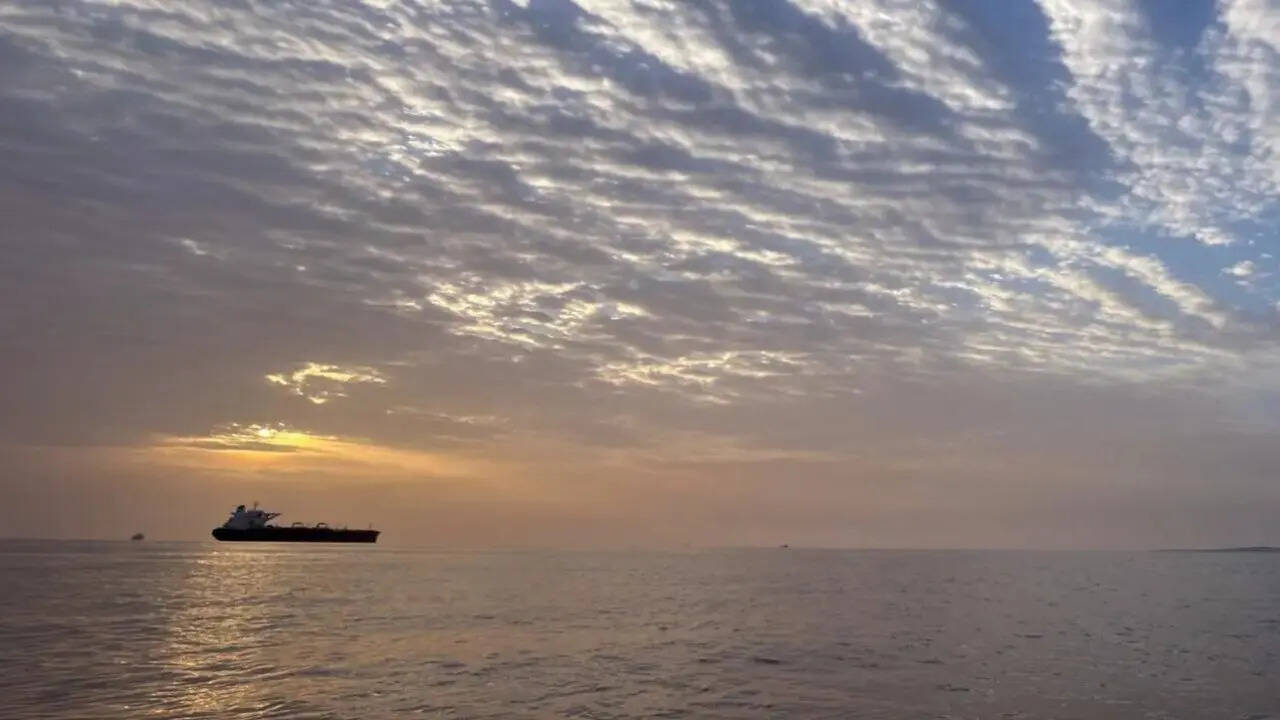
Economic sanctions only work if you can actually enforce them on the high seas. Last week, an Iranian super tanker proved that theory wrong by sliding right through a US-led blockade with $220 million worth of crude oil. It didn't just escape. It made the entire Western maritime strategy look slow and outdated.
The ship was carrying roughly two million barrels of oil. Think about that for a second. That’s enough energy to power a small country for days, and it's now headed to a buyer who doesn't care about Washington's naughty list. If you think this is a one-off event, you’re missing the bigger picture of how global shadow fleets operate in 2026.
I've watched these cat-and-mouse games for years. The reality is that the US and its allies are playing by 20th-century rules while the "ghost fleet" uses decentralized tech and complex shell companies to stay invisible. It’s not about luck. It’s about a calculated failure of international pressure.
How the Iranian super tanker vanished from the map
The tanker didn't just outrun a destroyer. It used a tactic called "AIS spoofing." Every major ship carries an Automatic Identification System (AIS) that broadcasts its position, speed, and identity to avoid collisions. When a captain wants to disappear, they don't just turn it off. That's too obvious. Instead, they manipulate the signal to show the ship is hundreds of miles away from its actual location.
This specific Iranian super tanker reportedly broadcasted coordinates that placed it off the coast of Africa while it was actually hugging the coastline of an entirely different region. By the time satellite imagery confirmed the physical hull of the ship, it was already in safe waters.
Satellite surveillance isn't a magic wand. Cloud cover, orbit timing, and the sheer volume of maritime traffic make it easy to lose a needle in a haystack—especially when the needle is painted a different color and flying a "flag of convenience" from a country like Panama or Cook Islands. These flags aren't just for show. They provide a legal layer of protection that makes immediate seizure a diplomatic nightmare.
The 220 million dollar cargo and who is buying it
Let's talk about the money. Crude oil prices aren't static, but $220 million is a solid estimate for a fully loaded Very Large Crude Carrier (VLCC). For Iran, this isn't just "extra" cash. It’s a lifeline. This money funds internal infrastructure, domestic subsidies, and regional influence programs that the US is actively trying to starve.
Who buys this stuff? Usually, it’s "teapot" refineries—independent operations in places like China that don't have significant exposure to the US financial system. If a bank doesn't use the US dollar, the US Treasury has very little power to freeze their assets. This creates a parallel economy where Iranian oil is bought at a slight discount, making it irresistible for buyers who want to cut costs and don't mind the political heat.
The transaction probably didn't even happen in cash. We're seeing more bartering and digital assets used in these deals. Iran gets the goods or the currency it needs, and the buyer gets cheap energy. The blockade is essentially a fence with a giant hole in it.
Why the US Navy can't just stop every ship
People often ask why the most powerful navy on earth doesn't just board these ships and take the oil. It sounds simple. It’s not.
Boarding a sovereign-flagged vessel in international waters is an act of war. Unless there is a specific UN mandate or a direct threat, physical intervention is a legal minefield. The US prefers to use "secondary sanctions," which means punishing anyone who helps the ship—the insurers, the port authorities, and the refiners.
But there's a problem with this strategy.
- Insurance bypass: The ghost fleet uses "sovereign insurance" from their own governments or unregulated providers.
- Ship-to-ship transfers: They park in the middle of the ocean and pump oil from the "dirty" ship to a "clean" one.
- Middlemen: The oil changes hands so many times through paper companies that the final buyer can claim they had no idea it was Iranian.
This tanker likely used a combination of all three. It probably met with smaller vessels under the cover of night, swapped its cargo, and effectively "laundered" the oil before it reached its final destination. By the time the US issues a seizure warrant, the oil is already being turned into gasoline in a refinery half a world away.
The tech gap in maritime enforcement
We like to think we have total domain awareness. We don't. The ocean is huge. Even with drones and high-res satellites, tracking thousands of tankers 24/7 is an impossible task for the current naval fleet. The US Navy is currently stretched thin across the South China Sea, the Red Sea, and the Arctic. Dedicating an entire carrier strike group to chase one tanker isn't a great use of resources.
The Iranian super tanker took advantage of this "bandwidth" issue. It moved during a period of high regional tension when eyes were elsewhere. It’s a classic distraction play. While everyone is looking at the latest drone strike or political standoff, the money-maker slips through the back door.
Breaking the blockade is a signal to the world
The success of this tanker isn't just about $220 million. It’s a signal to other sanctioned nations like Russia and Venezuela. It proves that the "rules-based order" has massive gaps. When a tanker successfully defies a blockade, it emboldens others to join the shadow fleet. This creates a self-reinforcing cycle. More ships join the fleet, making it even harder to track them all, which leads to more successful deliveries.
If you're a shipping company, you're looking at this and seeing a high-risk, high-reward business model. The premiums for hauling sanctioned oil are astronomical. For some, the risk of a US fine is just a cost of doing business compared to the massive payout of a successful run.
What actually happens next
You should expect to see more of this. The US Treasury will likely identify the specific hull and blackball it from every major port. They’ll sanction the captain and the shell company listed on the paperwork. But here’s what they won't tell you: that ship will just change its name.
A bucket of paint and a new registration number from a different tiny island nation, and that "blacklisted" ship is back in business in three weeks.
To actually stop this, the US would need a physical presence at every major chokepoint—the Strait of Hormuz, the Malacca Strait, and the Suez Canal. That’s not happening. Instead, look for the US to lean harder on "digital blockades"—working with satellite providers to automate the detection of AIS spoofing in real-time.
If you're tracking these movements, don't look at the official maps. Look at the "dark" spots where ships disappear for three days and magically reappear with a different draft depth. That's where the real action is. The Iranian super tanker didn't find a gap in the blockade; it exploited a fundamental weakness in how the world monitors the ocean. Start watching the ship-to-ship transfer zones in the Malacca Strait if you want to see where the next $200 million will vanish.