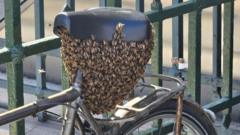
The convergence of 10,000 Apis mellifera (European honeybees) on a stationary bicycle in the high-traffic corridor of the Louvre Museum is not a biological anomaly; it is a predictable outcome of the reproductive bottleneck inherent in honeybee colony expansion. This phenomenon, known as swarming, represents the colony’s primary mechanism for genetic dispersal and population growth. When a hive reaches peak density, the incumbent queen departs with approximately 50% to 60% of the worker population to establish a new colony, leaving the original site to a newly emerged queen. The temporary cluster observed on the bicycle serves as a staging ground—a critical operational pause where the swarm protects the queen while scout bees execute a reconnaissance mission for a permanent nesting site.
The Mechanics of Thermal and Physical Site Selection
The selection of a bicycle as a temporary bivouac site is dictated by thermodynamic stability and physical geometry rather than any attraction to the object's function. In an urban environment like Paris, natural cavities (hollow trees or rock fissures) are scarce. This creates a forced adaptation where swarms prioritize surfaces that facilitate "clustering," a behavior used to regulate the queen’s temperature and maintain the integrity of the group.
Structural Integrity of the Cluster
The swarm forms a prolate spheroid around the queen. This shape is maintained through "tarsal interlocking," where bees link their legs to create a flexible, living fabric. The bicycle’s frame provides several advantages for this structure:
- High Surface-to-Volume Ratio: The tubular geometry of the bike frame allows for multiple attachment points, increasing the mechanical stability of the cluster against wind shear.
- Thermal Inertia: Unlike thin vegetation, the metal and rubber components of a bicycle offer a specific heat capacity that can buffer the cluster against rapid ambient temperature fluctuations in an open plaza.
- Elevation and Accessibility: Positioning the cluster roughly one meter off the ground minimizes terrestrial predator interference while remaining within the "flight ceiling" of returning scout bees.
The Scout Bee Decision Matrix
While the cluster remains stationary, a specialized sub-group of roughly 300 to 500 scout bees explores the surrounding three-to-five-kilometer radius. They evaluate potential permanent sites based on a rigorous set of criteria:
- Cavity Volume: Ideally between 15 and 40 liters.
- Entrance Height: High enough to avoid dampness and predators.
- Entrance Size and Direction: Small enough to defend (roughly 12-15 $cm^2$) and preferably south-facing to optimize solar gain.
- Proximity to Forage: Essential for the rapid production of wax and honey stores needed for winter survival.
The Signal-to-Noise Ratio in Urban Bee Communication
The "waggle dance" is the core communication protocol used during this staging phase. On the surface of the cluster—in this case, on the bees layered over the bicycle—scouts perform standardized movements to communicate the direction and quality of potential sites. The intensity and duration of the dance are directly proportional to the site’s viability.
This process is a biological implementation of a "consensus-sensing" algorithm. Rather than a top-down command from the queen, the swarm operates as a decentralized intelligence. The swarm only moves when a "quorum" of scouts—approximately 15 to 20 bees—agrees on a single location by dancing for it simultaneously. The presence of 10,000 bees in a high-decibel, high-pollution environment like the Louvre district introduces significant "environmental noise." Vibrations from heavy foot traffic and vehicular movement can interfere with the tactile sensing of the waggle dance, potentially lengthening the duration the swarm remains on the bicycle.
Risk Mitigation and Public Safety Protocols
Despite the visual intimidation of 10,000 bees, a swarming colony is at its least aggressive state. Because they lack a hive, brood, or honey stores to defend, the bees have no biological incentive to initiate an attack. Furthermore, prior to departure, bees engorge themselves with honey to provide energy for the transition, which physically limits their ability to arch their abdomens to sting.
The primary risk in this scenario is not the biology of the bees, but the unpredictability of human intervention. Standardized urban response involves three tiers of management:
- Exclusion Zones: Establishing a three-to-five-meter perimeter to prevent accidental crushing of bees, which releases alarm pheromones (isopentyl acetate).
- Vacuum Extraction: Specialized beekeeping equipment uses low-pressure suction to move the cluster into a transport box without causing physical trauma or thermal stress.
- Pheromone Management: Once the queen is secured, the remaining bees will follow her scent (Nasonov pheromone). If the queen is missed during the initial collection, the swarm will likely re-form on the nearest high point, leading to a secondary incident.
Resource Competition and Urban Carrying Capacity
The occurrence of large-scale swarms in central Paris highlights a growing friction point in urban ecology: the saturation of honeybee populations. Over the last decade, "urban beekeeping" initiatives have increased the density of managed hives. In many European capitals, the number of hives per square kilometer now exceeds the available floral biomass.
This saturation leads to several systemic failures:
- Nutritional Deficits: High competition for pollen and nectar reduces the overall health of colonies, making them more prone to disease.
- Increased Swarm Frequency: Crowded hives are more likely to trigger the swarming impulse as a relief valve for overpopulation.
- Pressure on Wild Pollinators: Managed honeybees are generalist foragers that can out-compete specialized native bees for limited resources in urban parks like the Jardin des Tuileries.
Operational Strategy for Urban Property Management
For municipal authorities and private property owners, the presence of a swarm must be viewed through the lens of liability and environmental stewardship. The objective is the rapid restoration of public access while ensuring the survival of the swarm, which holds significant economic value as a pollinator.
The strategic play is the integration of "Swarms as Service" (SaaS) protocols. Rather than relying on emergency services (firefighters), who may lack the specialized gear for live removal, municipalities must maintain a real-time registry of local apiarists capable of rapid deployment. This reduces the "dwell time" of the swarm on public infrastructure.
The long-term management of these events requires a shift from reactive removal to proactive capacity planning. This involves the installation of "swarm traps" or "bait hives" in discrete, high-elevation locations throughout the city. These traps are pre-treated with synthetic Nasonov pheromones to attract swarms away from high-visibility pedestrian assets like bicycles and doorways, directing them instead into manageable, pre-defined containers. This transition from accidental urban encounters to controlled biological relocation is the only viable path for maintaining high-density honeybee populations in 21st-century urban centers.