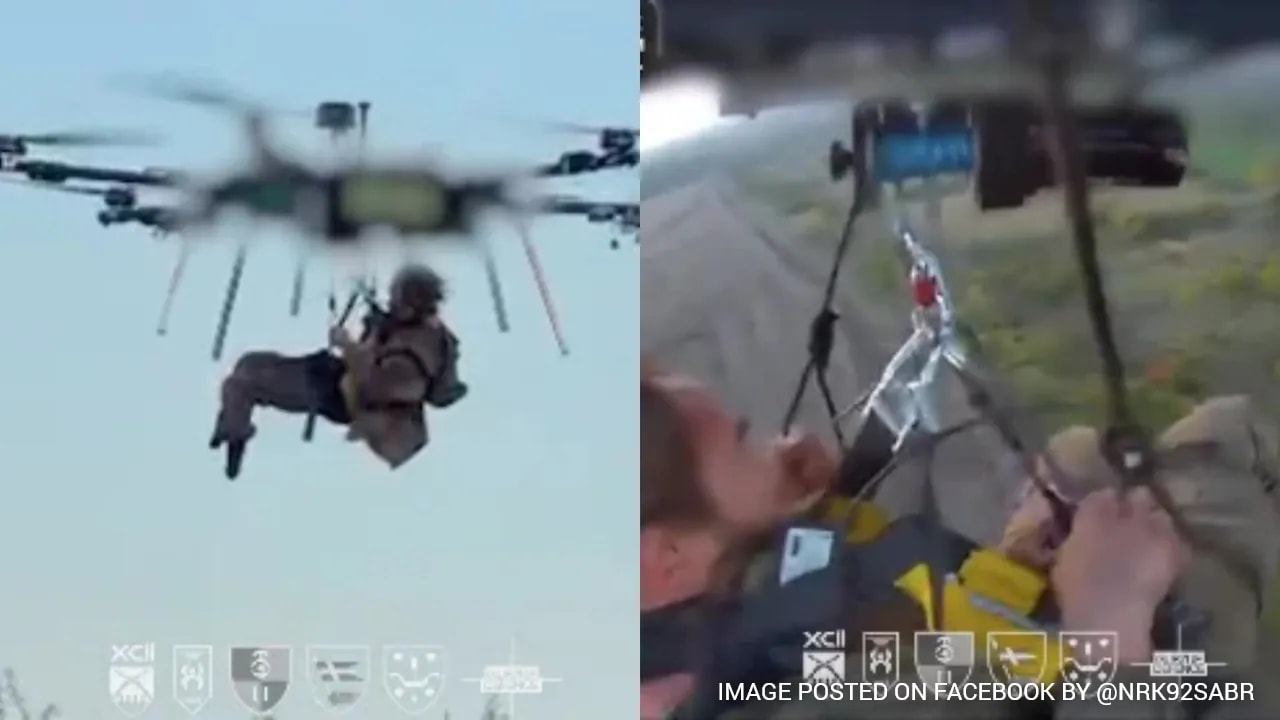
Ukrainian forces have begun using large unmanned aerial vehicles to airlift wounded soldiers out of front-line positions where ground evacuation has become too slow, mined, or lethal.
Headline writers love a "world's first," and the footage looks dramatic enough to feed a dozen viral clips. A heavy multi-rotor craft lifts a strapped-in combatant off contested ground in the dark while smaller reconnaissance and decoy machines hum overhead.
After covering military hardware and logistics for more than twenty years, I have learned to ignore the triumphalism in press releases and look straight at the casualty math. Nobody invents a 400-kilogram flying stretcher because things are going smoothly on the ground. You build it because traditional medical evacuation has hit a wall of loitering munitions, fiber-optic first-person-view drones, and dense minefields.
What Ground Evacuation Actually Costs Now
For decades, military medicine relied on a simple hierarchy. A medic stabilizes a wounded soldier at the point of injury, loads them into an armored vehicle or light truck, and races them toward a stabilization point before critical blood loss or shock sets in.
That model breaks down when a front line stretches into a multi-kilometer "kill zone" saturated with explosive drones. Any vehicle moving along a dirt track or tree line broadcasts a thermal and acoustic signature to operators watching live feeds miles away. Even an ambulance or armored personnel carrier becomes a high-value target, turning a rescue run into a secondary mass-casualty event.
Ukrainian units turned to unmanned ground vehicles to take human drivers out of the line of fire. Those tracked or wheeled robots proved useful for hauling supplies and pulling isolated soldiers out of ditches, yet their limits showed up fast. Ground drones crawl at roughly 10 kilometers per hour, get bogged down in mud or cratered roads, struggle across water barriers, and can take hours to complete a single round trip while sitting squarely in the path of anti-tank mines and patrolling drones.
When a wounded soldier waits hours in a foxhole or trench, dehydration, hypothermia, wound infection, and bleeding do half the enemy's work before evacuation even begins.
Speed is only half the equation. A ground robot still follows predictable corridors dictated by terrain and mine clearance. Lifting a soldier above the tree line changes the geometry of the trip—at least until you consider what waits in the air.
Inside the Flying Stretcher Push
Two high-profile threads in recent reporting show how fast this capability is moving from desperation to production. In mid-October 2026, Ukrainian units—including the 92nd Separate Assault Brigade, the 30th Separate Mechanized Brigade, and the 10th Army Corps, working alongside manufacturer Gurzuf Defense—publicized an evacuation using the Heavy Shot Ayudag-6 hexacopter. Around the same period and into November, reporting highlighted heavy evacuation craft such as Skyfall's Stargate, a six-rotor platform built around a capsule capable of carrying up to 150 kilograms at speeds around 105 kilometers per hour over roughly 30 kilometers.
Rather than waiting years for a defense prime contractor to certify an aircraft for peacetime aviation standards, Ukrainian brigades and domestic drone makers worked backward from a battlefield request. Skyfall's Stargate, for example, was developed after a request from the commander of the CODE 9.2 assault brigade, with production targets scaling toward 1,000 units a month by the end of 2026 at an estimated cost of about $50,000 per airframe.
How a Drone Medevac Mission Comes Together
A single evacuation flight is less like calling an Uber and more like staging a miniature combined-arms raid. Pilots and unit commanders spend days or even a week studying terrain, jamming zones, and enemy air-defense and drone patrols before launching.
To give a hypothetical example of how planners weigh the route, imagine a soldier pinned down four kilometers past a damaged bridge with a shattered leg and heavy Russian drone activity along the road. Sending a ground robot could take three hours along a mined detour; flying a heavy lift drone at night might cut transit time to a fraction of that, provided the aircraft can reach the pickup spot without being spotted or jammed.
Operators rely on several interlocking measures to keep the aircraft alive during the run:
- Night and low-visibility timing: Launching in the dark reduces visual detection while still requiring careful navigation and sensor management.
- Route planning and diversion: Supporting drones, decoys, or parallel activity help complicate an adversary's ability to single out the evacuation craft.
- Navigation resilience: Onboard navigation modules designed to follow pre-mapped routes using artificial intelligence help keep the drone on track if satellite signals are jammed, though electronic warfare remains a constant threat.
- Multi-unit coordination: Front-line infantry, drone pilots from neighboring formations, and engineering or support elements must synchronize timing so the wounded soldier can actually get into or onto the rig without drawing fire.
The Hard Limits Nobody Should Gloss Over
Calling an unmanned airlift a cure-all for battlefield medicine would be sloppy journalism. A heavy drone is big, loud, and expensive compared to a disposable quadcopter. Six spinning rotors moving enough air to lift a grown man in gear or a protective pod sound like a storm coming in, not a stealth glider.
Against an adversary with dedicated drone-hunting units and heavy electronic warfare, a large multi-rotor craft is an inviting target. Signal jamming can throw a drone off course, an interceptor drone can shred a rotor or battery pack, and mechanical failure with a human payload carries stakes that a crate of mortar rounds never had.
Medical care in flight is another sobering constraint. Loading an injured person into a pod or onto a platform does not magically place a trauma surgeon beside them. A soldier with severe internal bleeding, airway compromise, or blast trauma can deteriorate rapidly in transit if they are unmonitored, cramped, or exposed to cold. Getting a wounded fighter out of a kill zone is a huge step forward, yet survival still depends on what happens before loading and immediately after landing.
Ground Robots Versus Aerial Medevac
Neither system replaces the other because each fails where the other has an edge. A comparison makes the trade-offs clear without pretending either option is easy.
| Factor | Unmanned Ground Vehicles | Heavy Aerial Evacuation Drones |
|---|---|---|
| Speed and terrain | Slow (around 10 km/h); blocked by rivers, deep mud, or rubble | Much faster (around 105 km/h); bypasses surface obstacles |
| Mine and obstacle risk | High exposure to ground mines and tripwires | Bypasses ground mines; exposed during takeoff and landing |
| Air and EW signature | Lower in the air; vulnerable to FPV drones and ground fire | Large, loud, conspicuous; vulnerable to jamming and air interceptors |
| Mission duration | Often takes several hours | Substantially shorter transit times over tens of kilometers |
What This Signals for Modern Armies
Every major war forces armies to confront the gap between doctrine written in peacetime and reality under fire. For years, Western militaries treated rotary-wing air superiority as a baseline assumption for rapid medical evacuation. When dense drone coverage turns low-altitude airspace into a meat grinder for manned helicopters, that assumption looks fragile.
Unmanned air evacuation does not solve every problem of industrial drone warfare, and early missions remain high-risk experiments born out of sheer necessity rather than surplus budget. Still, the direction of travel is unmistakable: when the ground is too mined and the sky is too watched for manned aircraft, militaries will keep pushing heavier payloads onto unmanned wings until the math starts tipping back toward saving lives.
Watch Ukraine execute an aerial drone evacuation of a wounded soldier
This short clip shows the real-world visual context behind the reporting, capturing how Ukrainian forces use a heavy multi-rotor drone to extract an injured soldier when ground rescue is blocked.


