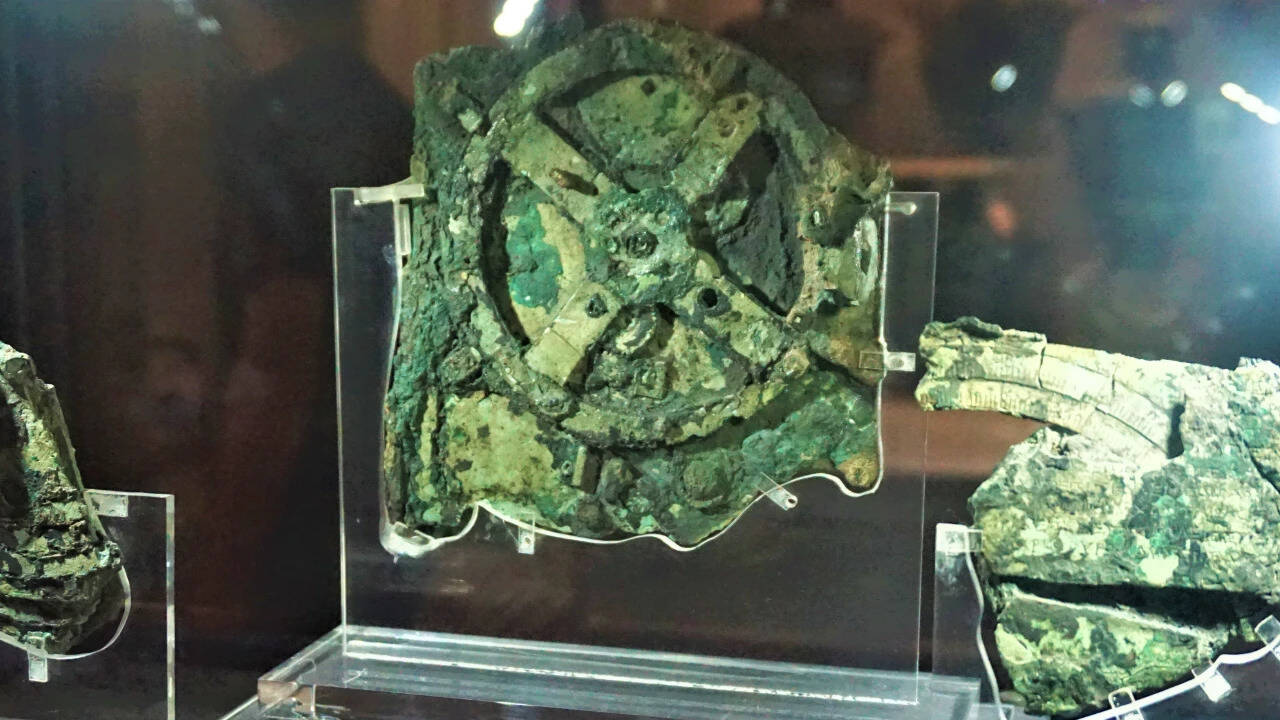
In 1901, Greek sponge divers driven off course by a violent storm stumbled upon a Roman shipwreck off the coast of Antikythera, recovering a calcified lump of bronze that turned out to be the world's oldest known analog computer. Built between 150 and 100 BCE, the Antikythera mechanism used at least thirty-seven hand-cut bronze gears to track the exact movements of the sun, moon, and planets, predict eclipses, and schedule the ancient Olympic Games. Its discovery shattered the modern assumption that complex differential gearing was not invented until the fourteenth century.
Most popular accounts treat this artifact as a solitary miracle. They frame it as an inexplicable anomaly, a sudden spark of genius that flashed and vanished without a trace. That narrative makes for good television, yet it is historically lazy. You might also find this related article useful: The Strategic Architecture of Small-State Space Recognition.
You do not wake up one morning in ancient Rhodes or Syracuse and casually machine thirty-seven interlocking triangular-toothed gears out of bronze sheet metal. You do not invent a pin-and-slot mechanism to model the variable elliptical orbit of the moon without a pre-existing industry of specialized metallurgists, astronomers, and toolmakers. The mechanism was not a fluke. It was the surviving end-product of a sophisticated, lost technological ecosystem that Western civilization spent over a millennium trying to rebuild.
Why It Was Ignored for Decades
When Elias Stadiatos pulled the green, crusted mass from 140 feet of water in the Aegean Sea, nobody cared about the gears. The divers were looking for marble statues and bronze sculptures, which the wreck had in abundance. The corroded lumps of metal were tossed into a courtyard at the National Archaeological Museum in Athens and largely forgotten while curators restored the flashier art. As highlighted in detailed reports by CNET, the implications are notable.
It took eight months for the salt-encrusted wood casing to dry out, shrink, and crack open. Only then did museum staff notice the gear teeth embedded in the stone-like corrosion. Even then, the academic establishment resisted the implications.
Early twentieth-century historians had a rigid, linear view of human progress. The Greeks were supposed to be philosophers, poets, and abstract mathematicians who disdained manual labor and mechanical engineering. Handing them credit for precision clockwork violated the prevailing consensus. For fifty years, skeptics dismissed the fragments as a much later medieval astrolabe that had accidentally fallen onto an ancient shipwreck.
It was not until the 1950s and 1970s that British physicist Derek de Solla Price teamed up with Greek radiographer Charalampos Karakalos to blast the fragments with gamma rays and X-rays. The images revealed an internal architecture so dense and precise it looked like the inside of a Swiss pocket watch. The timeline of human engineering had to be torn up and rewritten on the spot.
Inside the Bronze Box
To understand what makes this machine so unsettling to modern engineers, you have to look at the math encoded in its teeth. The device was housed in a wooden box roughly the size of a shoebox, measuring about 33 centimeters high, 18 centimeters wide, and 9 centimeters deep. A user operated it by turning a hand crank on the side, which drove a massive main gear representing the solar year.
From that single input, the machine split the motion into multiple astronomical outputs across front and back dials.
- The Metonic Cycle: A spiral dial on the upper back tracked a 19-year calendar cycle, reconciling the solar year with lunar months.
- The Saros Dial: The lower back dial predicted lunar and solar eclipses across an 18-year, 11-day cycle, complete with engraved glyphs indicating the exact hour an eclipse would occur and even the color the moon would turn.
- The Olympiad Dial: A smaller secondary dial tracked the four-year cycle of the Panhellenic Games, proving this was not just a scientific instrument, but a civic and cultural calendar.
- Planetary Epicycles: Recent micro-CT scans by researchers at University College London revealed the front display held an intricate gear train capable of modeling the irregular retrograde motions of Mercury, Venus, Mars, Jupiter, and Saturn.
The true masterstroke, however, sits inside the lunar mechanism. The moon does not orbit the Earth at a constant speed; it speeds up at perigee and slows down at apogee. To simulate this anomaly mechanically, the ancient engineer mounted one gear off-center on top of another and connected them via a pin sliding inside a narrow slot. As the bottom gear rotated at a uniform rate, the top gear accelerated and decelerated in exact alignment with the moon's actual celestial behavior.
That level of mechanical abstraction requires more than theoretical astronomy. It requires the ability to translate complex Babylonian arithmetic progressions into physical brass ratios without modern lathes, micrometers, or CAD software.
The Archimedes Connection
Who actually built this thing? We do not have a signature engraved on the casing, which means we have to follow the trail of surviving ancient texts and regional metallurgy.
The inscriptions on the mechanism's dials are written in Koine Greek, and the calendar uses month names specific to Corinth and its colonies. The strongest candidate for a Corinthian colony with the wealth, intellectual firepower, and astronomical pedigree to produce such a device is Syracuse, in Sicily. That puts the mechanism squarely in the orbit of Archimedes.
In the first century BCE, the Roman statesman Cicero wrote about two mechanical spheres built by Archimedes that had been looted from Syracuse by the Roman general Marcellus in 212 BCE. Cicero described one of these devices as a bronze planetarium that reproduced the motions of the sun, moon, and five wandering stars with a single rotation, accurately demonstrating how the moon eclipsed the sun.
The Antikythera mechanism itself dates to roughly a century after Archimedes' death, suggesting it was built by his successors or a workshop operating in the tradition he established. Another likely hub is the island of Rhodes, home to the astronomer Hipparchus, who developed the mathematical theories of lunar motion that the mechanism's pin-and-slot gears physically execute. A shipwreck traveling from the eastern Mediterranean toward Rome—laden with luxury goods from Rhodes, Pergamon, and mainland Greece—would naturally pass right by Antikythera.
The Myth of the Lone Genius
Blaming Archimedes for everything is convenient, yet it misses the broader industrial reality. A master mathematician does not file eighty-two separate fragments of bronze by hand.
If you examine the gear teeth under high-resolution micro-focus X-ray computed tomography, you can see the tool marks. The teeth are triangular, cut at roughly sixty-degree angles, likely using a specialized triangular file and simple dividers. Despite being hand-fabricated, the spacing error across a wheel of 223 teeth is remarkably low—often less than a fraction of a millimeter.
Achieving that tolerance requires a guild of master metalworkers who spent their entire lives working with high-tin bronze. It requires standardized workshop practices, specialized jigs, and apprentices learning how to temper metal so it would not shear under the friction of thirty-seven meshing gears. The Antikythera mechanism proves that Hellenistic Greece had a thriving, if small, high-tech manufacturing sector catering to wealthy patrons, temples, and state observatories.
How Civilization Forgot How to Build It
If the Greeks had the blueprints for precision mechanical computing in 100 BCE, why were Europeans still struggling to build reliable tower clocks in 1300 CE? The collapse of this technology is a sobering case study in how fragile human knowledge actually is.
First, bronze was too valuable to leave sitting in broken machines. Unlike marble statues or pottery shards, which survive because nobody can melt them down into weapons or coins, obsolete bronze mechanisms were prime scrap metal. When the Roman Empire absorbed the Greek world, the economic incentives shifted. Rome was an empire of monumental civil engineering—aqueducts, roads, concrete domes—not delicate theoretical instruments. As wealthy Greek patrons vanished, the niche market for bespoke astronomical computers dried up.
Second, this knowledge was locked behind extreme literacy and mathematical barriers. You could not reverse-engineer the Antikythera mechanism simply by looking at it. Even today, with three-dimensional X-ray reconstructions, world-class physicists and horologists spend years arguing over how the missing front gears were arranged. If the handful of master craftsmen who understood the gear ratios died during a plague, a war, or the sack of a city, the operational knowledge evaporated instantly.
The written manuals did not fare much better. The destruction of the Library of Alexandria and the subsequent decline of pagan academic institutions wiped out the theoretical texts that explained why a 223-tooth gear was needed to predict a Saros cycle.
The Byzantine Survival
The technology did not disappear entirely; it simply retreated eastward and shrank in complexity. By the sixth century CE, Byzantine craftsmen were building geared sundials—one surviving example from around 500 CE is housed in the Science Museum in London. It uses a simple eight-gear train to display the phases of the moon and the positions of the sun and moon in the zodiac.
Islamic scholars later inherited these Byzantine traditions, refining astrolabes and building geared calendar mechanisms in the tenth and eleventh centuries, such as the one described by the Persian polymath Al-Biruni. From there, the knowledge trickled back into Western Europe via Islamic Spain and the Crusades, eventually sparking the mechanical clock revolution of the late Middle Ages.
Yet none of those intermediate devices matched the sheer density and multi-variable ambition of the Antikythera wreck. For over a thousand years, humanity went backward in mechanical precision.
What Modern Tech Gets Wrong About Progress
We live in an era that treats technological advancement as an unstoppable, upward-sloping line. Silicon Valley operates on the unspoken assumption that every year brings faster chips, better software, and permanent progress.
The corroded bronze sitting behind glass in Athens tells a different story. Technological progress is not an automatic law of nature; it is a fragile alignment of economic surplus, specialized education, material supply chains, and institutional stability. When any one of those pillars cracks, high technology does not gently plateau—it vanishes, leaving future generations to stare at the ruins and wonder how the ancients pulled it off.
Modern reconstructions of the Antikythera mechanism using CNC milling machines and computer modeling still require months of painstaking calibration to run smoothly without binding. If a solar flare, a systemic supply chain collapse, or a century of institutional decay wiped out our semiconductor fabs today, our descendants would have a far harder time rebuilding a smartphone than medieval blacksmiths had rebuilding a bronze planetarium.
The sponge divers of 1901 did not just find an ancient curiosity. They pulled up a warning from the bottom of the sea, proving that a civilization can master the mathematics of the cosmos and still lose the keys to its own machines.