Silence.
That is the first thing a veteran merchant mariner notices when a massive crude carrier slows to a crawl in the Persian Gulf, dropping from fourteen knots to a nervous drift while radar screens glow green with the silhouettes of unseen patrol boats.
You probably do not think about a narrow strip of saltwater wedged between Oman and Iran while you stand at a gas pump in Ohio, pay for groceries in London, or check your retirement account on a Tuesday morning. Why would you? Water is just water. Maps make oceans look vast, forgiving, and impossible to corner.
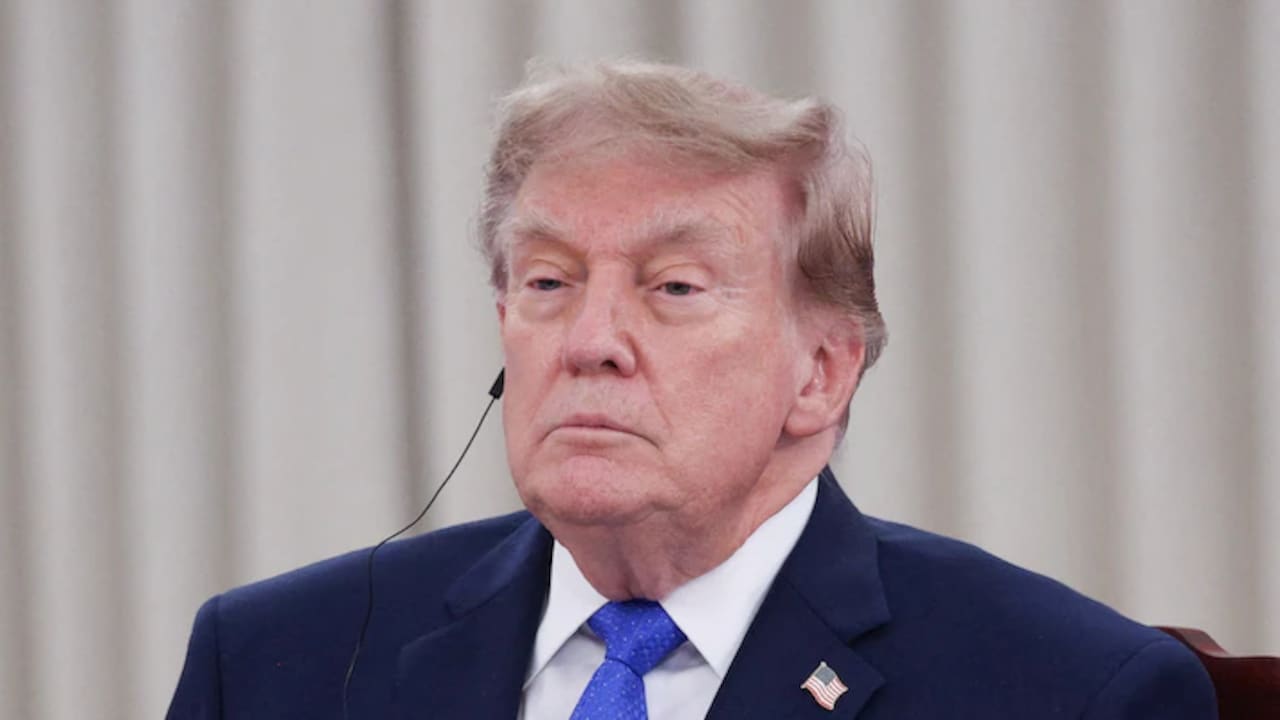
Then a headline drops like a wrench onto a steel deck. Donald Trump declares that the United States has achieved "total control" over the Strait of Hormuz.
The phrase sounds absolute. Clean. Final. It lands in the news cycle like a locked door, promising safety through sheer, unblinking dominance. Yet anyone who has ever watched global trade choke on a single geographic kink knows that "total control" over water is one of the oldest, most dangerous illusions in human history.
The Geography of a Hairpin
To understand why those four words send tremors from Pentagon briefing rooms to kitchen tables, you have to shrink the world down to twenty-one miles.
At its narrowest point, the Strait of Hormuz is barely wider than the distance of a morning commute. Within that twenty-one-mile stretch, the actual shipping lanes—the deep-water channels capable of carrying super-tankers stacked higher than office buildings—are each only two miles wide, separated by a two-mile buffer zone.
Picture a six-lane highway suddenly funneling into a single cobblestone alley, while every car on the road is carrying ten thousand gallons of jet fuel.
That is not a metaphor for dramatic effect. That is the literal geometry of global energy. Roughly one-fifth of the world's petroleum—about twenty million barrels every single day—squeezes through those two-mile lanes. Almost a third of the planet's liquefied natural gas follows the exact same path.
When a political leader claims total control over that corridor, they are claiming mastery over the jugular vein of the modern economy.
Meet the People in the Dark
Let us step off the podium and onto the bridge of a ship. Consider a hypothetical chief engineer—let us call him Mateo—working aboard a 300,000-ton Very Large Crude Carrier bound for Rotterdam. Mateo does not care about campaign slogans or cable-news graphics. He cares about draft depth, engine temperature, and the twelve-hour radar watch.
When politicians talk about naval supremacy, they imagine aircraft carriers, supersonic jets, and satellite grids locking down the horizon. Those machines are real, and their firepower is staggering. An American carrier strike group carries more destructive force than most nations possess in their entire arsenals.
Mateo, however, looks down at the waterline.
He knows that you do not need a navy to close a two-mile shipping lane. You only need a fishing skiff loaded with explosives, a mobile coastal missile battery hidden in a limestone cave three miles away, or a handful of drifting naval mines dropped under cover of a moonless night.
Insurance underwriters in London know this too. Long before a single shot is fired, Lloyd’s of London raises war-risk premiums on every hull entering the Gulf. Shipping companies pause. Tankers anchor outside the mouth of the strait, waiting. The oil stops moving not because the United States Navy lost a battle, but because a private insurer decided a three-hundred-million-dollar vessel was too expensive to gamble on a political boast.
The Illusion of the Locked Room
History is ruthless toward leaders who confuse military presence with total control.
During the Tanker War of the 1980s, the United States launched Operation Earnest Will, reflagging Kuwaiti tankers and escorting them through the exact same waters with guided-missile cruisers and frigates. On paper, American naval power was unmatched. In reality, the USS Samuel B. Roberts struck a decades-old Iranian contact mine in April 1988, nearly splitting the warship in two and blowing a fifteen-foot hole in her hull.
Control of the sea is never like holding a piece of territory on land. You cannot build a wall across a shipping channel. You cannot station a sentry on every wave.
When Trump asserts total control over Hormuz, he is leaning into a specific theory of deterrence—the idea that projecting overwhelming, unapologetic strength forces adversaries to blink first. Supporters of this posture argue that ambiguity invites aggression, and that drawing an unmistakable line in the water keeps hostile fast-attack craft in port.
There is logic there. Deterrence relies on psychology, and adversaries constantly test resolve.
But what happens when the claim itself becomes the target?
The Invisible Tax on Tuesday Morning
Let us trace the shockwave from that twenty-one-mile channel straight into your bank account, using a simple, real-world chain reaction.
Oil is priced on a global, interconnected market. Even if the country you live in pumps its own crude, refiners buy and sell on international benchmarks like Brent and West Texas Intermediate. A disruption—or even the credible fear of a disruption—in Hormuz does not stay polite and regional.
- The Spike: Traders in New York and Singapore react to maritime tension within seconds, bidding up crude futures by ten, twenty, or forty dollars a barrel before a single tanker even changes course.
- The Pump: Within days, diesel and gasoline prices climb. Every loaf of bread, carton of milk, and cardboard box delivered by a freight truck now carries a hidden fuel surcharge.
- The Freeze: Central banks, already wrestling with inflation, are forced to keep interest rates higher for longer to cool down energy-driven price spikes. Suddenly, a mortgage, a car loan, or a small business line of credit becomes measurably more expensive.
You never see a warship. You never smell diesel exhaust on the Persian Gulf. You just wonder why your grocery receipt is eighteen dollars higher than it was last month.
Why the Rhetoric Matters More Than the Radar
I have spent years watching markets and maritime tracking data during moments of geopolitical brinkmanship, and one pattern never changes: rhetoric moves faster than steel.
In maritime law, the Strait of Hormuz is governed by the principle of transit passage under the United Nations Convention on the Law of the Sea. Technically, no single nation owns the shipping lanes; ships of all flags have the right to pass unimpeded, even where territorial waters of Oman and Iran overlap.
Claiming unilateral, total control flips that legal architecture on its head. To allies in Europe and Asia—who depend far more heavily on Gulf oil than North America does—the phrase sounds less like a promise of protection and more like a unilateral claim over their energy lifeline. To adversaries in Tehran, it serves as domestic political fuel, turning a routine naval standoff into an existential test of pride.
When both sides corner themselves with absolute language, nobody has room to back down quietly.
The Difference Between Dominance and Safety
It is easy to feel cynical or overwhelmed when headlines reduce complex geopolitical chokepoints into chest-thumping soundbites. If the world's most powerful military cannot guarantee absolute safety in a twenty-one-mile stretch of water, what is the point?
Here is the truth that veteran naval strategists rarely say out loud on television: maritime security is not about total control; it is about shared risk management.
True stability in the Strait of Hormuz has historically relied on three unglamorous, painstakingly maintained pillars:
- Multilateral patrols: Quiet coordination among regional navies, European frigates, and American destroyers so no single flag carries the entire burden—or the entire blame.
- Redundant pipelines: Overland bypass routes, like Saudi Arabia's East-West Pipeline and the UAE's Fujairah pipeline, which allow millions of barrels of crude to reach the Red Sea and the Gulf of Oman without ever entering the strait.
- Strategic reserves: Emergency stockpiles held by consuming nations specifically designed to blunt price panics before they wreck household budgets.
None of those tools fit neatly onto a podium slogan. None of them generate viral clips. Yet they are the actual shock absorbers keeping the global economy from fracturing every time a patrol boat revs its engines near Bandar Abbas.
What Really Happens When the Water Narrows
Step back onto the bridge of that crude carrier with Mateo at three in the morning.
The air outside is thick, salty, and hot enough to warp steel. Off the port bow, the lights of oil platforms burn orange against a pitch-black sky. Ahead lies the narrowest bend of the channel, where the water turns shallow and the traffic funnels tight.
No speech delivered five thousand miles away widens that lane by a single inch. No declaration makes a floating mine less lethal or persuades an insurance broker in London to lower a premium.
In the end, the ocean belongs to no one, and a twenty-one-mile bottleneck will always remind the most powerful nations on earth just how fragile their certainty really is.