The air inside the collapsed parking garage tasted of pulverized concrete and old gasoline. It was a heavy, suffocating gray. Somewhere beneath three floors of pancaked steel and sediment, a rhythm persisted—a faint, metallic tapping. It wasn't a human heartbeat, but it was the only thing keeping the hope of one alive.
Rescue workers stood at the edge of the debris, paralyzed by the physics of the rubble. Send a dog, and the shifting rebar might impale it. Send a person, and the vibration of their boots could trigger a secondary collapse. In the brutal calculus of disaster recovery, the "Golden Hour" is a myth we tell ourselves to stay calm. In reality, every second is a jagged edge.
Then they uncapped the crate.
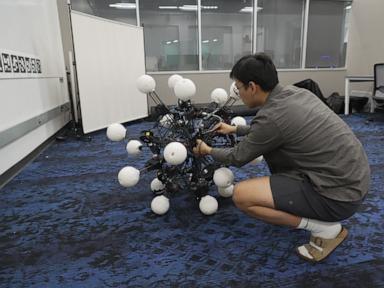
Out crawled Argus. It didn’t look like a hero. It didn’t even look like a dog. It looked like a nightmare birthed in a watchmaker's shop—a low-slung, multi-jointed chassis supported by twenty spindly legs. It didn't walk so much as it flowed.
The Geometry of Survival
Most robots fail because they are built in our image. We are obsessed with the bipedal form, that upright, precarious stance that makes us feel superior. But two legs are a liability in a world that has fallen apart. Even four legs—the gold standard of the animal kingdom—can get stuck in a crevice.
Argus, developed by researchers at the University of California, Berkeley, ignores the vanity of human biology. By utilizing twenty independent points of contact, the machine distributes its weight so thinly that it can traverse a pile of shards without shifting a single stone. If one leg slips into a void, nineteen others are already gripping the surrounding surface. It is redundant by design. It is stable by necessity.
Think of it as a centipede with a PhD in spatial awareness.
Traditional robots operate on a loop: see, think, act. They take a picture of the ground, calculate the depth, and decide where to put a foot. That process takes milliseconds, but in a chaotic environment, those milliseconds lead to stumbles. Argus uses what engineers call "whole-body proprioception." It doesn't need to think about the floor. Its legs feel the world, reacting to the texture of the terrain before the central processor even registers the change.
An Eye That Sees Everything and Nothing
If the legs provide the movement, the "head"—if you can call it that—provides the god-complex.
Standard cameras are directional. They have a field of view. They have blind spots. If a robot is looking at a ledge to its left, it cannot see the ceiling crumbling to its right. Argus solves this through a radical reconfiguration of vision. It is covered in sensors that allow it to see in 360 degrees simultaneously.
Imagine standing in a room and being able to see the floor beneath your heels, the rafters above your head, and the door behind your back all at once, without moving your neck. It is a disorienting prospect for a human brain, which is wired to focus on a single point of interest. For the AI driving Argus, it is total clarity.
This isn't just about avoiding obstacles. In a search-and-rescue scenario, the "point of interest" is often a sliver of color—a red sleeve, a glint of a wedding ring—buried in a sea of gray. Because Argus sees in every direction at once, it cannot miss the details that a human operator, exhausted and squinting at a monitor, might overlook.
The Invisible Stakes of Mechanical Empathy
There is a coldness to the way we discuss robotics. We talk about torque, battery life, and degrees of freedom. We treat these machines as tools, like a more expensive hammer.
But talk to the people who operate them.
When a robot enters a space where humans cannot go, it becomes a proxy for our presence. The engineers at Berkeley aren't just building a clever toy; they are attempting to solve the problem of distance. Every time a disaster strikes—a hillside in Turkey, a factory in Ohio, a mine in Chile—there is a moment of profound helplessness. We know people are there. We just can't reach them.
Argus is the bridge across that helplessness.
Consider a hypothetical engineer named Elias. Elias spent three years refining the gait of the twenty-legged platform. He didn't do it for the patent. He did it because he watched footage of the 2021 Surfside condo collapse, where rescuers had to stop searching because the structure was too unstable. He saw the faces of the families waiting behind the yellow tape.
He realized that the bottleneck wasn't human will. It was human anatomy.
By stripping away the human form, Elias and his team created something more "human" in its purpose. The robot’s strange, insect-like scuttle is a physical manifestation of our refusal to leave anyone behind. It is weird. It is perhaps even a little unsettling to watch. But beauty is a secondary concern when you are trapped under a million pounds of limestone.
The Logic of the Swarm
Argus represents a shift in how we think about "intelligence."
For decades, the goal was to build a singular, brilliant brain. We wanted an AI that could talk, write poetry, and solve equations. But Argus suggests that true utility lies in "embodied intelligence." This is the kind of smarts a mountain goat has when it scales a vertical cliff, or a cockroach has when it flattens its body to slide under a door.
It is the intelligence of survival.
The twenty legs aren't just for show. They allow the robot to lose half of its limbs and still function. In a test environment, researchers can snap off a leg, and the software immediately recalibrates. The remaining legs compensate, shifting the center of gravity, finding a new rhythm. It doesn't mourn the loss. It doesn't stop to troubleshoot. It simply continues.
This resilience is the difference between a successful mission and a multi-million dollar pile of junk. In the field, things break. Motors burn out. Saltwater corrodes joints. A robot with four legs that loses one is a tripod; it’s a struggle. A robot with twenty legs that loses one is still a powerhouse.
Beyond the Rubble
While the immediate application is clearly rescue, the implications of a 360-degree, multi-legged platform bleed into every corner of industry.
Think of the nuclear power plants that need inspection in areas where radiation would cook a human's DNA in minutes. Think of the deep-sea trenches where the pressure would crush a titanium sphere. Think of the maintenance of our aging infrastructure—the underside of bridges and the dark interior of sewer systems that keep our cities from drowning in their own waste.
We are currently living in a world built by giants, and we are finding it increasingly difficult to maintain the scales. Our structures are getting larger and more complex, while our ability to safely traverse them remains limited by our soft skin and two-legged balance.
Argus is the first of a new generation of "extreme terrain" workers. These aren't the humanoid assistants promised by 1950s science fiction, the ones that would flip our pancakes and walk our dogs. Those robots are domestic fantasies. Argus is a gritty, industrial reality.
It is built for the mud. It is built for the dark.
The Ghost in the Machine
There is a final, haunting quality to the way Argus moves. If you watch it long enough, the "robot" disappears. You stop seeing the wires and the carbon fiber. You start seeing an intent.
The way it pauses to "look" with its multi-directional sensors, or the way it gingerly tests a loose brick before committing its weight, mimics the caution of a living creature. It possesses a digital version of instinct.
We often fear that technology will replace us. We worry about the day the machine takes the job, the seat, or the crown. But standing at the edge of that collapsed garage, watching the twenty-legged shadow disappear into the dust, that fear evaporates.
You don't want a human in there. You want the thing that can see what we can't, go where we won't, and stay steady when the world starts to shake.
The tapping from deep within the rubble continues. It is slower now, more desperate. But the gap is closing. Inch by inch, the twenty legs find purchase on the slick, angled surfaces of the ruin. The 360-degree cameras map the void, sending back a 3D blueprint of the path to the survivor.
Argus doesn't feel tired. It doesn't feel afraid. It simply moves forward, a metallic spider spinning a web of data that serves as a lifeline for someone who thought they were forgotten.
The future of rescue doesn't look like a person in a cape. It looks like a twenty-legged machine scuttling through the dark, its unblinking eyes seeing every possible way home.