Twelve feet.
To appreciate the sheer, defiant absurdity of twelve feet, you have to stand in a suburban driveway in late September while a warm wind smells faintly of cut grass and distant woodsmoke, holding a stainless-steel Allen wrench and staring at a plastic femur the size of a canoe paddle.
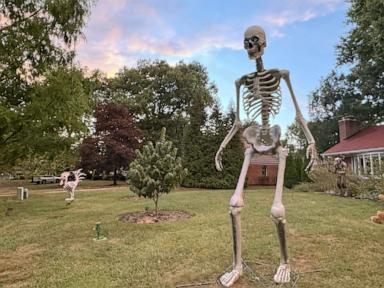
For the sake of grounding this in the exact reality thousands of families face every autumn, let us consider a hypothetical homeowner named Marcus. Marcus lives on a quiet cul-de-sac in Ohio. He owns a sensible midsize SUV, pays his property taxes on time, and possesses a garage that was already full before he decided to spend three hundred dollars at Home Depot on a Tuesday morning in July. Now, scattered across his Bermuda grass, are the disjointed remains of Skelly—the twelve-foot-tall animated skeleton that, since its debut in 2020, has quietly overthrown decades of suburban restraint to become the undisputed monarch of American Halloween.
Why?
On paper, the phenomenon makes no sense at all. A twelve-foot skeleton is an ergonomic nightmare. It weighs roughly ninety-six pounds, requires a box the size of a coffin to transport, demands a ladder and at least two adults to assemble without risking a slipped disc, and refuses to fit inside a standard attic hatch once November arrives. Yet every year, retailers sell out within hours of releasing their inventory. Secondary markets routinely list them for double or triple their retail price. Whole neighborhood factions have formed around them, complete with seasonal outfits, custom lighting rigs, and fierce debates over whether leaving a colossal resin ribcage up until Valentine’s Day constitutes festive whimsy or an actionable offense against the homeowners association.
To dismiss this as a mere retail fad is to miss the much deeper, quieter story happening on front lawns from Maine to California. We didn't fall in love with a giant plastic skeleton because we suddenly developed a collective passion for osteology. We bought it because, in an era defined by isolation, digital noise, and relentless uncertainty, we were starving for a reason to look up from our phones and talk to the people living thirty feet away.
The Anatomy of an Accidental Icon
The origin story of the giant skeleton reads less like a masterclass in corporate calculation and more like a happy collision between artistic stubbornness and a global crisis. Back in 2019, Lance Allen, a senior decorative holiday merchant for Home Depot, was walking through a haunted attraction trade show when a towering display caught his eye. At the time, standard yard skeletons topped out at around five or six feet—roughly human scale, easy to ignore, blending effortlessly into the visual clutter of faux cobwebs and plastic tombstones.
Allen wanted scale. He wanted something that didn't just sit on a lawn, but commanded the entire block. His team engineered a figure twice the height of a grown man, outfitted with LCD eyes that blinked and shifted, giving the hollow sockets an uncanny, almost soulful presence. They priced it at $299—expensive enough to make a shopper pause in the aisle, yet just affordable enough to justify as a splurge after a rough week at work.
Then came the autumn of 2020.
If you lived through that October, you remember the specific, heavy silence of those streets. Schools were fractured. Offices were empty. Traditional trick-or-treating hung in limbo, tangled in public health anxieties and makeshift PVC candy chutes taped to porch railings. People were exhausted by screens and starved for shared, physical joy. Into that quiet vacuum stepped a twelve-foot-tall grim reaper with glowing eyes.
Suddenly, a front yard wasn't just a patch of grass to be mowed on Saturday mornings; it was a stage. A single skeleton erected on a corner lot became a neighborhood landmark. Parents pushed strollers three blocks out of their way just to let their toddlers stare up at the towering ribcage. Delivery drivers took selfies beside the knees. Neighbors who hadn't exchanged more than a tight-lipped wave over garbage cans in five years found themselves standing at the curb, laughing about how on earth someone managed to get the skull onto the spine without a cherry picker.
Think of the giant skeleton like a modern front porch. For decades, American residential architecture systematically erased the porch, replacing it with oversized garages and backyard decks that turned our homes inward, away from the street. We traded community friction for private comfort. The twelve-foot skeleton acted like a crowbar against that isolation. It forced a shared visual experience onto the streetscape, turning passive passersby into an audience and solitary homeowners into hosts.
The Secret Language of Suburban Rebellion
Of course, once the novelty of the first season faded, something far more interesting took hold. The skeleton stopped being a Halloween decoration and started becoming a canvas.
Walk through almost any American suburb between October and January today, and you will witness a masterclass in vernacular folk art. Take our hypothetical Ohio homeowner, Marcus. In October, his skeleton wears a tattered pirate coat and clutches a plastic lantern. By November, the pirate coat comes off, replaced by a giant pilgrim hat and an oversized felt turkey leg wired to its bony fingers. Come December, the skeleton is draped in a twenty-foot red scarf, wearing a custom-sewn Santa hat the size of a sleeping bag, holding a strand of warm white LED lights like a lasso.
I remember the first time I saw one dressed in a giant floral sundress and a floppy sun hat in the middle of a humid July afternoon. I pulled my car over to the curb, genuinely baffled, and stared at it for a full minute. At first, it felt absurd—almost aggressively silly. Then the homeowner walked out of his front door holding a glass of iced tea, caught me staring, and grinned with the unmistakable pride of a man who had just won a bet against boredom. "My wife said if I didn't put it in the shed, I had to make it look presentable for the garden club," he told me. "So we went to the fabric store."
That moment captures the real emotional engine behind the trend. Adult life is relentlessly serious. It is governed by spreadsheets, mortgage rates, pediatric dental appointments, and an endless stream of breaking news alerts designed to keep our nervous systems permanently frayed. Almost every decision we make as adults is optimized for efficiency, resale value, or social conformity.
Putting a twelve-foot skeleton on your lawn is a deliberate, joyful rejection of optimization. It serves no practical purpose. It lowers no utility bills. It solves no problems. In fact, it actively creates problems—storage problems, wind-resistance problems, HOA-violation-letter problems. And yet, choosing to solve those problems purely for the sake of making a seven-year-old kid gasp on the walk home from school feels like a small, vital act of reclamation. It is permission to be ridiculous in public.
What the Neighbors Really Think
Not everyone cheers when the bones go up, and pretending otherwise would ignore half the story. For every cul-de-sac that rallies around a communal mascot, there is another neighborhood locked in a passive-aggressive cold war over property aesthetics and community standards.
Homeowners associations across the country have scrambled to update their bylaws to address what many covenants never anticipated: year-round skeletal installations. When those rules were written in the nineties and early two-thousands, "holiday decorations" meant a wreath on the door or icicle lights along the gutters—items that could be boxed up in a single afternoon. Nobody drafted a clause specifically anticipating a towering anatomical model anchored to the earth with steel guy-wires and sandbags.
Consider the friction that builds when one house treats the front yard as an evolving comedy routine while the house next door is trying to list their property for sale. A real estate agent showing a pristine colonial to prospective buyers has a hard time explaining why a twelve-foot skeleton dressed as Taylor Swift is towering over the property line. The tension isn't really about plastic; it's about competing visions of what a neighborhood is for. Is a street a quiet financial asset to be protected through uniformity, or is it a living, breathing commons where personality is allowed to spill over the edges?
Even among enthusiasts, there is an unspoken learning curve—and a fair bit of quiet anxiety—that rarely makes it into the cheerful social media photos. I learned this the hard way the first time I helped a friend anchor a towering yard display ahead of an autumn storm. Until you have stood outside at midnight in sideways rain, watching a twelve-foot plastic frame sway like a ship's mast in forty-mile-per-hour gusts, you do not truly understand wind load. We had used the flimsy stakes included in the box, trusting factory engineering over basic physics. By morning, the skeleton had face-planted directly into a prize hydrangea bush, snapping a collarbone and leaving us with a humbling lesson in mechanical leverage.
Veteran collectors now trade engineering advice like seasoned civil contractors. They discuss heavy-duty ground augers, braided steel cables, weighted sandbags hidden beneath artificial autumn leaves, and the exact torque required to keep a plastic spine upright through a Midwest gale. What begins as an impulse buy in a fluorescent-lit hardware aisle quickly evolves into a crash course in structural stability and creative storage.
The Economics of Viral Nostalgia
From a business perspective, the rise of the giant skeleton rewrote the playbook for seasonal retail. Historically, holiday merchandise followed a predictable, gentle curve: stock hit shelves in early September, peaked in mid-October, and went on clearance the morning of November first. Margins were steady, and surprises were rare.
The twelve-foot skeleton shattered that rhythm by turning seasonal decor into a limited-edition drop, mirroring the hype cycles of collectible sneakers or gaming consoles. When Home Depot realized they had struck cultural gold, they leaned into the spectacle without over-saturating the market to the point of killing the magic. They introduced companions—a seven-foot skeletal dog, a towering werewolf, an inferno pumpkin skeleton with pulsing flames inside its chest—creating an entire ecosystem of oversized lawn mythology.
Competitors rushed to claim a piece of the territory. Lowe’s countered with massive animated figures of its own, including a twelve-foot mummy and towering ghostly knights. Target, Costco, and Spirit Halloween pushed their own oversized centerpieces. Suddenly, the front yard arms race was an official retail category, driving Halloween spending in the United States past the twelve-billion-dollar mark.
Yet the most telling detail about this retail boom isn't the revenue—it's the longevity. Most viral products burn bright and vanish within eighteen months, relegated to thrift store bins and garage sale tables. Seven years into its reign, the giant skeleton shows no signs of retreating into the attic. Instead, it has matured into a genuine cultural tradition, passed down through neighborhood lore and family photo albums. Kids who were five years old when the first skeleton appeared on their street in 2020 are twelve now. For them, autumn doesn't officially begin when the leaves turn or when coffee shops roll out pumpkin spice; it begins the afternoon the giant bones rise above the rooflines.
The Shadow Cast Across the Grass
There is a quieter, almost philosophical irony tucked inside this whole phenomenon, one that rarely gets spoken aloud while people are wrestling with socket wrenches and extension cords.
For centuries, human beings kept skeletons close as a memento mori—a sobering visual reminder that life is brief, status is temporary, and all of us eventually end up in the exact same condition beneath the soil. Medieval art, Renaissance still lifes, and Victorian mourning jewelry used the human skull to whisper a quiet warning against vanity and distraction.
In twenty-first-century America, we took that ancient symbol of mortality, blew it up to twelve feet tall, gave it blinking digital eyes, put a novelty Santa hat on its head, and parked it next to the hydrangeas.
We didn't erase the reminder of mortality; we simply defanged it through sheer, joyful scale. By making death enormous, cartoonish, and slightly clumsy, we turned something terrifying into something neighborly. We gave it a nickname. We dressed it up for football Sundays. We used a symbol of endings to spark thousands of small, human beginnings right there on the sidewalk.
Late on an October evening, after the trick-or-treaters have gone home and the porch lights begin winking out one by one along the street, step outside and look up at one of those towering silhouettes against a bruised autumn sky. The glowing eyes still shift slowly from left to right, watching over a quiet block of darkened windows and parked cars. Somewhere inside, a family is sorting through pillowcases full of chocolate, someone is sweeping stray leaves off the front steps, and for one brief season, a twelve-foot piece of molded plastic has reminded an entire street how good it feels to look up together.