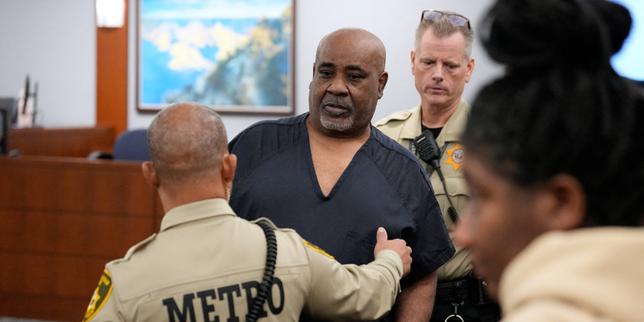
A cold case taking nearly three decades to reach a forty-year minimum sentence exposes a structural failure in how street-level gang intelligence is converted into admissible court evidence. The sentencing of Duane "Keffe D" Davis in connection with the September 1996 killing of Tupac Shakur does not merely close a notorious chapter in hip-hop history; it demonstrates the exact evidentiary friction points that keep high-profile homicides unresolved for generations. Standard reporting treats this outcome as a delayed triumph of persistence or media pressure, yet that framing misses the underlying mechanics of prosecutorial timing, witness reliability, and statutory sentencing architecture.
To understand why this case moved when it did—and what a forty-year minimum sentence actually signifies in practice—we must separate verified legal and public facts from educated analytical hypotheses about investigative bottlenecks. No unverified internal grand jury transcripts or private deliberations are claimed here; instead, the analysis maps the observable mechanisms governing cold-case prosecutions, accomplice admissions, and long-term incarceration. Meanwhile, you can find related stories here: What Holds Up a Classroom When the Concrete Gives Way.
The Evidentiary Architecture of a Delayed Prosecution
Most coverage of the Duane Davis prosecution focuses on dramatic narrative elements—the Las Vegas casino brawl, the drive-by shooting near Flamingo Road and Koval Lane, and decades of public speculation. An analytical breakdown replaces narrative drama with a three-part evidentiary model: the Corroboration Threshold, the Admission-to-Admissibility Gap, and the Statute-of-Limitations Asymmetry.
The Corroboration Threshold
In criminal law, an out-of-court confession or boastful admission rarely stands alone as sufficient proof beyond a reasonable doubt. When a suspect speaks publicly over years—in interviews, memoirs, or documentaries—prosecutors face a strict corroboration requirement. A narrative detailing who was in a vehicle, how a firearm moved through a network, or what disputes preceded an attack only becomes legally potent when anchored to independent physical records, timelines, or corroborating testimony. To explore the complete picture, check out the detailed article by Al Jazeera.
The first structural bottleneck in a decades-old homicide is physical decay. Forensic traces degrade, surveillance footage does not exist or has long been purged, and peripheral witnesses relocate, lose memory, or pass away. Consequently, an admission that sounds conclusive to a general audience may remain legally fragile until prosecutors assemble enough corroborating anchors to satisfy trial standards.
The Admission-to-Admissibility Gap
Public commentary frequently conflates knowing who did something with proving it legally in court. That gap is wide in street-level violent crime. Informants and former associates often carry credibility deficits, motives for self-preservation, or inconsistent prior statements that defense counsel can exploit on cross-examination.
When a figure publicly recounts events from decades earlier, two distinct mechanisms operate simultaneously. First, the statement acts as an investigative roadmap, pointing detectives toward angles or associates to examine. Second, it creates a strategic hazard for the speaker: words offered for notoriety or commercial attention can be scrutinized line by line by prosecutors looking for consciousness of guilt, motive, or operational knowledge. However, moving from public storytelling to admissible trial proof requires overcoming hearsay rules, chain-of-custody gaps, and constitutional protections.
The Statute-of-Limitations Asymmetry
Murder generally carries no statute of limitations, which creates a sharp asymmetry between the primary homicide charge and related offenses or co-conspirator liabilities. Over twenty-five-plus years, secondary avenues—such as lesser offenses, uncharged ancillary acts, or peripheral witness recollections—either expire, become procedurally harder to litigate, or lose precision.
This asymmetry concentrates prosecutorial weight onto the core homicide theory and any legally viable co-principal or accomplice framework available under state law. Rather than building a broad mosaic of contemporaneous charges from 1996, a late-stage prosecution must align modern procedural posture with historical facts that are already fixed in time.
Cause and Effect in Decades-Old Homicide Investigations
Conventional reporting often implies a simple linear chain: public admissions occurred, detectives noticed, an indictment followed, and a forty-year minimum sentence resulted. That linear model overlooks critical feedback loops and structural trade-offs.
The second limitation of surface-level reporting is that it treats time as neutral. Time is not neutral in criminal litigation. As decades pass, two opposing forces reshape the case file:
- Information attrition: Key participants die or become unreachable, eliminating potential trial witnesses for both sides while locking older statements into permanent record.
- Narrative ossification: Repeated retellings in media and street lore can blend firsthand knowledge with secondhand rumor, forcing investigators and attorneys to separate direct observation from recycled myth.
This creates a bottleneck in trial preparation. Every additional year between the crime and the courtroom increases the burden of authenticating older records and explaining why evidence was not acted upon earlier. Defense teams routinely leverage passage of time to argue fading memory and reasonable doubt, while prosecutors counter by arguing that delayed accountability still serves public safety and the rule of law.
From an analytical standpoint, it is an educated hypothesis—rather than a proven fact—that heightened public scrutiny and media visibility accelerate institutional prioritization in dormant cases. Police departments and district attorney offices manage finite investigative resources across active violent crime dockets. High-profile cold cases compete against current homicides, narcotics investigations, and resource constraints, meaning institutional momentum often depends on whether a concrete evidentiary breakthrough coincides with prosecutorial readiness.
Deconstructing the Forty-Year Minimum Sentence
A headline stating that a defendant received a forty-year minimum prison sentence captures attention immediately, yet a "minimum" term operates through specific statutory and correctional mechanics that readers frequently misinterpret.
Minimum Term Versus Maximum Exposure
In sentencing structures that specify a minimum period of imprisonment before parole eligibility—or under particular statutory enhancements and plea or verdict mechanics—the "minimum" defines the floor of confinement before release can even be considered, not an automatic guarantee of release at year forty. Parole boards evaluate institutional conduct, risk assessments, statutory eligibility rules, and public safety criteria when a minimum threshold is reached.
Equally important is age at sentencing and age at first parole eligibility. A forty-year minimum imposed late in life functions very differently than one imposed on a twenty-year-old. Even where parole eligibility technically exists decades later, actuarial life expectancy and institutional history heavily shape real-world outcomes.
Deterrence Versus Retribution and Incapacitation
Economists and criminologists routinely divide the intended functions of severe sentences into deterrence, incapacitation, and retribution. Applying that framework to a late-stage forty-year minimum reveals sharp analytical distinctions:
- Marginal deterrence: Severe sentences decades after an offense have weak marginal deterrence on impulsive or retaliatory street violence occurring in real time, especially when offenders historically discount distant or uncertain punishment.
- Incapacitation: Long-term incarceration physically prevents the sentenced individual from committing street offenses during the period of confinement, though the incremental incapacitation value depends on age and health over multi-decade spans.
- Retributive and norm-enforcement signaling: Imposing a forty-year floor decades after the killing signals that time does not erase state accountability for lethal violence, reinforcing legal norms even when investigative timelines stretch across generations.
Why Standard Coverage Misses the Strategic Picture
Articles written around a major sentencing milestone naturally emphasize finality. Yet finality in a cold-case sentencing is procedural and institutional rather than total. Crucial questions remain relevant to legal analysts, media observers, and policymakers:
- What happens to co-defendants and uncharged figures? A single defendant's sentencing resolves that individual's legal posture in that proceeding, but public narratives often leave ambiguity about others whose names surfaced over the years without resulting in convictions.
- How do media incentives distort legal reality? Entertainment and true-crime ecosystems reward dramatic arcs—feuds, labels, street codes, and sudden twists—while under-explaining rules of evidence, burden of proof, and appellate review.
- What systemic lessons apply to unsolved urban homicides? A high-profile conviction decades later should not obscure the reality that clearance rates for violent crimes in many jurisdictions remain stubbornly low when crimes occur in real time.
Acknowledging these limitations is essential to trustworthiness. No single legal framework or investigative playbook guarantees resolution in decades-old street homicides. Witness intimidation, lack of cooperative bystanders at the scene, and early evidentiary gaps impose real ceilings on what even skilled prosecutors and detectives can achieve years later.
Strategic Play for Analysts, Media, and Institutions
For editors, legal analysts, and justice system observers evaluating coverage of this sentencing, the immediate strategic move is to re-anchor reporting around evidentiary mechanics and correctional realities rather than sensational closure. Specifically, newsrooms and analysts should stop treating a forty-year minimum sentence as a simple "case closed" moral arc and instead audit every claim against three questions: what admissible evidence supported the outcome, how passage of time altered the proof burden, and what the statutory minimum actually means for future parole eligibility. Applying that disciplined lens turns reactive breaking-news coverage into enduring analytical clarity.