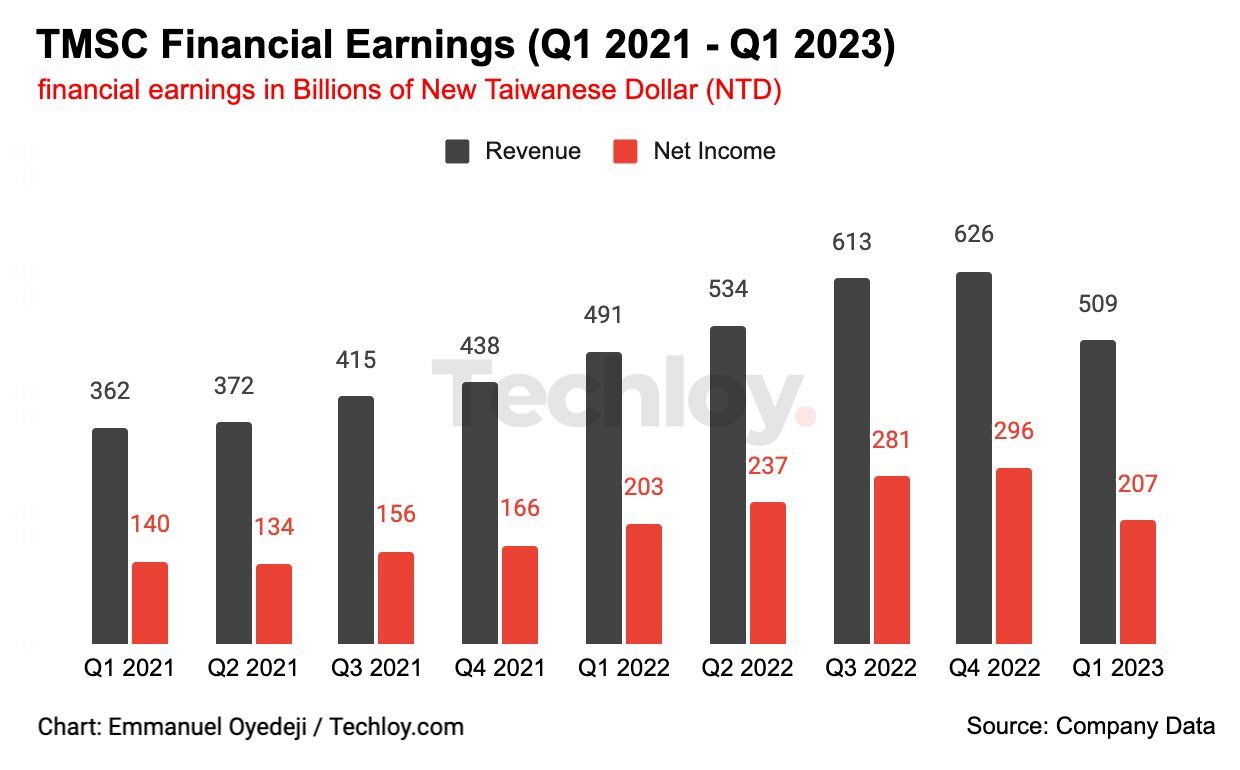
TSMC’s first-quarter fiscal performance functions as a concentrated proxy for the global shift from general-purpose silicon toward specialized accelerated computing. While top-line revenue growth and a 58% net profit surge often dominate market headlines, these figures are merely outputs of a more significant structural realignment: the transition of the High Performance Computing (HPC) segment from a growth engine to the primary foundation of the company’s capital allocation strategy. The firm is no longer a diversified foundry; it is a specialized infrastructure layer for the generative AI era.
The Revenue Composition Pivot
The core of TSMC’s outperformance lies in the radical divergence between its two primary platforms: Smartphones and HPC. Historically, the smartphone cycle dictated the company’s seasonality and margin profile. That era has ended.
- HPC Dominance: HPC now accounts for 46% of total revenue, underpinned by the insatiable demand for AI accelerators and server CPUs. This segment grew significantly while the smartphone segment—traditionally the largest—retreated to 38% due to a slowdown in replacement cycles and market saturation in the high-end mobile space.
- Node Migration Dynamics: The 3nm (N3) and 5nm (N5) technologies together represent 65% of total wafer revenue. N3, which contributed 9% of total revenue, is currently in a steep ramp-up phase. This represents the "initial margin drag" period common to new nodes, yet the company maintained a gross margin of 53.1%. This indicates an unprecedented level of pricing power and yield efficiency at the N5 and N7 levels, which are effectively subsidizing the expansion of N3 capacity.
The operational reality is that TSMC is trading volume in legacy nodes for extreme value in advanced nodes. The "record run" is not a function of producing more wafers, but of producing more expensive, high-complexity wafers for a smaller, more concentrated group of customers.
The Three Pillars of TSMC Profitability
To understand why TSMC consistently beats estimates, one must analyze the internal cost functions that govern their foundry model.
1. The Yield Learning Curve as a Moat
TSMC’s ability to achieve high yields on extreme ultraviolet (EUV) lithography faster than its competitors (Intel and Samsung) creates a compound interest effect on its margins. When a competitor struggles with a 40% yield on a leading-edge node, and TSMC operates at 70%+, the unit cost difference allows TSMC to either undercut the market or, as they have chosen, capture 100% of the industry’s economic profit. This yield gap is the primary reason why NVIDIA and Apple remain locked into TSMC’s ecosystem.
2. Capital Intensity vs. Operating Leverage
The company maintains a capital expenditure budget of $28 billion to $32 billion for the fiscal year. Approximately 70% to 80% of this is dedicated to advanced process technologies. This creates a massive barrier to entry. However, the true strength lies in the depreciation schedule. As N5 and N7 equipment becomes fully depreciated, the cash flow generated from these "older" advanced nodes provides the liquidity needed to fund the exorbitant R&D required for 2nm (N2) production, scheduled for 2025.
3. The CoWoS Bottleneck and Value Capture
Chip-on-Wafer-on-Substrate (CoWoS) packaging has transitioned from a niche backend service to a critical strategic bottleneck. TSMC’s profit beat is partially attributed to its success in scaling advanced packaging capacity. By controlling both the front-end (wafer fabrication) and the back-end (packaging), TSMC captures a larger share of the total bill of materials for an AI accelerator. They are no longer just selling "chips"; they are selling "systems-on-integrated-substrates."
Structural Risks and the Inventory Myth
While the "AI demand" narrative is compelling, it masks a secondary risk: the concentration of counterparty risk. TSMC’s growth is increasingly dependent on the capital expenditure budgets of a handful of hyperscalers—specifically those buying chips from NVIDIA, AMD, and Broadcom.
There is a common misconception that inventory levels are the primary indicator of foundry health. In the current cycle, "days of inventory" is a lagging metric. The real indicator is "capacity utilization of advanced nodes." If a major cloud service provider pauses its AI infrastructure build-out, TSMC faces an immediate utilization gap that cannot be easily filled by automotive or IoT customers, who do not require N3 or N5 capacity.
The second risk is the "geographic premium." The expansion into Arizona, Japan, and Germany introduces a higher cost of operation. While TSMC has indicated that these costs will be passed on to customers to maintain a 53% long-term gross margin, the elasticity of demand for geographically diversified silicon remains untested. If the "Taiwan discount" disappears—meaning the lower costs of producing in a centralized, highly efficient domestic ecosystem—TSMC will have to rely even more heavily on its technological lead to justify higher ASPs (Average Selling Prices).
The Mechanism of the AI Multiplier
The 58% profit rise is a result of the "AI Multiplier" effect on silicon area. An H100 or B200 GPU consumes significantly more silicon area and utilizes more complex mask sets than a standard laptop processor.
- Die Size Expansion: Large AI dies have lower yields per wafer by definition. TSMC charges per wafer, not per working die, effectively shifting the yield risk to the designer while collecting a premium for the complexity of the process.
- SRAM Scaling Stagnation: As logic continues to shrink, SRAM (memory) does not shrink at the same rate. This forces chip designers to use more physical space or more complex chiplet architectures to achieve performance gains. Both scenarios benefit TSMC’s revenue per wafer.
- The Interconnect Tax: The move toward chiplet-based architectures requires high-speed interconnects. TSMC’s 3D Fabric technology allows them to charge for the "glue" that holds these chiplets together, creating a new revenue stream that did not exist during the monolithic chip era.
The 2nm Transition and the Gate-All-Around (GAA) Hurdle
TSMC is currently preparing for the transition from FinFET architecture to N2, which utilizes Nanosheet (GAA) transistors. This is the most significant architectural change in over a decade.
The success of the 2026 fiscal year depends entirely on the N2 ramp-up. Unlike the transition from 5nm to 3nm, which was an evolution of FinFET, GAA requires entirely new manufacturing protocols and materials. The risk of "learning curve stall" is non-zero. If TSMC encounters yield issues with Nanosheet, the profit margins seen in Q1 2024 will be impossible to sustain as R&D costs balloon without a corresponding revenue offset.
Strategic Implementation for Stakeholders
For those navigating the semiconductor supply chain or managing portfolios exposed to these dynamics, the following logical framework should be applied to TSMC’s trajectory:
- Monitor the Spread: Track the spread between TSMC’s gross margin and the capital expenditure intensity of its top three customers. If customer Capex slows while TSMC’s depreciation grows, a margin squeeze is inevitable.
- The Packaging Hedge: Evaluate TSMC not just as a fabricator but as a packaging provider. The growth in the "All Other" revenue category often hides the high-margin advanced packaging contributions that are becoming the primary differentiator for AI silicon.
- Geopolitical Cost Modeling: Factor in a structural 200–300 basis point drag on operating margins as international fabs come online. The company’s ability to mitigate this through "value-based pricing" (charging more for chips made in the US) will determine if the current valuation is sustainable.
The record-breaking quarter is not an anomaly; it is the first clear evidence of TSMC’s successful capture of the AI value chain. However, this success brings a new form of fragility: the company is now a mono-cultural entity whose health is inextricably linked to the continued exponential growth of large language model training. Any cooling in the AI infrastructure "arms race" will have a disproportionate impact on TSMC compared to the more diversified cycles of the past.
The strategic play is to monitor N2 development milestones as the only true indicator of long-term dominance. Current Q1 profits are a reflection of yesterday's R&D; the N2 yield data, expected in late 2024, will be the reflection of tomorrow's market cap.