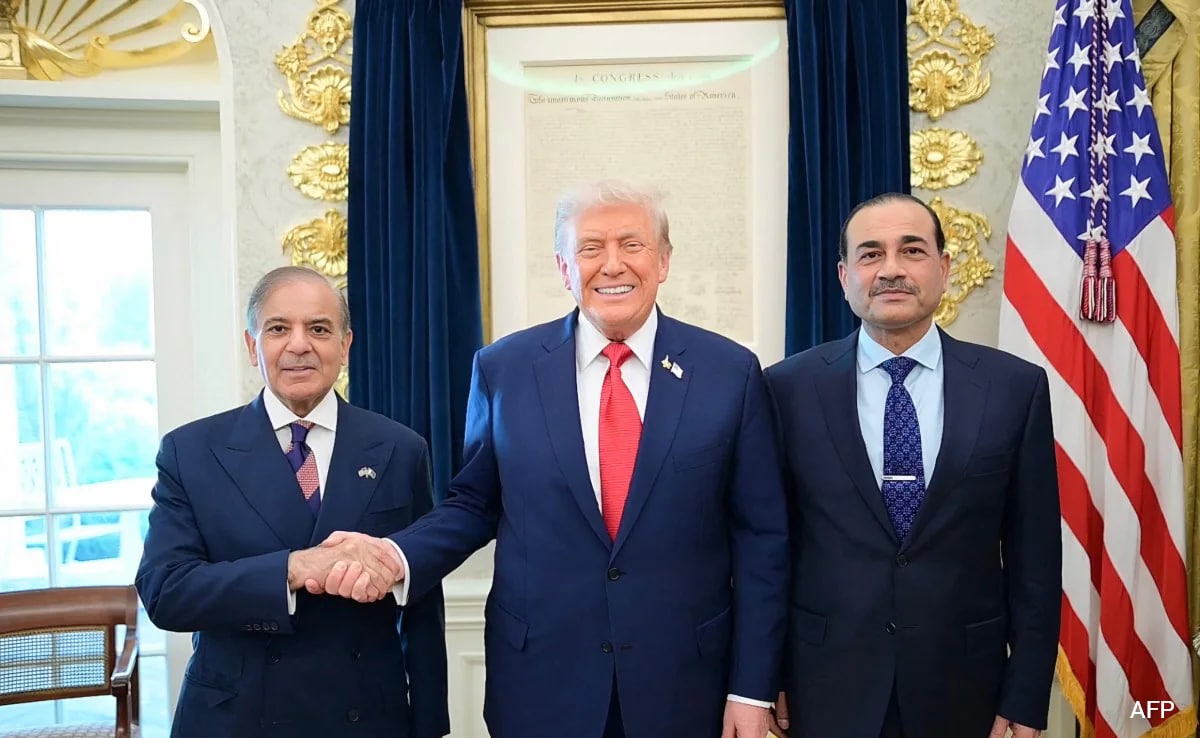
The media is currently hyperventilating because Donald Trump supposedly "snubbed" Pakistan’s Prime Minister Shehbaz Sharif while directing his gaze toward General Asim Munir. Pundits call it a breach of protocol. They call it an insult to democracy. They are wrong.
It is a rare moment of geopolitical clarity.
For decades, Washington has played a tired charade: pretending that the occupant of the Prime Minister’s Office in Islamabad holds the keys to the kingdom. We’ve watched billions in aid vanish into a bureaucratic black hole while the real decisions—nuclear policy, regional counter-terrorism, and the messy chess match with India—are made three miles away at General Headquarters (GHQ) in Rawalpindi.
Trump isn't "ignoring" the Prime Minister. He is acknowledging the reality of the Pakistani power structure. In a world of limited diplomatic bandwidth, talking to the figurehead is a waste of time. You talk to the person who can actually move the needle.
The Myth of the Civilian Mandate
Every few years, the West falls for the same "democratic spring" narrative in Pakistan. We see a new face in a suit, hear promises of economic reform, and sign checks. Then, the moment a hard security decision needs to be made, the suit disappears, and the uniform takes the stage.
The current government in Islamabad is walking on ice so thin it’s practically liquid. It exists by permission, not by power. To expect a U.S. administration—especially one that prioritizes "The Deal"—to spend its political capital negotiating with a middleman is delusional.
I’ve watched foreign policy "experts" spend months drafting memos for Pakistani civilian leaders, only to see those memos end up in a shredder because the military establishment didn't sign off. Trump’s approach skips the middleman. It’s brutal. It’s "undiplomatic." It’s also the only way to get a straight answer.
The Abraham Accords are Not a Participation Trophy
The noise surrounding Pakistan and the Abraham Accords is particularly thick with misunderstanding. The Accords aren't just a "peace club" you join to get a photo op in the Rose Garden. They are a hard-nosed realignment of trade, technology, and security.
The "lazy consensus" says Pakistan should be courted into the Accords to stabilize the region. The reality? Pakistan’s civilian leadership couldn't sell a deal with Israel to its own street even if they wanted to. The political cost would be instant immolation.
The military, however, views the world through the lens of cold, hard realism. They see the Gulf states—Pakistan’s primary creditors—pivoting toward Israel. They see the technological edge Israel provides in defense and surveillance. If a shift toward the Abraham Accords vision ever happens, it won't be because a Prime Minister gave a stirring speech in Parliament. It will be because the Chief of Army Staff decided it was necessary for national survival.
Stop Asking if it’s Right and Start Asking if it Works
People also ask: "Doesn't this undermine democracy in a nuclear-armed nation?"
The premise of the question is flawed. It assumes that U.S. recognition is what creates or destroys Pakistani democracy. It doesn't. Pakistan's internal power dynamics are forged in its own history, its own crises, and its own judicial battles. A phone call to a General doesn't "break" a democracy that is already struggling; it simply recognizes where the levers of power actually sit.
The counter-intuitive truth: Dealing directly with the military establishment provides more stability than propping up a fragile civilian government with false expectations. When you deal with GHQ, you are dealing with an institution that has a 50-year plan. When you deal with the Prime Minister's Office, you are dealing with a 5-month plan.
The Economic Realignment No One is Mentioning
Pakistan is currently drowning in debt. The IMF is the only thing keeping the lights on. But the IMF isn't a long-term strategy; it’s a ventilator.
The real economic future of Pakistan lies in its ability to integrate into the new Middle East. Saudi Arabia and the UAE are no longer interested in writing blank checks for "brotherly Islamic ties." They want ROI. They want infrastructure. They want a bridge to the West.
By focusing on Munir, the U.S. is signaling that any economic "reset" must be underpinned by security guarantees that only the army can provide. You can’t build a trade corridor through a country where the government can't guarantee the safety of the asphalt.
The Risk of the Direct Approach
Is there a downside? Of course. By bypassing the civilian leadership, the U.S. risks alienating the very demographic it claims to support: the liberal, democratic-leaning youth of Pakistan. It validates the "Establishment" and makes the civilian government look like a collection of glorified clerks.
But diplomacy is not about making people feel good. It is about outcomes. If the goal is to prevent a hot war with India, secure the Afghan border, and keep nuclear assets out of the hands of radicals, you go to the source of power.
The New Rules of Engagement
The era of "Strategic Patience" and "Democratic Promotion" is dead. The new era is "Transactional Realism."
- Ignore the Title, Follow the Force: In volatile states, the person with the most stars on their shoulder is the CEO. Treat them as such.
- End the Aid Loop: Stop giving money to civilian "development projects" that act as slush funds. Tie every dollar to specific security benchmarks that the military must hit.
- Formalize the Backchannel: The most effective U.S.-Pakistan diplomacy has always happened in private between the CIA/Pentagon and the ISI/GHQ. Trump is simply moving the backchannel to the front.
The critics will say this emboldens autocracy. I say it ends the expensive theater of pretending. Pakistan is a complex, multi-layered society, but its foreign policy is a monolith. Trying to navigate that monolith through the front door of the Parliament House is a recipe for failure.
You don't go to a restaurant and try to negotiate the price of the steak with the waiter. You talk to the owner. Trump just walked past the maître d' and headed straight for the kitchen.
Stop mourning the breach of protocol and start watching the results. For the first time in years, both sides know exactly who is in charge. That is the beginning of a real conversation, not a diplomatic fairy tale.
The suit is for show. The uniform is for business. Decide which one you want to talk to before you complain about the seating chart.