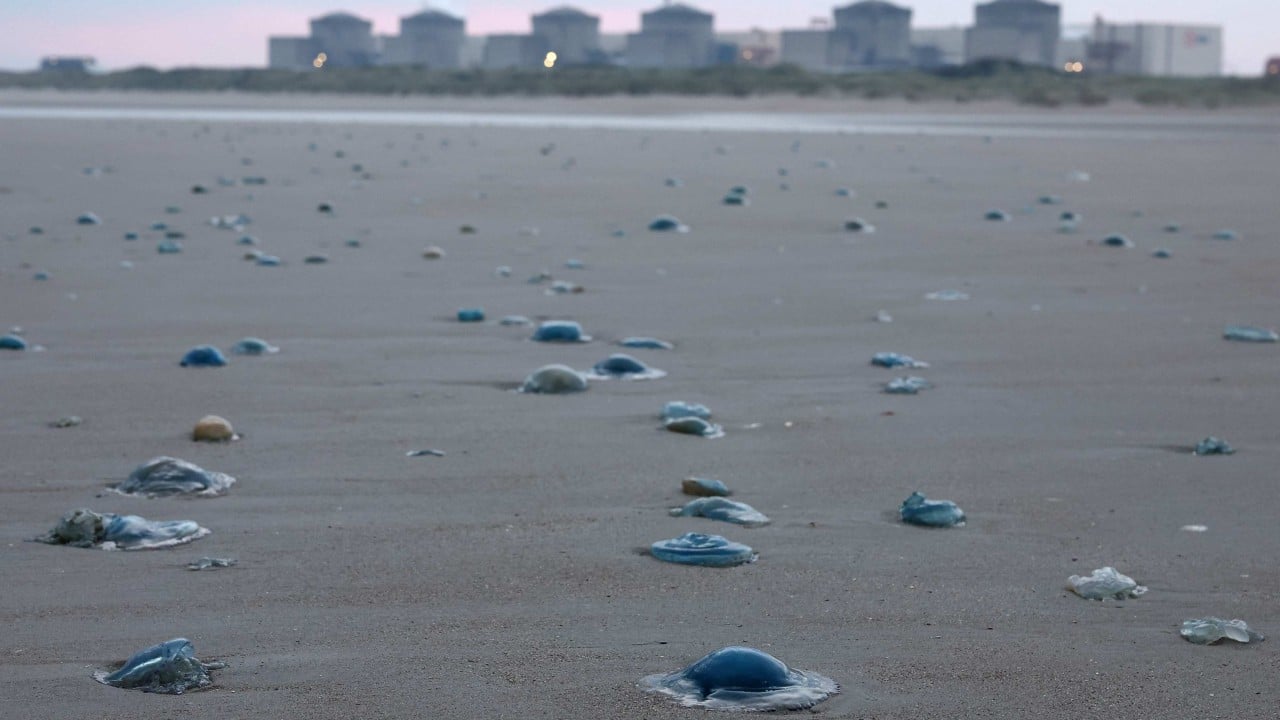
The cooling water of a nuclear station does not care about beauty. It only cares about temperature.
Day after day, millions of gallons of the Atlantic Ocean or a nearby river are pulled through massive intake tunnels to swallow the colossal waste heat generated by splitting atoms. It is a violent, mechanical necessity. A turbine spins. A generator hums. Power floods the grid to light kitchens, charge phones, and run hospitals miles away.
Then, the ocean answers back.
Sometimes, the answer arrives not as a hurricane or a rogue wave, but as a gelatinous ghost.
Imagine standing on the concrete apron of the Paluel nuclear power plant in northern France. The wind smells of salt and iodine. The concrete is stained with decades of sea spray. Below the surface of the channel, things are changing. They are drifting. Thousands upon thousands of translucent, pulsing bells begin to crowd the intake screens.
They are moon jellyfish. Individually, they are fragile, harmless pools of seawater held together by a thin, rhythmic heartbeat. But millions of them together represent an immovable mass.
Silence is terrifying in an engineering control room.
Jean-Luc knows this silence well. He has spent thirty years watching dials that measure the pulse of reactors. He is a hypothetical operator, yes, but he is modeled on every shift supervisor who has ever watched an anomalous spike on a monitor and felt the cold drop in their stomach.
"Flow rate is dropping on Unit Three," a voice calls out from across the floor.
Jean-Luc doesn't look up immediately. He taps a pencil against a grease-stained logbook. "Is it a valve?"
"No. Condenser intake."
Within minutes, the data clarifies into an absurdity. The sea has clogged the throat of the giant. The intake filters, designed to catch seaweed and debris, are choked with a thick, pulsating soup of marine life. The pressure sensors scream. If the cooling water stops, the uranium core inside the reactor retains its deadly, residual decay heat. It is a physics problem with no margin for error.
Automatic protection systems kick in. They do not wait for human permission.
Clang.
Control rods drop into the core. The fission chain reaction halts. Silence falls over the turbines as steam pressure bleeds away. Three reactors go dark simultaneously at Paluel.
Millions of kilowatts vanish from the French grid in an instant.
How did this happen?
To understand why a creature with no brain, no bones, and no blood can bring a multi-billion-dollar technological titan to its knees, we have to look at the intersection of human engineering and marine biology. We built our civilization on the edges of the water. We draw cool life from the sea, and we pump it back warmer, richer in nutrients, and altered.
Jellyfish blooms are not random accidents. They are ecological feedback loops. When overfishing removes their natural predators, like tuna and sea turtles, and agricultural runoff pumps nitrogen into coastal waters, jellyfish thrive. They multiply in exponential bursts. They do not fight the currents; they ride them. And when a dense swarm drifts near the coast, the massive suction pumps of coastal power plants act like an irresistible magnet.
At Paluel, the sheer volume of the bloom overwhelmed the mechanical clearing systems. The rotating drum screens, built to scoop away ordinary ocean debris, simply packed solid. The jellyfish ruptured under the pressure, forming a dense, rubbery paste that plastered against the mesh. Water could not pass.
The plant had no choice. It surrendered.
We tend to view technology as absolute. We build steel containment domes three feet thick to withstand earthquakes, airplane impacts, and the passage of centuries. We calculate stresses to the decimal point. We model thermal fatigue, neutron embrittlement, and seismic fault lines.
Yet, we remain vulnerable to creatures that have existed for five hundred million years without changing their basic design.
Think about the irony. We split the atom, capturing the fundamental energy of the cosmos, only to be outmaneuvered by a bag of ocean water.
When the news broke across France, the headlines focused on the grid vulnerability and the sudden loss of generation capacity. Engineers scrambled. Divers were sent down into the murky, swirling mass of the intake channels to manually clear the blockage with high-pressure hoses, working blind in freezing water surrounded by millions of stinging tentacles.
It is humbling work.
We forget that we are just guests on a planet governed by biological systems far older and more resilient than our machines. Nuclear power plants require massive, continuous sources of cooling water, which permanently binds our most advanced energy infrastructure to the whims of the tides, the health of the oceans, and the strange migrations of marine life.
As climate change warms coastal waters, these biological blooms are happening earlier, lasting longer, and growing denser. The sea is shifting. Our infrastructure must adapt or break.
Back in the control room at Paluel, the lights remain on, powered by backup grids and neighboring stations that picked up the slack. Jean-Luc wipes coffee from the edge of his console. The crisis has passed for today. The reactors are cooling safely, locked in their heavy steel tombs, waiting for the green light to restart.
Outside, the tide turns. The water laps gently against the gray concrete, hiding what floats just beneath the surface, waiting for the next intake cycle.


