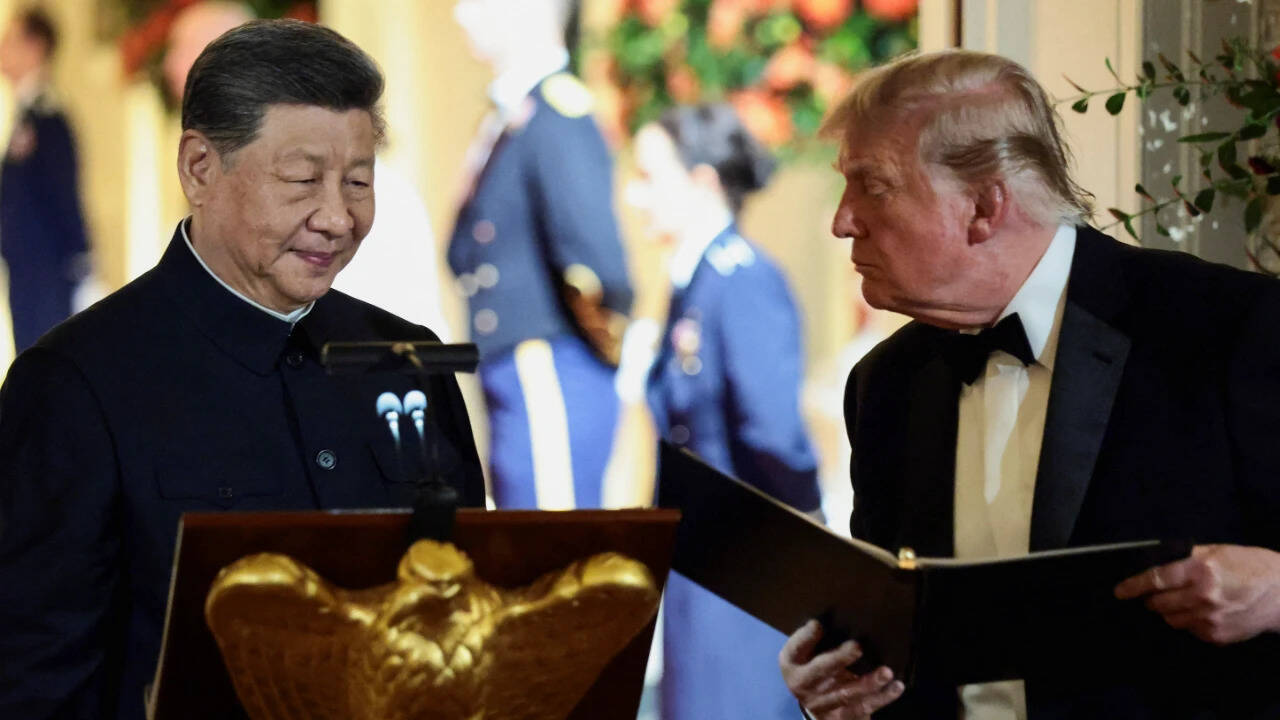
Silver chandeliers caught the warm, amber glow of a ballroom heavy with history, casting long shadows across tables laden with crystal and fine china. Outside, the autumn air of Washington carried the chill of an approaching winter. Inside, the atmosphere was thick with the scent of roasted meats, expensive wine, and the unmistakable aroma of cautious diplomacy.
Two men sat near the center of the room. One wore the red tie of a familiar American presidency, his shoulders squared against the weight of a restless nation. The other wore the dark, tailored suit of a global superpower, his expression carefully neutral, revealing nothing of the vast machinery he commanded across the Pacific.
Between them sat a menu of diplomacy, seasoned with pandas, eagles, and the quiet, heavy hum of artificial intelligence.
History is rarely made in the blinding flash of a battlefield. More often, it happens over poached salmon and polite applause. When Donald Trump hosted Xi Jinping for a high-stakes state dinner, the cameras captured the smiles, the handshakes, and the theatrical pageantry designed for the evening news. Yet, beneath the polished veneer of silverware and toasts lay a profound tension. Two titans were sizing each other up, measuring the future of the world in kilobytes, tariffs, and territorial lines.
Consider what happens when the cameras turn off.
In rooms like these, the language shifts. The grand pronouncements meant for domestic audiences give way to the transactional reality of modern empire. On the table were not just diplomatic niceties, but the invisible architecture of the twenty-first century. Semiconductors. Rare earth minerals. Algorithms capable of shifting the balance of global power before a diplomat can pour a second cup of coffee.
To understand why a dinner between two leaders matters to a person sitting in a quiet kitchen thousands of miles away, you have to look past the political theater. You have to look at the wiring of our daily lives.
Every smartphone in our pockets, every automated supply chain moving goods across oceans, and every algorithmic forecast dictating market trends rests upon the fragile truce between Washington and Beijing. When these two nations lock horns, the shockwaves travel outward, rattling factories in Shenzhen, software firms in Silicon Valley, and grocery prices in suburban Ohio.
The state dinner was a masterclass in the delicate art of coexistence. For years, the narrative surrounding the United States and China has been one of inevitable collision—a modern-day Thucydides Trap where a rising power and an established hegemon march inexorably toward conflict. But the reality is far more nuanced, and frankly, far more precarious. It is not a war of armies, but a war of momentum.
Think of it as two massive cargo ships navigating a narrow, fog-shrouded channel. They are not trying to ram each other; neither captain wants to sink his own vessel. But they are testing how close they can sail without scraping paint. Every trade restriction is a nudge of the rudder. Every technological sanction is a warning blast of the horn.
During that evening, amidst the clinking of glasses and the diplomatic pleasantries, the conversation inevitably drifted toward the frontier that neither nation fully understands or controls: artificial intelligence.
Long gone are the days when superpower competition was measured solely in nuclear warheads and aircraft carriers. Today, the ultimate high ground is cognitive. The nation that masters autonomous systems, quantum computing, and advanced machine learning will write the rules for the rest of the planet.
Imagine sitting across from a rival who controls the supply chains for the very silicon chips your own tech sector relies upon. Imagine knowing that the software powering your financial markets could theoretically be crippled by a line of code written half a world away. That was the invisible tension hanging over the dessert course.
Xi Jinping knows that China's economic engine needs global markets to keep running, especially as domestic growth faces headwinds. Trump knows that American economic nationalism strikes a powerful chord with voters who watched their factory jobs vanish overseas. Both men are constrained by their domestic audiences, yet both recognize the terrifying cost of total economic decoupling.
So they smile. They talk about pandas as symbols of enduring cultural exchange. They invoke the majesty of the bald eagle. They offer vague commitments to communication and stability.
And then they go back to their respective corners to plot their next move.
This is the strange reality of our modern era. We live in a world knit tightly together by fiber-optic cables and global trade, yet governed by ancient tribal instincts. We rely on factories in nations we distrust to build the devices we cannot live without. We preach self-reliance while checking our imports every morning.
The ordinary citizen feels this disconnect without always having the words for it. You see it in the fluctuation of interest rates, the shifting availability of consumer goods, and the low-level hum of anxiety about where the world is heading. We are passengers on a high-speed train operated by two conductors who disagree on the destination, yet share the same track.
When the dinner ended and the motorcades rolled away into the Washington night, the grand architecture of global politics remained unchanged. No treaties solved the deep structural divides of our time in a single evening. No magical compromise erased decades of suspicion.
Yet, the dinner itself was the point.
Dialogue, even when masked in performance and guarded by skepticism, keeps the channel open. It is the friction that prevents a fire. As long as leaders are breaking bread across a table, they are not pushing buttons across a map.
The story of our century will not be decided by a single banquet, nor by a clever political soundbite. It will be forged in the day-to-day grind of negotiation, adaptation, and survival.
The chandeliers have long since been dimmed in that grand ballroom. The leftover wine has been poured away. But the conversation—stretching across continents, coded in algorithms, and carried on the fragile wings of diplomacy—continues, echoing quietly in the dark.