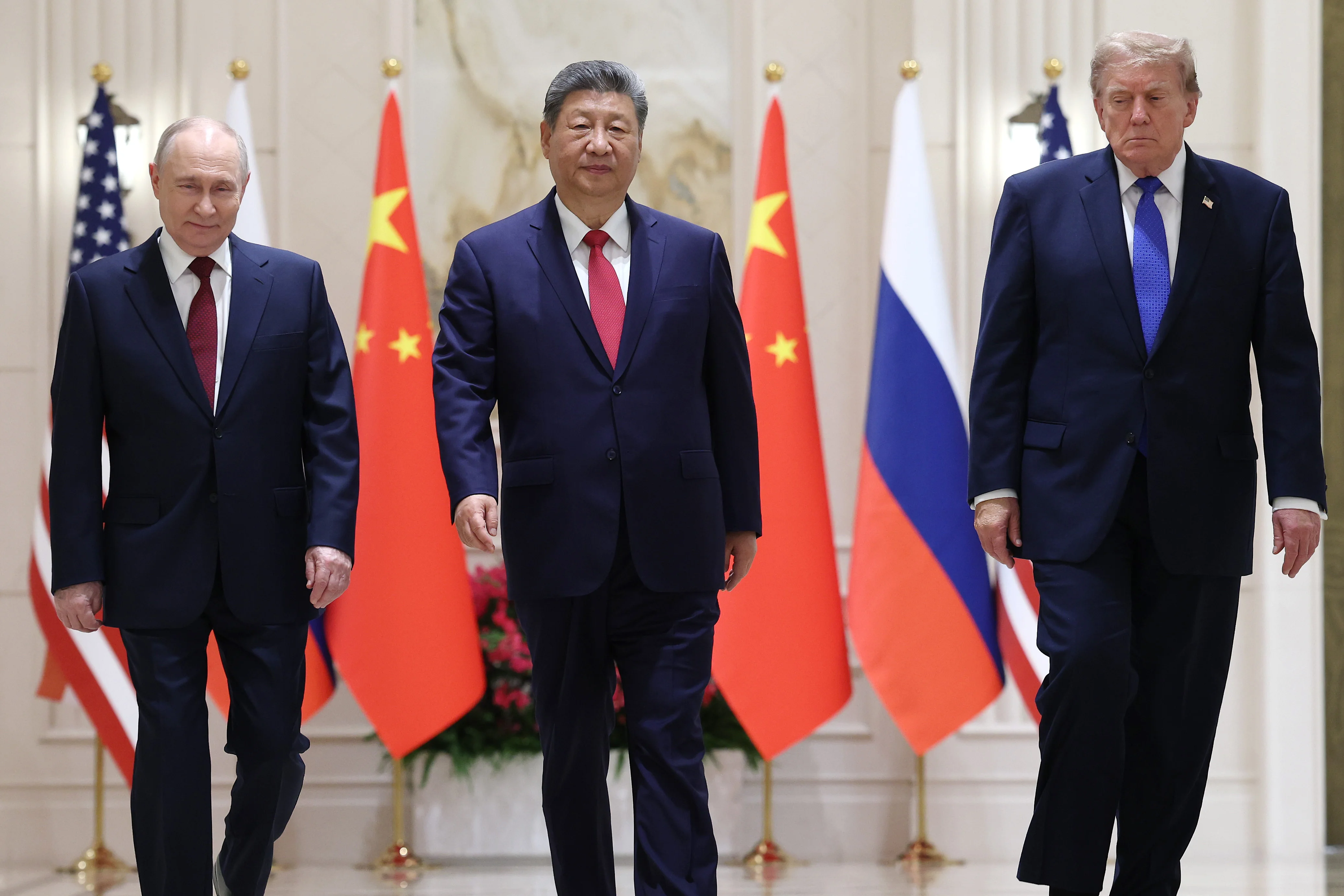
The porcelain teacups do not rattle when a superpower shifts its weight. There is no thunderclap when trade routes redraw themselves across the Pacific, and no siren wails when three men sit down across a polished mahogany table in Beijing to decide what the next decade will cost a baker in Ohio, a dockworker in Rotterdam, or a software engineer in Shenzhen.
Silence. That is the actual sound of history turning on its hinge.
According to official state media releases from Beijing, Washington, and Moscow, Xi Jinping, Donald Trump, and Vladimir Putin have convened in China for a trilateral summit without modern precedent. The diplomatic communiqués are sterile, sanitized paragraphs about bilateral frameworks, strategic stability, and mutual economic interests. Standard wire reports treat the gathering like a high-stakes chess match—a cold calculation of tariffs, territorial buffers, and energy pipelines.
They miss the point entirely. Geopolitics is never really about maps. It is about the grocery bill.
The Invisible Thread Between Beijing and Your Kitchen Table
To understand why a closed-door meeting between the leaders of China, the United States, and Russia matters to people who will never step inside the Great Hall of the People, we need to step away from the podiums and look at a hypothetical family. Call them the Millers, living in a mid-sized manufacturing town outside Toledo, Ohio.
Sarah Miller manages logistics for a regional auto-parts supplier. Her husband, David, teaches high school history. Neither of them follows the daily fluctuations of the Shanghai Composite Index, nor do they read translated transcripts from the Kremlin. Yet every single morning, their lives are dictated by the invisible architecture built by the three men currently sitting in Beijing.
When Donald Trump threatens sweeping tariffs on Chinese imports, that policy does not stay trapped in a diplomatic briefing book. It travels across the ocean, lands on Sarah’s desk as a thirty percent spike in the cost of stamped steel components, and forces her to choose between freezing wages or cutting shifts. When Vladimir Putin restricts natural gas flows or redirects Russian crude toward Asian refineries, the ripple hits global energy markets, showing up six weeks later as an extra forty dollars on David’s winter heating bill. When Xi Jinping tightens export controls on rare earth minerals—the microscopic elements required to make everything from smartphone screens to electric vehicle batteries—the supply chain tightens like a fist.
Think of the global economy not as a machine, but as a pressurized plumbing system spanning every continent. Beijing, Washington, and Moscow hold the three largest main valves. For thirty years after the Cold War ended, the unspoken rule was that those valves stayed mostly open, allowing cheap goods, capital, and energy to flow freely. Now, those hands are gripping the iron wheels, ready to twist.
Ghosts of Yalta in a Digital Age
History rarely repeats itself, though it certainly borrows the same furniture. The last time three leaders of comparable global reach sat together to divide spheres of influence, it was February 1945 in the Livadia Palace in Yalta. Franklin D. Roosevelt, Winston Churchill, and Joseph Stalin carved up post-war Europe over cigarettes and brandy, drawing lines on paper that kept families separated by concrete walls for nearly half a century.
The Beijing summit carries that same heavy, unmistakable scent of great-power realism, yet the terrain has mutated beyond anything Stalin or Roosevelt could have imagined. Back then, power was measured in tank divisions, steel tonnage, and square miles of conquered soil. Today, the battlefield is invisible. It runs through undersea fiber-optic cables, semiconductor fabrication plants in Taiwan, sovereign debt holdings, and the algorithms that decide what millions of teenagers watch before they fall asleep.
I remember standing on the docks in Busan, South Korea, a few years ago during a sudden maritime shipping bottleneck. Thousands of steel containers sat stacked six stories high under a bruised, overcast sky, motionless as tombstones. The port was dead quiet. No cranes moved. No diesel engines idled. Inside those metal boxes were winter coats that wouldn't reach Chicago until April, medical sensors destined for hospitals in Munich, and lithium batteries waiting for assembly lines in Nagoya. Watching that stillness taught me a visceral lesson that no international relations textbook ever captures: modern civilization is remarkably fragile. We have built an intricate, hyper-efficient world with almost zero margin for error.
When Xi, Trump, and Putin enter the same room, they are testing just how much strain that system can bear before the pipes burst.
What Each Leader Brings to the Table
Diplomatic analysts at institutions like the Council on Foreign Relations and the Carnegie Endowment for International Peace point out that this trilateral dynamic is defined by competing insecurities masked as strength. None of these men arrived in China holding an invincible hand.
Donald Trump arrives operating on a transactional worldview that treats alliances as business contracts and trade deficits as personal insults. His political survival and historical legacy rest on delivering tangible economic wins for an American working class tired of watching factories shutter while foreign competitors prosper. To Trump, tariffs are both shield and sword—a way to force manufacturing back to American soil while extracting concessions from rivals who rely on access to the American consumer market. Yet his dilemma is acute: push too hard on trade barriers, and inflation roars back to life at home, punishing the very voters who put him in office.
Xi Jinping plays host from a position of immense industrial might shadowed by deep structural anxiety. China manufactures nearly a third of the world’s physical goods, dominating solar panels, electric vehicles, and shipbuilding. At the same time, Xi presides over an aging population, a bruised domestic property market, and youth unemployment numbers that have forced Beijing to rethink its entire growth model. China needs foreign markets to absorb its massive industrial output. A full-scale economic divorce from the West is a price Beijing cannot easily afford, even as Xi refuses to bow to American demands on technology transfers or regional security in the South China Sea.
Vladimir Putin enters the room as the disruptor, leaning heavily on resource leverage and geopolitical patience. Sanctioned by Western capitals following the war in Ukraine, Moscow has pivoted aggressively toward Beijing, selling discounted oil, gas, and grain while buying Chinese electronics and industrial machinery. Putin’s strategic goal is straightforward: fracture Western unity, weaken the dominance of the U.S. dollar in global trade, and prove that Russia remains an indispensable pole in a multipolar world. For Putin, friction between Washington and Beijing is oxygen. Every argument between Trump and Xi buys Moscow more breathing room.
The Cost of Misreading the Room
It is tempting to view these summits as choreographed theater, and much of what happens in front of the cameras certainly is. Handshakes are timed to the second. Flags are arranged to project strict parity. Translators murmur into earpieces while photographers capture expressions designed for domestic news broadcasts.
But behind the heavy wooden doors, when the press corps is ushered out and the notebooks close, human psychology takes over. History is full of moments where leaders misread one another’s red lines because they projected their own logic onto an adversary. Nikita Khrushchev thought John F. Kennedy was weak after their tense meeting in Vienna in 1961, a miscalculation that led directly to placing nuclear missiles in Cuba sixteen months later.
We have to be honest about how unsettling this moment truly is. No intelligence agency in Washington, no ministry in Beijing, and no strategist in Moscow knows with certainty where the guardrails sit anymore. The old rules of engagement—arms control treaties, predictable trade dispute mechanisms, quiet backchannel diplomacy—have largely eroded. In their place stands raw personal diplomacy, where the chemistry, ego, and instincts of three aging men carry more weight than entire departments of seasoned diplomats.
Consider what happens next if the talks stall. Suppose Trump walks away convinced that Xi is stalling on currency and market access, and immediately signs executive orders imposing sixty percent duties across the board. Within forty-eight hours, Beijing retaliates by halting shipments of processed gallium and germanium—minerals essential for defense contractors and tech giants alike. Moscow, seizing the opening, announces new joint energy and security corridors with Beijing priced entirely in yuan and rubles.
Back in Toledo, Sarah Miller gets an email on a Tuesday morning telling her that three major client orders have been suspended indefinitely. That evening, David looks at their retirement account statement and sees four years of steady gains erased in forty-eight hours of panic selling on Wall Street. Nobody fired a shot. Nobody declared war. Yet the damage is immediate, personal, and deeply felt.
A Different Kind of Truce
Now flip the script. What if self-interest forces a pragmatic, messy compromise?
Great powers do not need to like each other to cut a deal; they only need to fear the alternative more than the concession. Richard Nixon and Mao Zedong shared zero ideological common ground when they met in Beijing in 1972, yet mutual fear of the Soviet Union drove them to reshape the twentieth century in a single week.
A realistic breakthrough at this summit will not look like world peace. There will be no grand declarations of universal harmony, no sudden dismantling of military bases, and no miraculous overnight reconciliation on human rights or territorial claims. Instead, success would look deliberately unglamorous: a managed truce.
It would mean Washington agreeing to pause new tariff escalations in exchange for verifiable Chinese purchases of American agricultural and energy exports, alongside strict enforcement against the export of fentanyl precursors. It would mean establishing clear, automated military hotlines between U.S. and Chinese naval commanders in the Pacific so a collision between two patrol boats doesn't spiral into an accidental war. And it would require hard, uncomfortable negotiations around a frozen ceasefire framework in Eastern Europe that halts the daily slaughter while keeping NATO security guarantees intact.
None of these outcomes would satisfy purists in any capital. Hawks in Washington would call it appeasement. Nationalists in Beijing would whisper about bowing to pressure. Hardliners in Moscow would resent any limit on their regional ambitions. Yet statecraft has never been about purity. It is the art of choosing the least terrible option in a room full of bad ones.
The Quiet Before the Bill Arrives
Right now, inside a guarded compound in China, translators are converting English, Mandarin, and Russian into careful, measured sentences. Outside, Beijing’s traffic hums along the Chang'an Avenue, millions of commuters staring at glowing phone screens, entirely unaware of the exact words being spoken a few hundred yards away.
Thousands of miles across the Pacific, night is falling over Ohio. Sarah Miller is packing lunches for tomorrow while David grades papers at the dining room table, the hum of the refrigerator filling the quiet kitchen. They do not know the names of the deputy trade ministers drafting memos in Beijing tonight, and they will never read the classified cables summarizing the afternoon session.
Tomorrow morning, they will wake up, turn on the coffee maker, and check the news on their phones before heading to work—waiting, like the rest of us, to find out what three men decided their lives will cost.