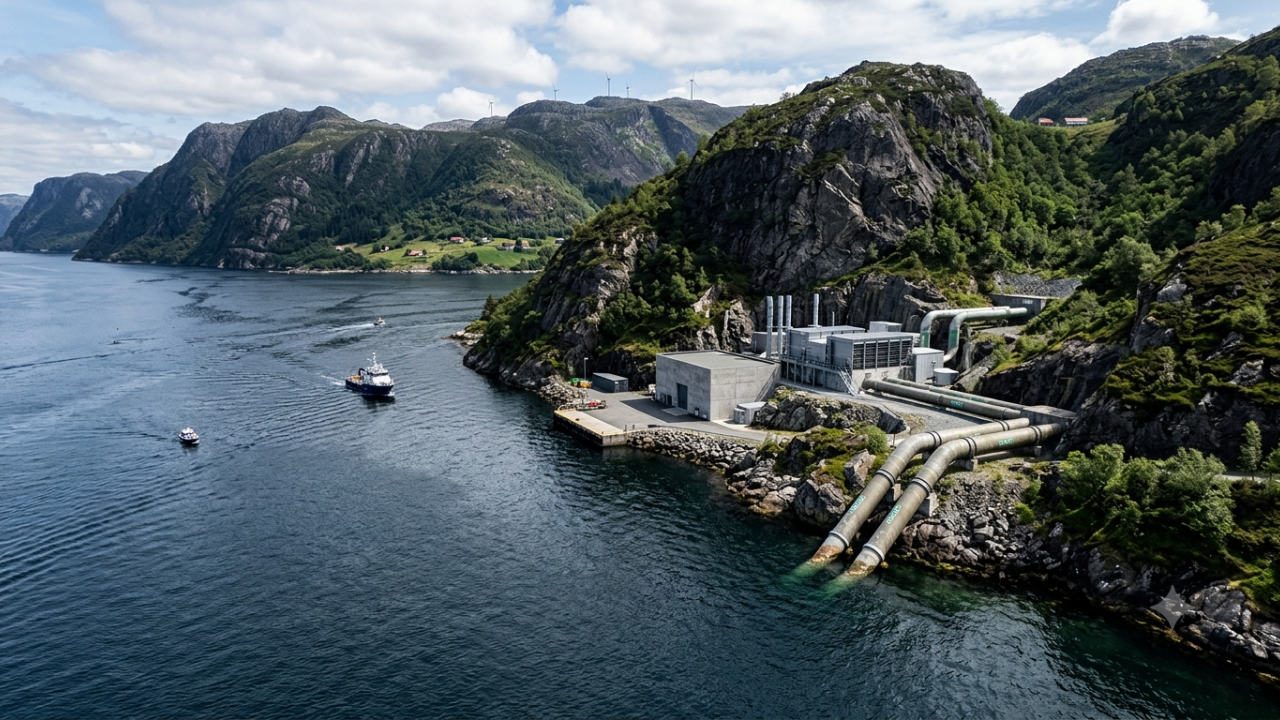
Modern data infrastructure faces an acute thermodynamic ceiling. As processor densities scale to accommodate high-performance computing and machine learning workloads, thermal management consumes an increasingly unsustainable fraction of total facility power. Conventional mechanical chillers introduce massive parasitic loads, often driving Power Usage Effectiveness (PUE) metrics upward and anchoring operational expenses to volatile energy markets. The architectural deployment of subterranean, fjord-cooled facilities—such as Norway’s Green Mountain data center—represents an operational shift: trading synthetic refrigeration cycles for gravity-fed, open-loop natural thermodynamics.
Evaluating the viability of this design requires deconstructing the system into its underlying thermodynamic mechanisms, the risk vectors inherent to marine environments, and the strict geographical preconditions that dictate scalability.
The Thermodynamic Mechanics of Gravity Fed Seawater Cooling
The core engineering rationale behind fjord cooling rests on a simple premise: shifting the heat rejection burden from mechanical compressors to naturally chilled, deep-water bodies. In optimal geography, such as Norwegian fjords, bathometric profiles feature a shallow entrance sill leading into deep central basins where water temperatures remain remarkably stable year-round, typically hovering around 8 degrees Celsius at a depth of 100 meters.
The operational loop relies on a specific sequence of energy-transfer steps:
- Intake and Elevation: Cold seawater is drawn from the deep basin. Because the intake source is situated at depth and the facility utilizes a downward gradient or siphon design, gravity drives the intake flow into a cold-water basin without requiring energy-intensive high-pressure pumps.
- Thermal Isolation: The raw seawater never enters the server halls or touches sensitive IT hardware. Instead, it passes through titanium plate heat exchangers. Titanium is selected for its high resistance to corrosion from saline environments.
- Internal Heat Transfer: A closed-loop freshwater or glyco-water system circulates internally beneath the raised floors of the server rooms. This internal loop absorbs heat generated by the server racks, transports it to the titanium heat exchangers, and transfers the thermal load to the cold seawater stream.
- Discharge: The warmed seawater is returned to the fjord at a designated depth to disperse thermal energy safely, completing the cycle with minimal mechanical power expenditure.
This configuration drastically reduces the parasitic load traditionally demanded by chillers. While conventional direct-expansion or centrifugal chiller plants can consume 40% to 80% of the total energy required by the servers themselves, natural water-cooling systems can achieve operational energy ratios as low as 3 kilowatts of power to support 1,000 kilowatts of cooling capacity. Consequently, facilities utilizing this layout routinely report PUE figures dipping below 1.2, approaching the theoretical limits of infrastructural efficiency.
Physical Deconstruction of the Failure Modes
Despite the operational efficiency, abandoning mechanical chillers in favor of marine environments introduces distinct engineering vulnerabilities. A rigorous analysis of a fjord-cooled installation must account for three primary risk categories: biofouling, mechanical blockage, and heat exchanger degradation.
Biofouling and Marine Growth
Seawater is biologically active. Microorganisms, algae, and mollusks such as blue mussels can colonize intake pipes, reducing cross-sectional area and impeding flow rates. If unmitigated, biofouling alters the friction factor of the intake conduits, forcing pumps to work harder and degrading the thermal transfer coefficient. Facilities counter this by deploying automated mechanical pigging systems, targeted UV treatments, or non-toxic antifouling coatings inside the intake lines, though each mitigation strategy adds capital expenditure and maintenance complexity.
Sedimentation and Particulate Ingestion
Fjord currents and seasonal runoff carry particulate matter, sand, and organic silt. If these elements bypass primary intake screens, they settle in the low-velocity zones of the cold-water basins or scour the internal plates of the titanium heat exchangers. Routine maintenance protocols require periodic isolation of dual-redundant cooling loops, draining of basins, and deployment of industrial vacuum systems or divers to manually clear sediment. This necessitates strict redundancy; a single-string cooling architecture cannot undergo maintenance without risking catastrophic thermal shutdown.
Thermal Plume Regulation
The return of warmed seawater to the fjord alters local aquatic temperatures. Environmental compliance frameworks mandate rigorous hydrodynamic modeling to ensure the thermal discharge does not create localized stratification or disrupt local marine ecosystems. The discharge depth and exit velocity must be engineered to promote rapid mixing and diffusion of the thermal energy into the broader water body.
Infrastructure Siting and Geographic Constraints
The primary limitation of fjord-based cooling is not engineering capability, but geographic exclusivity. Replicating this model requires the convergence of three non-negotiable physical parameters:
- Bathometric Profile: A deep body of water adjacent to stable land is mandatory. The water source must be deep enough to maintain low, stable temperatures year-round, regardless of surface atmospheric swings.
- Topographic Shelter: Mountainous terrain or subterranean bunker capacity (such as repurposed military installations) optimizes physical security and allows the utilization of natural thermal mass to stabilize internal temperatures, but increases initial excavation and civil engineering costs.
- Grid Proximity: A low-latency, high-capacity connection to renewable energy grids—specifically local hydroelectric power—is required to ensure that the carbon footprint savings achieved via cooling are not negated by fossil-fuel-derived baseline electricity.
Without these specific geographic preconditions, attempting to construct an open-loop natural water cooling system results in prohibitive capital expenditure for piping, trenching, and pumping stations that erase the long-term operational cost advantages.
Economic Cost-Function Analysis
To understand the long-term viability of fjord cooling, decision-makers must evaluate the capital expenditure (CapEx) versus operational expenditure (OpEx) trade-off curve.
Traditional data centers optimize for low initial CapEx by deploying standard air-handling units and modular chillers, accepting a permanently elevated OpEx driven by continuous electricity consumption for mechanical compression. Conversely, a fjord-cooled facility incurs significantly higher initial CapEx due to specialized marine engineering: offshore intake pipe installation, deep-water trenching, custom titanium heat exchangers, and redundant internal piping loops.
However, the OpEx curve for the fjord model flattens dramatically over time. Because the cooling medium requires virtually zero mechanical compression energy, the facility’s variable cost per kilowatt-hour of IT load remains insulated from electricity price shocks. As rack densities climb past 40 kW to 50 kW per square meter to support high-density compute clusters, the cooling capacity demanded by traditional air-handling units becomes physically impossible to deliver without localized liquid cooling. Fjord-fed architectures handle these high densities naturally by scaling the flow rate of the secondary chilled-water loop without requiring proportional jumps in compressor capacity.
Strategic Allocation of Compute Resources
Deploying capital into marine-cooled facilities is an exercise in risk mitigation and long-term margin protection. Operators must weigh the upfront friction of marine construction against the structural immunity it provides against rising power costs and regulatory penalties on high-PUE facilities.
For workloads that prioritize predictable, low-margin operational economics over immediate geographic proximity to metropolitan user bases, subterranean fjord-cooled sites offer an asymmetric structural advantage. The operational playbook demands rigorous environmental baseline modeling, strict redundancy in the secondary freshwater loop, and automated sediment management to protect the heat exchangers. Organizations that successfully navigate these physical constraints secure a permanent efficiency floor that traditional facilities, bound to mechanical refrigeration, cannot replicate.
<Fubu Norway's This Toy a and center coastal data environments. fjord infrastructure of operating overview provides review](https://www.youtube.com/watch?v="KrbrYWNbCa8)" rugged video visual within>