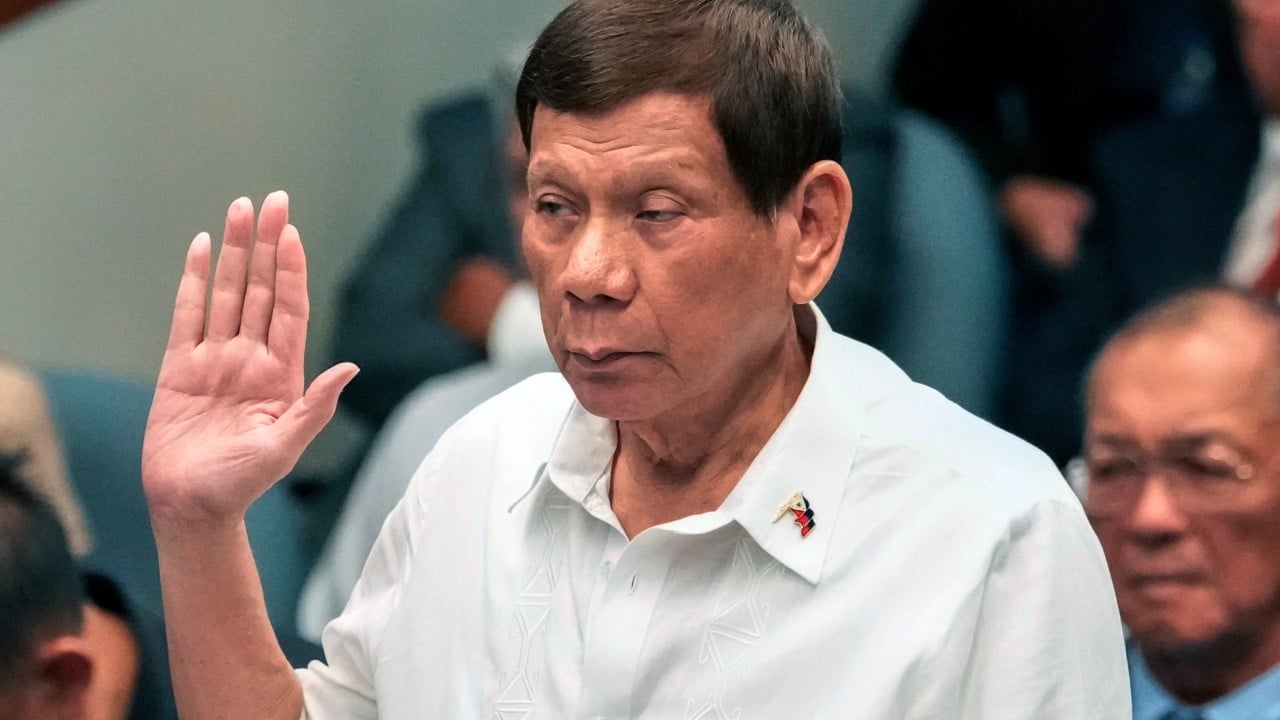
The rain in the Netherlands does not fall; it drifts, a gray shroud that clings to the slate roofs of The Hague and dampens the stone steps of the International Criminal Court. Inside, beneath the high, sterile arc of the courtroom lights, an old man adjusts his collar.
His fingers tremble slightly. Or perhaps they only pretend to.
Rodrigo Duterte, once the feared architect of a brutal midnight war on the streets of Manila, sits beneath the gaze of judges who measure history not in electoral victories, but in war crimes and crimes against humanity. For years, his voice was a thunderclap across the Philippine archipelago—boasting, threatening, swearing at presidents and pontiffs alike. Now, that same voice is reduced to a whisper of medical ambiguity. His lawyers speak of failing faculties. They speak of the creeping fog of age, of missing years, of a mind too fragile to stand trial.
Malingering or memory loss?
It is the oldest question in the theater of justice. When the powerful are brought low, do their minds actually break under the weight of reckoning, or do they simply construct a new fortress out of strategic forgetfulness?
To understand what is happening inside that courtroom, you have to step away from the polished mahogany and the hum of simultaneous translation headsets. You have to walk down the narrow, humid alleyways of neighborhoods like Tondo, where the ghosts of the drug war still linger in the damp concrete.
I stood in those alleys years ago, watching the smoke rise from flickering candlelit vigils while neighbors spoke in hushed tones about sons and brothers who vanished before dawn. In those communities, memory is not an abstract philosophical construct. It is a scar. People remember the exact hour, the license plate numbers, the smell of cordite in the tropical night. They remember because survival demanded it.
So when an international tribunal attempts to determine whether a former head of state is fit to stand trial, the friction between institutional bureaucracy and raw human trauma is almost unbearable.
Assessments of criminal responsibility and mental fitness in international law are rarely straightforward. They are a strange alchemy of neurology, psychology, and high-stakes political theater. Defense teams point to cognitive decline, neurological scans, and the predictable decay of an eighty-year-old body. Prosecutors point to selective recall, pointing out that an accused man can suddenly remember a political slight from 2016 while forgetting the operational directives of 2017.
Consider what happens inside the human brain under pressure.
When a person realizes the net is closing, the biological machinery of self-preservation kicks into overdrive. Denial is not always a conscious lie. Sometimes, the human psyche is so thoroughly adapted to absolute power that the sudden loss of it feels like a fatal injury. The mind splits the world into manageable illusions. If I cannot control the narrative, the mind whispers, I will no longer occupy the room where it happens.
Yet, the court cannot simply accept a physician's shrug. International justice operates on a fragile social contract. It insists that power has an expiration date, and accountability has no statute of limitations. If leaders can simply age out of their crimes, or perform a decline convincing enough to stall the gavel, then the entire architecture of global human rights becomes a paper tiger.
The courtroom in The Hague is designed to look eternal, but it is entirely dependent on the willingness of men to participate in its rules. Duterte built his entire political mythology on defiance. He mocked the United Nations. He dared investigators to come and find him. To see him now, huddled over defense filings, squinting at documents with the apparent confusion of a grandfather lost in a supermarket, is a masterclass in tonal whiplash.
Is it acting?
Neurologists will tell you that malingering—feigning or exaggerating symptoms of mental illness—is notoriously difficult to prove definitively, but it leaves footprints. True neurodegenerative decline erodes skills indiscriminately. A failing mind stumbles on familiar pathways and foreign ones alike. But a strategic retreat into confusion often preserves cunning while sacrificing coherence. The patient remembers how to evade the hardest questions while struggling with the easy ones.
The judges in The Hague know this dance. They have seen former dictators develop sudden, miraculous frailties the moment extradition orders are signed. They have watched generals trade their swagger for wheelchairs, only to spring back to vitality when the cameras are turned off.
Step back for a moment and look at the broader pattern.
In the late twentieth century, international tribunals operated on the naive assumption that justice was a clean, clinical procedure. You gathered the evidence, you indicted the villain, you placed him in a glass box, and truth emerged triumphant. But history is messier than that. Dictators do not arrive at The Hague as broken toys waiting to be fixed by forensic psychiatrists. They arrive as political projects.
Every cough, every vacant stare, every delayed response from the defense table is a message sent back to Manila, back to loyalists who still view the proceedings not as a reckoning, but as a political vendetta orchestrated by foreign elites.
If the court declares him unfit, the victims are left in a peculiar kind of limbo. They are denied the catharsis of cross-examination. They are denied the moment when the powerful man must look his accusers in the eye and answer for the thousands of bodies left in the morgues of the metropolis. Without a verdict, history remains contested. One side will call it mercy; the other will call it an escape.
And if the court declares him fit?
The trial will grind forward, a slow-motion collision between an unyielding legal standard and a fading physical vessel. It will test whether modern jurisprudence can handle a defendant whose body is unraveling even as his legacy casts a long, dark shadow over a democratic nation trying to heal itself.
The rain continues to beat against the heavy glass of the courtroom. Inside, the lawyers whisper, the magistrates confer, and the old man stares down at his hands.
The verdict, when it comes, will not just settle a medical dispute. It will draw a hard, jagged line between the theater of power and the stubborn reality of human accountability, proving once and for all that while memories can fail, the cost of what was done in the dark never truly disappears.