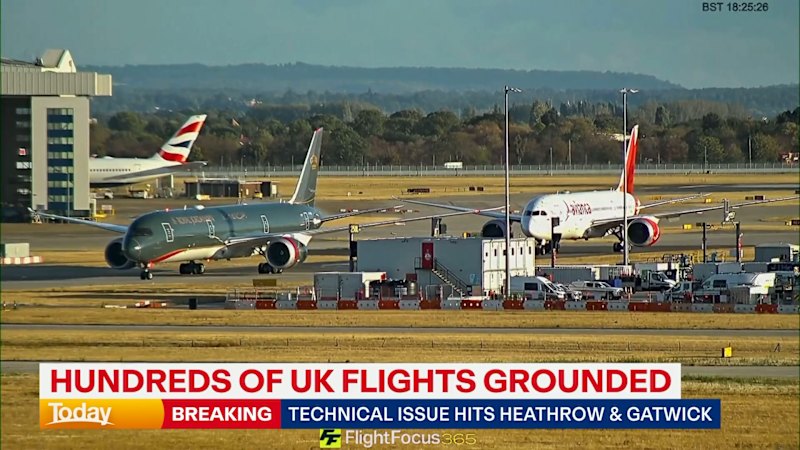
The coffee in Terminal 5 was lukewarm, tasting faintly of cardboard and expensive desperation. Outside the floor-to-ceiling glass, the gray London drizzle smeared against the tarmac, blurring the runway lights into smeared orange smears. Arthur adjusted the strap of his briefcase. It held three proposals, a worn passport, and a promise he had made to his daughter: I will be home for your birthday candle blowing.
Then the departure board blinked.
Not with a friendly green update. Not with a reassuring delay of twenty minutes. Instead, a silent, synchronized wave of red sliced across the monitors. Dozens of flights. Hundreds of flights. A sprawling network of metal and human ambition suddenly frozen by an invisible administrative and technological phantom.
We forget that aviation is not just an industry of engines and lift coefficients. It is an intricate, gossamer-thin choreography of timing. Every second matters. Every air traffic controller, every transponder ping, every pre-flight checklist forms a fragile chain holding together a world that has grown accustomed to breakfast in Manchester and dinner in Madrid. When that chain snaps, the noise doesn't roar. It hushes.
Consider what happens next in the quiet hours after a mass grounding.
The initial shock gives way to a peculiar kind of human stasis. Thousands of travelers realize simultaneously that their plans have dissolved into thin air. Business meetings evaporate. Family reunions turn into pixelated video calls over spotty airport Wi-Fi. Honeymoons stall before they begin. The economic cost is staggering, measured in millions of pounds of lost productivity, stranded cargo, and emergency hotel vouchers. Yet the immediate currency spent is patience, and the account is permanently overdrawn.
Arthur watched an elderly couple two rows ahead of him. They didn't shout. They didn't curse at the gate agent whose badge read Sarah, whose eyes were already rimmed with the exhaustion of delivering bad news for five straight hours. They simply sat down on their carry-on bags, opened a tin of shortbread, and stared into the middle distance.
This is the hidden cost of our hyper-connected convenience. We build systems so vast, so blindingly efficient when they work, that we completely lose sight of their fragility. A single software glitch, a localized radar failure, or a cascading scheduling bottleneck can paralyze an entire nation's airspace. The UK airspace, one of the busiest and most complex pieces of sky on the planet, operates on a razor-thin margin of error. When the margin vanishes, the chaos is absolute.
Let us look closer at the machinery behind the panic.
Air traffic management is often envisioned as men and women staring at glowing green radar scopes, barking coordinates like cinematic heroes. The reality is far more administrative, regulated, and vulnerable to systemic bottlenecks. Flight plans must cross-reference weather patterns, staffing rosters, airspace restrictions, and cross-border handovers. When a critical data feed stutters or a central computer system hiccups, the safety protocol demands only one response: freeze.
Safety is the ultimate anchor. No one wants a plane in the sky that shouldn't be there. Every grounded aircraft is, technically, a tragedy avoided. That is the cold comfort offered by airport authorities over the scratchy public address system. But try explaining abstract safety margins to a mother whose toddler is sleeping fitfully on a plastic chair, or to a surgeon whose transplant team is waiting across the channel.
The psychological toll of sudden immobility is strange. Modern humans are migration addicts. We measure our lives by motion, by the distance between our origins and our destinations. To be pinned to a specific floor tile in a concrete hangar somewhere near Heathrow or Gatwick is an unnatural state. It induces a primal claustrophobia. We are trapped not by walls, but by logistics.
Hours bled into one another. The departure board remained a graveyard of red text.
Arthur eventually gave up on his flight. He joined the snaking queue for customer service—a line that curved like a wounded serpent around the baggage carousel. People swapped rumors like medieval peasants whispering about a plague. One man claimed the entire computer network had been hit by a cyberattack. Another swore it was a localized power grid failure in Swanwick. The truth, as it usually is, was far more mundane and far more frustrating: a localized data processing error that cascaded through the flight planning software, rendering automated clearance impossible.
When he finally reached the desk, Sarah looked up. She looked younger than his daughter. Her voice was cracked, reduced to a dry rasp.
"I can get you on something by Thursday," she said.
Thursday. Today was Tuesday. His daughter's birthday was tonight.
Arthur looked at the ticket printer clicking quietly beside her hand. He looked past her shoulder at the rain still sheeting down against the idle wings of a Boeing 777. The steel beasts stood silent, monuments to human brilliance and human limitation, grounded by a ghost in the machine.
We build towers to touch the clouds, yet we remain entirely dependent on the invisible threads connecting them. When those threads snap, we are reminded of how small we really are, waiting in the terminal quiet for the world to start moving again.


