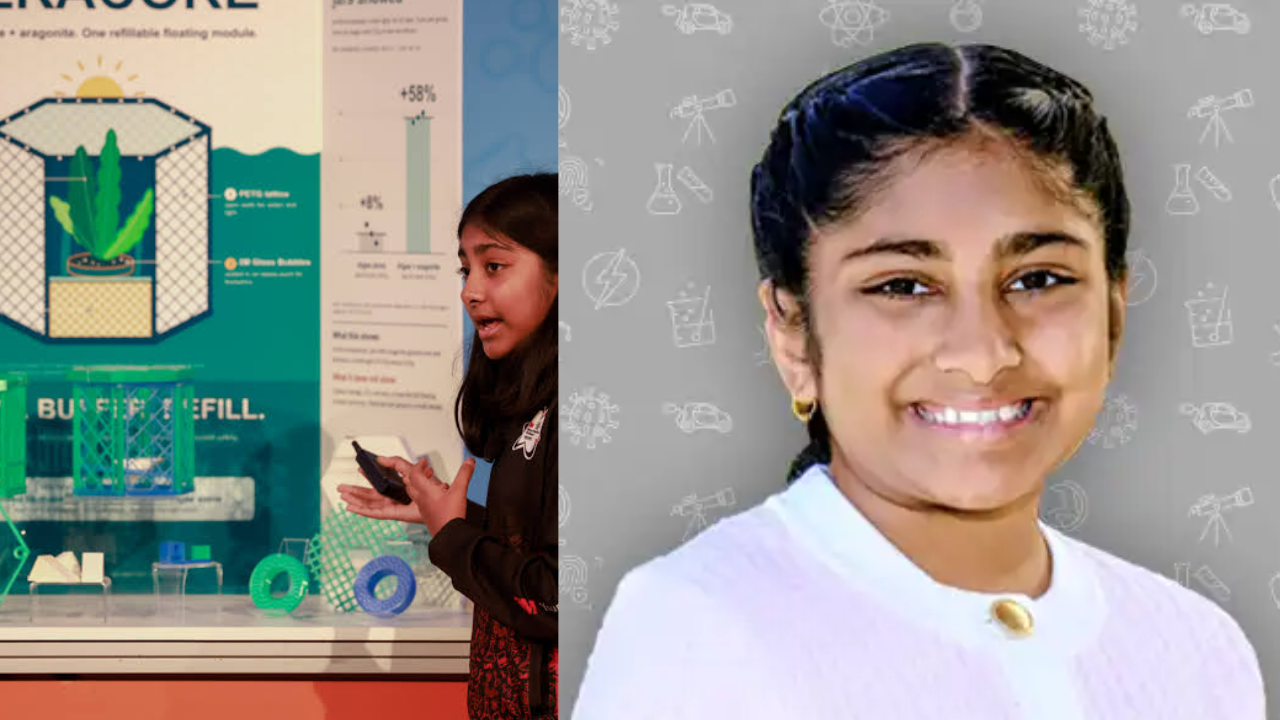
Twenty-five thousand dollars sounds like a lot of money until you try to buy a house, or pay a year of college tuition, or fund a medical laboratory for a single month.
Then again, if you are a teenager standing on a stage with a trophy that says you are America's Top Young Scientist for 2026, twenty-five thousand dollars feels like a rocket strapped to your back.
That is the headline version of Raji Doshi's story. It is neat. It is shiny. You can read it over morning coffee in forty seconds, nod at how smart kids are these days, and move on to whatever is burning on the stove.
I used to read stories like that the exact same way. For years, I covered science fairs, innovation awards, and youth competitions as a writer who secretly doubted whether anything real came out of them. Too often, those contests felt like polished theater—teenagers building neat little models that looked great in a press release and vanished into a closet by Thanksgiving. When a headline announces "America's Top Young Scientist 2026" and a $25,000 prize, my instinct has always been to ask: Okay, what is actually behind the curtain?
Sometimes, though, a teenager looks at something ordinary that adults have grown numb to, refuses to accept that "just the way it is" is a good enough answer, and builds something that changes the room.
The Quiet Weight of Invisible Problems
To understand why a young researcher's work matters beyond a press release, we have to talk about what happens in the spaces between big medical breakthroughs and everyday life.
Consider a hypothetical scenario. Picture a mid-sized community clinic on a humid Tuesday afternoon. The waiting room smells faintly of lemon disinfectant and damp coats. Behind the counter sits Maya, a nurse who has worked double shifts twice this week because two people called out sick. A father brings in his son, whose breathing sounds slightly too fast, slightly too tight. Maya does what nurses have done for decades: she checks vitals, listens closely, asks questions, and tries to read every subtle clue before deciding how urgently to escalate care.
Now step back from Maya's desk. Think about how many early warnings in health, environment, and daily safety go unnoticed not because nobody cares, but because the tools to catch them early are either too expensive, too slow, too bulky, or locked inside places ordinary people cannot reach.
That gap is where real scientific curiosity lives. Not in a sterile Hollywood lab with blue laser beams, but at a kitchen table or a school workbench where someone asks a stubborn, slightly inconvenient question: Why does this still work so poorly?
When a young person like Raji Doshi steps into that space, they do not bring a lifetime of institutional baggage. Adults carry assumptions like heavy backpacks. We know what has failed before. We know who holds the funding. We know how long regulatory approvals take, how messy data gets in the real world, and how easy it is to compromise.
Youth can be blind to those barriers—and sometimes that blindness is the sharpest lens in the room.
Why "Top Young Scientist" Is Both a Triumph and a Trap
Let's be honest about something confusing and a little uncomfortable.
When a student wins a major national title like America's Top Young Scientist, the spotlight turns up to blinding brightness. Suddenly, a kid who was just trying to solve a problem is treated like a finished prophet. People want miracles. They want instant commercialization, instant global scale, and neat answers to questions that took seasoned researchers twenty years to untangle.
I have watched that pressure crush good ideas before. It is a heavy burden to place on young shoulders.
Yet dismissing the recognition is just as lazy as worshiping it. Competitions that elevate young researchers exist for a reason. Historically, scientific progress has always depended on fresh eyes colliding with stubborn problems. Think about how many everyday tools—from better filtration systems to smarter diagnostic concepts—started when someone noticed a friction point that experts had learned to step around.
To make this concrete, imagine a metaphor. Suppose an entire town walks across a wooden footbridge every morning. One board near the middle has a faint crack. After ten years, everyone knows how to step slightly to the left without thinking about it. A visitor from out of town walks across, nearly trips on that exact spot, and asks, "Why is nobody fixing that board?"
The locals shrug. "Oh, that's just how the bridge is."
A curious mind does not shrug. It kneels down, inspects the wood, tests the weight, and asks what happens if the crack spreads.
The Human Cost of Waiting for "Someday"
When we read about a $25,000 prize, it is easy to treat money as the whole story. Look at the number. Twenty-five thousand dollars. It sounds tidy and final, like the end of a movie.
In reality, a grant or award like that is a bridge, not a destination.
Building a real solution—something tested, repeatable, honest about its flaws, and useful outside a display board—takes time that does not fit neatly into a school semester. It takes failed prototypes. It takes ordering parts that arrive late or do not fit right. It takes showing your work to mentors who poke holes in your favorite assumptions until only the strongest parts remain.
Here is where the human stakes become impossible to ignore. Behind every practical problem that young scientists tackle are real people living with real consequences right now. Not next decade. Not after three rounds of venture capital. Right now.
If a detection method is faster, a material is safer, a process is cleaner, or an assessment is more accessible, those improvements do not live on a spreadsheet. They show up as hours saved, risks reduced, or answers found before a small problem turns into a crisis.
Even when a project is still in its early stages—even when it needs years of refinement before reaching wide adoption—the act of pushing it forward sends a quiet signal to everyone else watching: This problem is worth solving.
Doubt, Friction, and the Messy Middle
I want to pause and admit something that rarely makes it into celebratory coverage.
Science in the real world is messy. It is slow. Half the time, your first hunch turns out to be half-wrong, and the other half of the time, you discover a complication you never thought to look for. If you are reading about Raji Doshi's win and wondering whether a single breakthrough fixes everything overnight, healthy skepticism is your friend. It rarely does.
Real progress usually happens in the unglamorous middle. It happens when a student goes back to the drawing board after a test fails. It happens when judges ask tough questions that expose a blind spot. It happens when a teenager has to explain complex mechanics in plain English so a non-specialist understands why it matters.
There is courage in that middle stretch. Anyone can celebrate a trophy. It takes grit to go back into the lab the next morning when the novelty wears off and the real work of verification begins.
Look at why stories like Raji Doshi's resonate so strongly with people who feel worn down by big, distant headlines. We spend so much time reading about massive institutions moving at glacial speed that seeing one determined young mind cut straight to the heart of a problem feels refreshing. It reminds us that agency still exists. You do not have to own a giant corporation or hold three doctoral degrees to notice a flaw and start building a better alternative.
What Happens When Curiosity Meets Conscience
There is a particular kind of intelligence that shows up when technical skill is paired with genuine empathy.
Anyone can chase cleverness. Cleverness builds flashy demos that impress people for five minutes and gather dust for five years. Empathy asks who gets left behind if a tool is too expensive, too complicated, or too narrow. Empathy asks who actually feels the pain of the problem every single day.
When a young scientist leads with that kind of awareness, the $25,000 award stops looking like a prize for trivia. It starts looking like fuel for responsibility.
Not every student who wins a national title will change the world on their first try, and pretending otherwise does nobody any favors. Some ideas evolve. Some pivot into something completely different. Some lay a foundation that someone else builds upon ten years later.
None of that diminishes what it takes to stand out among thousands of peers in 2026. To get there, you have to care enough to stay curious when quitting would be easier. You have to listen. You have to test. You have to stand behind your work when people ask hard questions.
Think back to that crowded waiting room, or to any everyday place where a small delay, a missed signal, or an outdated method creates quiet stress. Progress rarely arrives as a thunderclap. Most of the time, it starts with one person refusing to walk past the cracked board.
A spotlight on a teenager. A twenty-five-thousand-dollar check. A stubborn question that refuses to sit still.
Long after the applause fades and the cameras pack up, the real measure of the moment is simple: did someone look closer than the rest of us—and did the rest of us bother to pay attention?