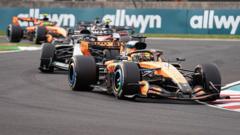
The 2026 Formula 1 technical regulations represent a fundamental shift from thermal efficiency dominance to a complex optimization problem involving energy harvesting, aerodynamic drag coefficients, and weight distribution. The FIA’s recent adjustments to these regulations are not merely "tweaks" but necessary corrections to prevent a performance bottleneck where cars lack the energy to maintain top speeds on long straights. By rebalancing the ratio of Internal Combustion Engine (ICE) output to Electrical Recovery System (ERS) deployment, the sport is attempting to maintain the "lap time DNA" of F1 while transitioning to a sustainable fuel and high-hybridization model.
The Tri-Component Power Architecture
The 2026 Power Unit (PU) removes the MGU-H (Motor Generator Unit - Heat), a component that previously converted exhaust heat into electricity. While technically brilliant, the MGU-H was prohibitively expensive and lacked road relevancy. Its removal creates a massive energy deficit that must be compensated for by the MGU-K (Motor Generator Unit - Kinetic). This shift establishes a new tripartite power structure:
- The Thermal Core: A 1.6-liter V6 turbo producing approximately 400kW (535hp). The reduction from the current ~550kW is a direct result of fuel flow restrictions and the move to 100% sustainable fuels.
- The Kinetic Reservoir: The MGU-K output triples from 120kW to 350kW (470hp). This creates a near 50/50 split between thermal and electrical power.
- The Energy Buffer: The battery must now sustain significantly higher discharge rates, requiring advanced cooling and chemical stability to prevent thermal runaway under the intensified duty cycle.
This 50/50 power split introduces the "clipping" risk. At high speeds, the aerodynamic drag increases with the square of velocity, requiring exponential power to overcome. If the battery depletes before the end of a straight, the car loses 470hp instantly, leading to a dangerous speed differential between cars with and without energy reserves.
Aerodynamic Compensation and the Drag-to-Power Ratio
To mitigate the power deficit, the FIA has introduced Active Aerodynamics (X-Mode and Z-Mode). This is a structural pivot from the current DRS (Drag Reduction System) which was a tactical overtaking tool. In 2026, active aero is a survival requirement for energy management.
- Z-Mode (High Downforce): Standard configuration for cornering, utilizing maximum wing angles to generate suction.
- X-Mode (Low Drag): Both front and rear wing elements flatten on straights to minimize the "wake" and air resistance.
The primary friction point identified by teams in early simulations was "aerodynamic imbalance." When only the rear wing opened, the car shifted its aero balance significantly toward the front, making the rear axle unstable at high speeds. The revised regulations now mandate a synchronized movement of front and rear elements to maintain a stable center of pressure. Without this synchronization, the cars would be undriveable in low-drag modes, particularly on tracks like Spa-Francorchamps or Monza.
The Physics of Energy Harvesting: The Braking Constraint
The increased reliance on the MGU-K creates a logistical challenge regarding "harvesting." To gather 350kW of energy, the car needs significant braking events. On tracks with long straights and few heavy braking zones, the car may never fully recharge its "energy store."
This creates a State of Charge (SoC) Bottleneck.
The mathematical reality is that 2026 cars will likely be slower at the end of a straight than they are at the midpoint. Current cars accelerate until the braking point. 2026 cars will likely hit a peak velocity, then decelerate as the ERS deployment is "de-rated" to protect the remaining battery charge for the next acceleration phase. To counter this, the FIA has adjusted the "Override Mode," allowing drivers to use extra energy up to 355km/h to facilitate overtaking, but this energy must be "borrowed" from the subsequent lap’s allocation.
Weight Distribution and the Chassis Penalty
The 2026 regulations mandate a shorter wheelbase (3400mm down from 3600mm) and a narrower width (1900mm down from 2000mm). The goal is a 30kg weight reduction. However, the increased weight of the electrical components—specifically the larger battery and more robust MGU-K—creates a weight distribution paradox.
- Component Mass: The PU is heavier, yet the car must be lighter.
- Structural Integrity: Smaller dimensions reduce the floor area available for "ground effect" downforce, forcing teams to rely more on the wings, which increases drag—the very thing they are trying to avoid.
The technical revisions have sought to loosen the constraints on floor geometry to ensure that the cars do not lose too much "clean" downforce. If the floor is too restricted, teams revert to "dirty" downforce (large wings), which destroys the ability for cars to follow closely, nullifying the primary goal of the 2022-era aero philosophy.
The Sustainable Fuel Variable: Stoichiometric Realities
The move to 100% sustainable fuels is not a one-to-one swap for current high-octane petroleum. These fuels have different energy densities and combustion characteristics. The ICE must be redesigned to handle different "knock" limits and flame speeds.
The "Overnight Development Lock" has been a point of contention. To prevent a spending war, the FIA is strictly limiting the number of dyno hours and computational fluid dynamics (CFD) iterations. However, new entrants like Audi and Red Bull-Ford face a steep learning curve compared to incumbents like Ferrari and Mercedes, who have a decade of hybrid data. The recent regulatory updates have provided "catch-up" provisions, allowing newer manufacturers slightly more flexibility in testing to ensure a competitive grid in 2026.
Strategic Mapping of Competitive Tiers
The 2026 ruleset will likely bifurcate the grid based on three specific technical competencies:
- Thermal Efficiency Leaders: Those who can extract the most work from the limited fuel flow will have a higher "baseline" power, making them less dependent on ERS.
- Energy Management Software: The "brain" of the car that decides exactly when to deploy the 350kW. A sub-optimal deployment map will lead to "clipping" and defenselessness on straights.
- Aero-Elasticity Experts: Teams that can design wings that pass static load tests but subtly flex to optimize the X-Mode/Z-Mode transition will gain a significant drag advantage.
The current adjustments emphasize the "manual override" function. This is a tactical layer where the driver can bypass the standard energy map to defend or attack. It transforms energy from a purely mathematical background process into a finite resource that must be managed under pressure, similar to the "push-to-pass" systems in IndyCar but with much higher stakes.
The Cost Cap Friction Point
Every regulatory change carries a financial penalty. The 2026 changes were finalized late in the cycle, forcing teams to scrap early chassis designs. Under the $135 million cost cap (adjusted for inflation), this creates a "resource diversion" problem.
- Current Development: Teams must still invest in the 2024 and 2025 cars to satisfy sponsors and championship standings.
- 2026 Development: The R&D for the new PU and chassis is happening concurrently.
The FIA’s decision to allow certain 2026 R&D to fall outside the cap—specifically regarding safety and sustainable fuel testing—was a necessary concession to prevent teams from being forced to choose between safety and performance. However, the complexity of the integrated aero-power unit system means that teams with superior simulation tools will still hold a massive advantage, as they can "test" thousands of iterations virtually before a single carbon fiber part is laid up.
Tactical Recommendation for Stakeholders
Manufacturers must prioritize Thermal Management of the Battery over peak ICE horsepower. In a 50/50 power split environment, the limiting factor is not how much power you can deploy, but how much power you can consistently deploy without the battery overheating and forcing a low-power "limp mode."
The winning strategy for 2026 will not be found in the pursuit of maximum downforce, but in the perfection of the Drag-to-Harvest ratio. Teams must design a chassis that minimizes drag while maximizing the mechanical resistance during braking to feed the MGU-K. This requires a rethink of suspension geometry to ensure stability during the high-torque harvesting phases.
The era of "pure" aerodynamics is over; the era of "Energy-Aero Integration" has begun. Success will be determined by the software engineers who write the deployment algorithms just as much as the aerodynamicists in the wind tunnel. The 2026 car is no longer a vehicle with an engine; it is a mobile battery management system with a thermal range extender.