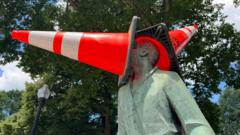
A wave of Scottish soccer fans recently descended upon Boston, leaving locals baffled as prominent statues across the city were suddenly topped with bright orange traffic cones. To the average passerby in Boston Common, it looked like a random act of midnight vandalism or a bizarre fraternity prank. The truth is far more calculated. This was not a chaotic outburst of public intoxication, but the deliberate export of a deeply entrenched piece of Scottish cultural defiance.
By placing traffic cones on Boston’s historical monuments, the traveling supporters were replicating a decades-old tradition from Glasgow. They converted unfamiliar American streets into a familiar home turf.
Understanding this phenomenon requires looking past the superficial mess and examining the specific mechanics of Scottish fan culture. The prank relies on a shared, unspoken script that travelers carry with them across the Atlantic.
The Glasgow Blueprint Replicated in New England
The practice of crowning statues with traffic cones originates with the equestrian statue of the Duke of Wellington in Glasgow, Scotland. For more than thirty years, local authorities attempted to deter pranksters from climbing the monument. They raised the plinth, threatened fines, and spent thousands of pounds annually removing the cones. Every single time a cone was removed, another appeared within days. Eventually, the city capitulated, recognizing that the cone had transformed from an act of petty mischief into an official symbol of the city's stubborn humor.
When Scottish fans traveled to Boston, they looked at the city's abundant colonial and revolutionary monuments through that exact same cultural lens.
- The Target Selection: Statues of historical figures with extended arms or prominent hats became immediate targets.
- The Tool: Standard municipal construction cones, easily sourced from ongoing Boston roadworks.
- The Execution: Quick, coordinated group efforts under the cover of night, utilizing basic climbing formations.
Bostonians woke up to find figures like Samuel Adams and various military heroes sporting plastic orange headwear. Local social media channels quickly filled with confusion. Some residents assumed it was a protest against local transit delays, while others blamed rowdy university students. The precision of the placement, however, pointed directly to the visiting contingent of football supporters who had been seen singing in local pubs hours earlier.
Why Football Supporter Culture Exports Its Rituals
Sports fandom is rarely just about the ninety minutes on the pitch. For traveling European supporters, an away match in North America is an opportunity to assert identity in a foreign environment. The traffic cone is a low-stakes, high-visibility marker. It allows a group to say "we were here" without causing permanent property damage or triggering severe criminal charges.
+---------------------------+-----------------------------------+
| Bostonian Perception      | Scottish Intention                |
+---------------------------+-----------------------------------+
| Random civic vandalism    | Calculated cultural homage        |
| Drunk and disorderly      | Structured group ritual           |
| Disrespect for history    | Satirical democratization of icons|
+---------------------------+-----------------------------------+
This behavior serves as a visual takeover. When thousands of fans arrive in a host city, they experience a form of cultural friction. Local laws are different. The bar culture is different. By altering the physical environment with an object as mundane as a traffic cone, the fans create a temporary zone of familiarity. It is a assertion of ownership over public space, turning a historic American plaza into an extension of a Scottish public square.
The Logistics of the Midnight Climb
Executing these pranks in a foreign city presents specific logistical challenges that the fans had to overcome. Boston maintains a heavy civic security footprint, particularly around its historic tourist trails. The fans had to navigate active police patrols and a dense network of surveillance cameras.
The process relies on rapid crowd dynamics. A small group creates a distraction or a wall of bodies to block the view of security cameras, while the most agile members of the group scale the stone bases. The entire operation takes less than sixty seconds. The choice of a traffic cone is deliberate because it is lightweight, easily gripped, and disposable. If a police cruiser approaches, the cone is dropped, and the group melts back into the pedestrian crowd.
Municipal responses to these acts usually follow a predictable pattern. City workers are dispatched with long poles or cherry pickers to remove the items, treating them as litter. This reaction misses the point entirely. To the fans, the removal of the cone is simply the cue for the next group to attempt the climb. It creates a repetitive cycle where the city spends tax dollars to fight an opponent that views the cleanup as a challenge rather than a deterrent.
Cultural Misinterpretation and the Risk of Escalation
The main danger in these cross-cultural sports invasions is misinterpretation by local law enforcement. In Scotland, police officers generally tolerate the cone phenomenon, viewing it as a harmless nuisance compared to actual violence or destructive vandalism. They know that intervening aggressively can escalate a peaceful, humorous situation into a riot.
American policing models tend to emphasize strict property control and immediate compliance. What a Glasgow native views as a joke, a Boston Police Department officer might classify as trespassing, disorderly conduct, or destruction of public property. This cultural disconnect creates a volatile environment where fans expecting a laugh can end up in a holding cell.
During this recent visit, the tension was palpable but managed to avoid a major flashpoint. Local authorities chose to quietly remove the cones during early morning maintenance shifts rather than making high-profile arrests in the middle of the night. This passive approach successfully defused the competitive element of the prank, preventing the fans from turning the statue climbing into an ongoing battle of wits with the local precinct.
The Satirical Deconstruction of Authority
The underlying philosophy behind the traffic cone prank is the subversion of authority. Statues are erected by institutions to project power, permanence, and solemnity. They demand respect from the public walking beneath them.
Placing a cheap, plastic piece of road safety equipment on top of a grand bronze monument completely strips away that intended solemnity. It reduces a grand historical figure to a prop in a street comedy. For Scottish fans, who often come from working-class backgrounds with a historic skepticism toward authority figures, this satire is second nature.
When they applied this logic to Boston's revolutionary heroes, they weren't insulting American history. They were treating Boston's icons exactly how they treat their own. It is an equalizer, proving that no matter how high the pedestal is, a determined group of citizens can always reach the top and leave a mark. The orange cone remains the ultimate democratic equalizer of the urban landscape.


