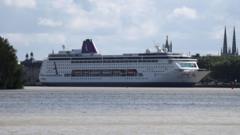
The legal world is salivating. Every time a headline mentions "outbreak" and "cruise ship" in the same breath, a swarm of personal injury lawyers starts drafting class-action templates. They want you to believe that a virus on a ship is a guaranteed payday. They want you to think the cruise line is a deep-pocketed villain that failed in its "duty of care."
They are selling you a fantasy.
If you think you can easily sue a cruise line over Hantavirus, you haven't read the fine print on your ticket, and you certainly don't understand the brutal reality of maritime law. While the "lazy consensus" in legal blogs suggests that negligence is a slam dunk, the truth is that Hantavirus is the ultimate legal ghost. It is a pathogen designed by nature to be un-sueable.
The Rodent in the Engine Room
Hantavirus isn't Norovirus. It isn't a "stomach flu" passed around because someone didn't wash their hands after the buffet. Hantavirus Pulmonary Syndrome (HPS) is a severe respiratory disease carried by rodents—specifically deer mice, cotton rats, and rice rats. Humans catch it by inhaling aerosolized droppings, urine, or saliva.
Here is the problem for your legal team: Cruise ships are floating steel cities. They are cleaned with industrial-grade intensity. To win a negligence case, you have to prove the cruise line knew about a specific infestation and did nothing.
I’ve seen maritime defense firms crush these cases before they even hit discovery. They don't have to prove they were perfect; they just have to prove they followed standard pest control protocols. If the ship has a contract with an exterminator and logs of regular inspections, your "negligence" claim evaporates.
The Jurisdictional Black Hole
Most passengers assume that because they bought their ticket in Miami or London, they can sue in their local courthouse.
Wrong.
Flip over your cruise contract. It’s a document you "signed" the moment you paid your deposit. You’ll find a "Forum Selection Clause." For the giants like Carnival or Royal Caribbean, this usually means you are forced to sue in the U.S. District Court for the Southern District of Florida.
You aren't just fighting a billion-dollar corporation; you are fighting them on their home turf, under General Maritime Law. This isn't your local small claims court. This is a specialized, pro-industry legal environment where the "Death on the High Seas Act" (DOHSA) might apply. DOHSA is a relic from 1920 that limits recovery to "pecuniary" losses—meaning actual financial loss. If you lose a loved one, the law often cares more about their lost wages than your emotional pain and suffering. It’s cold. It’s calculated. And it’s the law.
The Causation Nightmare
Let’s talk about the science that lawyers love to ignore. Hantavirus has an incubation period that ranges from one to eight weeks.
Imagine the timeline. You go on a seven-day Caribbean cruise. Three weeks later, you get sick.
The defense lawyer’s first question: "Where were you the week before the cruise?"
Did you go hiking? Did you clean out your garage? Did you stay in a cabin in the woods?
Because Hantavirus is endemic in many parts of the Americas, proving that you inhaled that specific microscopic particle on the MS Serenity rather than in your own backyard is scientifically near-impossible. Unless there is a massive, documented cluster of cases all linked to one specific vent on one specific deck, your individual case is dead on arrival.
The Myth of the "Safe" Vacation
The industry wants to market safety. The public demands a "risk-free" environment. Both sides are lying to themselves.
A cruise ship is an unnatural environment. It is a high-density metal box moving through diverse ecosystems. Expecting a cruise line to be 100% rodent-free is like expecting a city subway to be 100% germ-free. It’s an impossible standard.
Courts generally hold that cruise lines must exercise "reasonable care under the circumstances." They are not "common carriers" with a heightened duty of care in the way some people think. They aren't insurers of your health. If a mouse hitches a ride in a crate of pineapples in Cozumel and scurries into a vent, that isn't necessarily negligence. That's biology.
Stop Looking for a Settlement and Start Looking at Your Insurance
The "sue the bastards" mentality is a distraction from the only thing that actually works: high-end travel insurance with a "cancel for any reason" (CFAR) clause and robust medical evacuation coverage.
If you get Hantavirus on a ship, you don't need a lawyer; you need an ICU and a Gulfstream jet with a medevac team. Most people skimp on the $200 insurance policy and then try to chase a $2,000,000 settlement when things go south. It’s bad math.
The Hidden Defense: The "Act of God" Clause
Don't be surprised when the cruise line invokes the "Force Majeure" or "Act of God" defense. While usually reserved for hurricanes or pirates, savvy defense councils argue that a sudden, unpredictable viral outbreak in a previously clean environment fits the bill.
If the CDC hasn't issued a specific warning for that ship, and the ship passed its last Vessel Sanitation Program (VSP) inspection with a high score, you are climbing a mountain of greased glass.
The Brutal Truth About Class Actions
You’ll see the "Join the Lawsuit" ads on social media. What they don't tell you is that class actions in cruise law are notoriously difficult to certify. Every passenger has a different medical history, a different cabin location, and a different pre-cruise exposure risk. These "individualized issues" usually prevent a class from ever forming.
The lawyers get the headlines. You get a voucher for a free drink on your next cruise five years from now.
Why the CDC VSP Scores are a Red Herring
Many "experts" point to the CDC Vessel Sanitation Program scores as proof of negligence. They see a 92 and think, "Aha! They failed to keep it clean!"
In reality, VSP inspections are incredibly granular. A ship can lose points because a lightbulb in a walk-in freezer is out or because a pool’s pH level was recorded ten minutes late. A "passing" score—anything 86 or above—is actually a powerful shield for the cruise line. If they have an 86 or higher, they are effectively compliant with federal standards. Good luck arguing they were negligent when the federal government gave them a passing grade.
The Thought Experiment: The Invisible Mouse
Imagine a scenario where a passenger brings a pet hamster on board illegally (it happens). The hamster escapes, dies in a wall cavity, and attracts local rodents at a port of call. A week later, a different passenger in the adjacent cabin gets sick.
Who is liable?
The cruise line? They didn't know the hamster was there.
The passenger who brought the pet? Good luck finding them.
The port authority?
This is the chaotic reality of maritime infection. It’s a chain of events where the link of "foreseeability" is almost always broken. If the cruise line couldn't foresee the specific risk, they aren't liable.
The Actionable Reality
If you are currently sitting in a hospital bed thinking about your "big win" against a cruise line for a Hantavirus infection, here is your reality check:
- Check the VSP Logs: If the ship has a history of rodent sightings in their official CDC reports, you have a 5% chance. If not, you have 0%.
- Preserve the Evidence: You need the clothing you wore, logs of where you ate, and a list of every person you interacted with.
- Hire a Maritime Specialist: Not your cousin who does car accidents. If they haven't spent twenty years arguing in the Southern District of Florida, they are outclassed.
- Expect Zero Dollars: Assume the cruise line will fight you for five years, spend $500,000 on expert witnesses to prove you got sick at a gas station in Nebraska, and eventually offer you a "nuisance settlement" that barely covers your filing fees.
The cruise industry is protected by a fortress of 19th-century laws and modern contract trickery. They aren't going to pay for your misfortune just because it happened on their deck.
Stop looking for a legal lottery ticket in a petri dish.