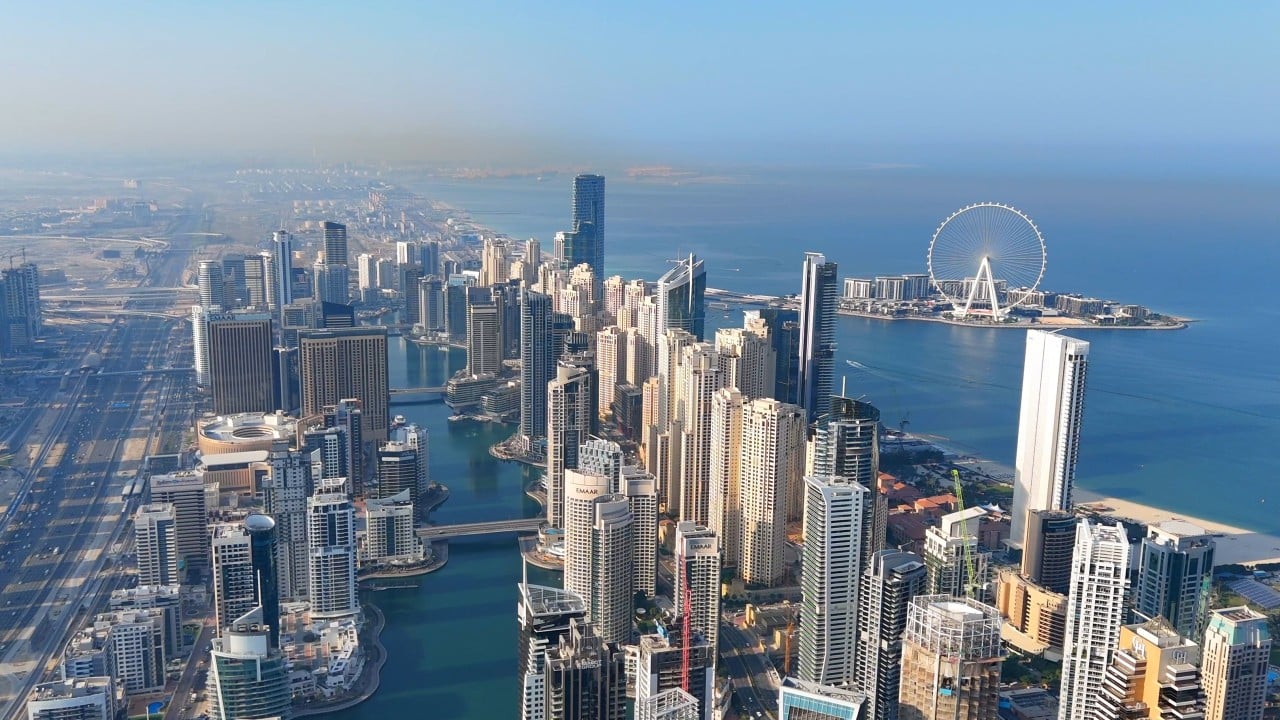
Every armchair macro-analyst in London and New York is peddling the exact same fairy tale right now. They look at a map of the Persian Gulf, trace a line from Washington's midterm election results straight to a hypothetical de-escalation with Tehran, and declare that Dubai and Abu Dhabi property prices are about to skyrocket on the back of a "peace dividend."
It is lazy thinking. Worse, it is financially dangerous.
If you are deploying capital into Emirati bricks and mortar on the thesis that a weakened White House forcing an end to regional hostilities will trigger a fresh bull run, you fundamentally misunderstand how Gulf real estate actually makes money. You are applying a textbook Western equities model to an asymmetric safe-haven market.
Here is the uncomfortable truth that local developers will never print in their glossy off-plan brochures: regional instability is the primary fuel behind the UAE's multi-year property boom, and a sudden, comprehensive peace deal would trigger an immediate capital flight.
The Safe-Haven Paradox Nobody Wants To Admit
To understand why peace is bearish for Dubai Marina and Saadiyat Island, you first have to strip away the marketing fluff about tax-free living and sunshine. Capital is cowardly. When geopolitical friction spikes across the Middle East, high-net-worth individuals, family offices, and corporate treasuries from the Levant to Central Asia do not pack their bags for Zurich or Singapore. Time zones matter. Cultural proximity matters. Visa accessibility matters. They move their liquid wealth and their families to the United Arab Emirates.
I have sat across the table from family office principals in DIFC who wired eight-figure sums into Downtown Dubai penthouses precisely because their home jurisdictions were destabilizing. They were not buying yield. They were buying an insurance policy with a sea view.
In financial economics, this is known as the safe-haven premium—the excess valuation an asset commands purely because of its perceived insulation from surrounding chaos. The UAE spent decades building bulletproof diplomatic neutrality, world-class security infrastructure, and a pegged currency specifically to capture this flow. When regional tension stays elevated—simmering just hot enough to scare capital out of neighboring states without physically threatening Emirati soil—Dubai and Abu Dhabi act as a giant vacuum cleaner for regional liquidity.
Remove that friction overnight, and you remove the urgency.
Imagine a scenario where Washington pivots aggressively toward de-escalation following midterm shifts, lifting sanctions and stabilizing neighboring economies. Suddenly, that panicked flight capital stops arriving. Worse, the defensive money that parked itself in Dubai villas over the last thirty-six months starts looking for higher-yielding, undervalued opportunities back in its home markets or in traditional Western growth assets. You do not get a rally. You get a liquidity vacuum.
Why The "Lower Oil And Lower Rates" Argument Fails On Contact
The consensus crowd loves to argue that ending hostilities will crash crude prices, crush global inflation, and force the Federal Reserve to slash interest rates. Because the UAE Dirham is pegged to the US Dollar, the Central Bank of the UAE mirrors Fed rate cuts. Lower mortgage rates equal higher property prices, right?
Wrong. Again, you are looking at the wrong side of the balance sheet.
- The Gulf is an all-cash market. According to transaction data consistently tracked by Knight Frank and CBRE, cash buyers routinely account for upwards of 70% to 80% of residential transactions in Dubai. Mortgage rate fluctuations move the needle for a narrow slice of mid-market expat end-users, not the whale investors driving headline price-per-square-foot records on Palm Jumeirah or Jumeirah Bay Island.
- Oil is still the sovereign lifeblood. While Dubai has successfully diversified its direct GDP away from hydrocarbons, its liquidity ecosystem remains deeply tethered to regional petrodollars. Abu Dhabi sits on roughly 6% of the world's proven oil reserves. Sovereign wealth funds like ADIA and Mubadala, alongside regional buyers from Saudi Arabia and Qatar, inject massive indirect liquidity into the UAE economy when Brent crude trades at a geopolitical risk premium.
If a sudden peace treaty strips a $15 to $20 risk premium out of crude oil prices, sovereign surpluses across the Gulf Cooperation Council shrink overnight. Government spending tightens. Mega-project timelines stretch. The cascading wealth effect that trickles down from Abu Dhabi’s state balance sheet into Dubai’s luxury real estate sector slows to a crawl. You cannot cheer for collapsing oil prices and booming Gulf real estate in the same breath. The math does not work.
The Supply Tsunami Waiting In The Wings
If you want to know what actually breaks a real estate cycle in the Emirates, stop watching cable news pundits talk about Washington politics and start counting cranes on Sheikh Zayed Road.
Dubai's real estate market has a historical fatal flaw: developers respond to demand spikes with massive, uncoordinated supply surges. Over the past two years, off-plan launches have shattered every historical record. Tens of thousands of residential units are scheduled for handover between 2026 and 2028.
Right now, that pipeline is being absorbed by two forces:
- Relocating wealth fleeing geopolitical and tax pressures in Europe, Russia, and the broader Middle East.
- Speculative flippers trading off-plan payment plans before handover.
A sudden geopolitical normalization hits both of those pillars simultaneously. Without fresh waves of displaced wealth arriving to absorb the handovers, the speculative flippers get trapped. When an investor who only paid 30% during construction realizes there is no end-user waiting to buy them out at a 20% markup upon completion, they dump the asset at a discount to avoid paying the remaining 70% handover balance.
I watched this exact movie play out in 2014 and 2015. Back then, oil prices collapsed and the lifting of sanctions on Iran under the JCPOA was widely hailed by clueless analysts as a massive boon for Dubai trade and real estate. What actually happened? Dubai residential prices peaked in mid-2014 and entered a brutal, six-year bear market that wiped out over 30% of property values. History does not repeat itself verbatim, but in Gulf real estate, it rhymes with terrifying precision.
What Investors Are Actually Getting Wrong About Washington
Let us address the political premise directly, because the mainstream commentary is equally naive about how American foreign policy operates.
Assuming that a shift in congressional control immediately neutralizes Middle Eastern conflict ignores how executive power works in Washington. Foreign policy, sanctions enforcement, and military posture in the Persian Gulf remain overwhelmingly dominated by the White House and the Pentagon, regardless of who holds the gavel in the House of Representatives.
More importantly, a gridlocked Washington creates policy unpredictability, not tidy peace treaties. When a president faces domestic legislative paralysis, foreign policy often becomes the primary arena where they still wield unilateral authority. That leads to erratic, transactional diplomacy—sudden tariff threats, snap sanctions, and abrupt military posturing—rather than stable, long-term regional settlements.
For Gulf real estate investors, betting on a clean political resolution out of Washington is like betting on the weather in London. You are pricing in certainty where none exists.
The Brutal Reality Of Where The Smart Money Is Moving
If you are sitting on capital in the UAE right now, or looking to enter the market, you need to stop trading headlines and start trading structural realities.
To be completely transparent, betting against the UAE's long-term trajectory has been a widow-maker trade for twenty years. The leadership in Abu Dhabi and Dubai executes infrastructure and economic policy at a speed that makes Western democracies look frozen in amber. Population growth is real. The Golden Visa program permanently altered the residency retention rate of wealthy expats. If you buy a prime asset with zero leverage and hold it for ten years, you will almost certainly do fine regardless of what happens in Washington or Tehran.
The danger is in the medium-term mispricing. If you are buying mediocre off-plan apartments in secondary locations expecting a geopolitical "peace rally" to bail you out on an 18-month flip, you are the exit liquidity for smarter players.
Here is how you actually position a portfolio when the consensus is chasing ghosts:
- Dump generic off-plan exposure immediately. Any project in a non-prime corridor with a high concentration of speculative buyers and post-handover payment plans is toxic if liquidity tightens. Look for completed, income-producing assets with proven rental histories.
- Prioritize scarcity over yield. In a correction, oversupplied apartment towers bleed value first. Land-constrained assets—waterfront villas, established master communities with mature greenery, and ultra-prime commercial office space in DIFC or ADGM where vacancy rates sit near historic lows—hold their floor because you cannot print more coastline.
- Watch the secondary market spread, not developer launches. Developers can manipulate launch prices through extended payment plans and fee waivers. The true pulse of the market lives in the secondary cash-transaction data published by the Dubai Land Department. When secondary prices stagnate while off-plan prices keep rising, the bubble is ready to pop.
- Hedge your currency and rate assumptions. Do not underwrite deals assuming aggressive rate cuts will bail out thin rental yields. Demand a net yield of at least 6.5% to 7% after service charges on any residential acquisition today. If the numbers only work on projected capital appreciation, walk away.
Stop Confusing Quiet Headlines With Bull Markets
The financial media loves a neat narrative. War equals bad; peace equals good. Elections happen; markets go up. It fits cleanly into a 600-word morning newsletter and requires zero understanding of capital flows, sovereign balance sheets, or supply pipelines.
Real estate in the Persian Gulf does not operate on Western sentiment. It operates on the movement of frightened capital, the price of crude oil, and the relentless supply discipline—or lack thereof—of master developers.
A sudden outbreak of regional peace would be a massive humanitarian triumph for the Middle East, but for an overheated property market addicted to safe-haven inflows and high oil revenues, it would be the ultimate cold shower. Position your capital for the liquidity hangover, not the victory parade.