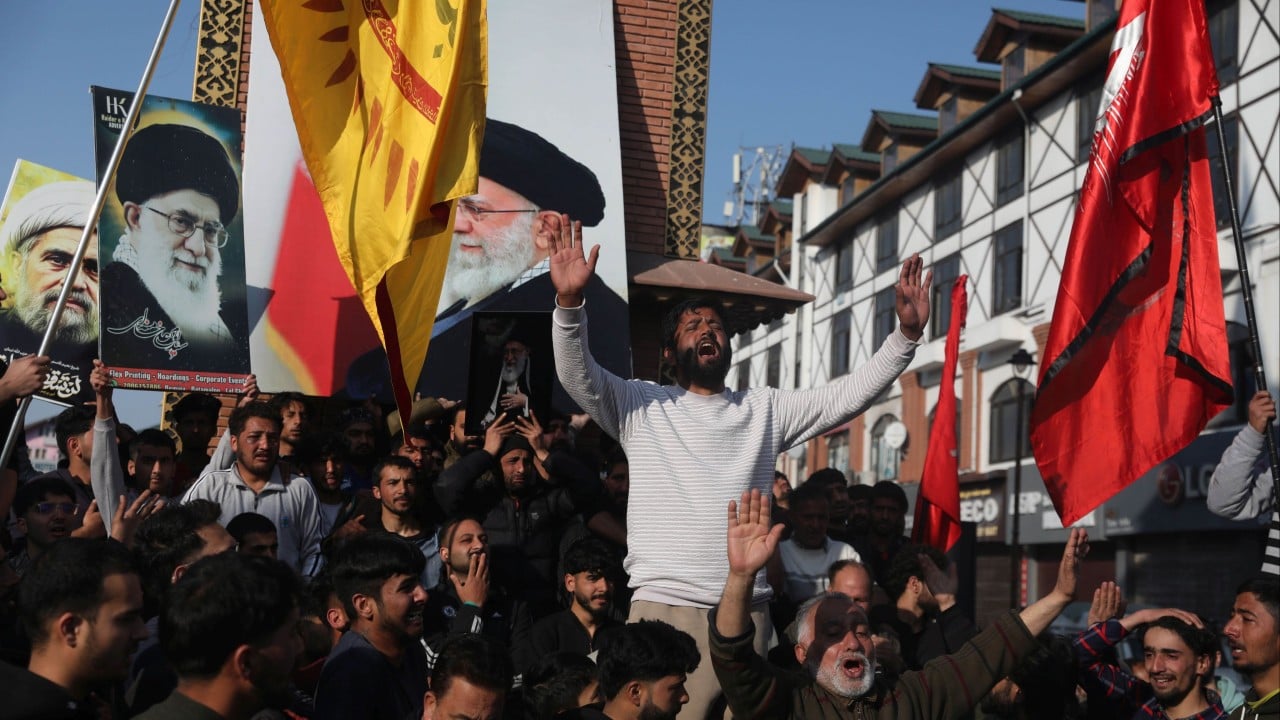
The death of Ali Khamenei represents more than a biological conclusion; it is the catastrophic failure of a singular point of stabilization in the Middle East’s most complex power hierarchy. For the Asian markets and diplomatic corps, this event is not a localized tragedy but a systemic shock to the energy and security corridors that sustain the Eastern hemisphere's industrial base. Analyzing the fallout requires moving beyond the surface-level "outrage" reported by legacy media and instead examining the three structural pillars of Iranian power: the clerical legitimacy, the Islamic Revolutionary Guard Corps (IRGC) economic-military complex, and the regional proxy network known as the Axis of Resistance.
The Triple Crisis of Iranian Succession
The vacancy at the top of the Velayat-e Faqih (Guardianship of the Jurist) triggers an immediate three-fold crisis.
1. The Constitutional Bottleneck
The Assembly of Experts is tasked with selecting a successor, but the criteria for this selection have narrowed significantly over the last decade. The tension exists between a "revolutionary" candidate who prioritizes ideological purity and a "pragmatic" candidate favored by the bureaucratic and mercantile classes. Because Khamenei did not explicitly name a successor with universal consensus, the legal transition is a friction-filled process where every day of deliberation increases the probability of domestic civil unrest.
2. The IRGC Securitization Trap
As the clerical establishment fumbles for a leader, the IRGC—which controls an estimated 30% to 50% of the Iranian economy through various holding companies and foundations—moves to fill the vacuum. This shifts Iran from a theocracy with a military to a military junta with a religious veneer. For Asian partners like China and India, dealing with a purely military-led Iran changes the risk profile of long-term infrastructure projects like the Chabahar Port or the 25-year Comprehensive Strategic Partnership.
3. The Proxy Decentralization Risk
Hezbollah, the Houthis, and various PMF groups in Iraq operate on a command structure that relies heavily on the personal authority of the Supreme Leader. Without a central arbiter, these groups may begin to act autonomously to secure their own local interests, leading to "uncoordinated escalation." This increases the likelihood of a miscalculation in the Strait of Hormuz, a maritime chokepoint through which approximately 20% of the world's total oil consumption flows.
The Asian Response Function: Energy and Geopolitics
The calls for restraint emanating from Beijing, New Delhi, and Tokyo are not mere diplomatic platitudes; they are expressions of a high-stakes cost-benefit analysis. Asia’s dependency on Middle Eastern stability is codified in the "Malacca Dilemma" and the "Hormuz Vulnerability."
The China-Iran-Russia Strategic Triangle
Beijing’s primary objective is the preservation of the Status Quo Ante. China is Iran’s largest trading partner and a significant buyer of discounted "teapot" refinery oil. A destabilized Iran threatens the Middle East component of the Belt and Road Initiative (BRI). The Chinese response follows a specific logic:
- Buffer Strategy: Beijing will likely offer immediate "recognition" to whoever the Assembly of Experts names first, regardless of their internal standing, to project a sense of continuity.
- Capital Flight Mitigation: Chinese state-owned enterprises (SOEs) may temporarily pause new investments while maintaining operational status on existing energy fields to avoid being caught in a potential civil conflict.
India’s Strategic Autonomy at Risk
India views the death of Khamenei through the lens of the International North-South Transport Corridor (INSTC). If a hardline military faction takes control and triggers further Western sanctions, India’s "Diamond Necklace" strategy to bypass Pakistan via Iran faces a total operational shutdown. The Indian Ministry of External Affairs must balance its growing defense ties with Israel against the physical necessity of Iranian transit routes.
Quantifying the Economic Transmission Mechanism
The "outrage" mentioned in initial reports is a psychological precursor to real economic shifts. The market is currently pricing in a "Succession Premium" on Brent Crude.
The Volatility Equation
The impact on Asian economies can be modeled by the relationship between Iranian domestic stability ($S$) and the Global Energy Supply Chain ($G$).
$$V = \frac{1}{S} \times (I + P)$$
Where:
- $V$ is the resulting market volatility.
- $I$ is the IRGC's level of internal control.
- $P$ is the activity level of regional proxies.
As $S$ (Stability) decreases, the volatility $V$ increases exponentially. If the IRGC ($I$) takes aggressive measures to suppress dissent, it may temporarily stabilize $S$, but it triggers secondary sanctions that restrict $G$, leading to a sustained inflationary spike across the manufacturing hubs of Vietnam, Thailand, and South Korea.
The Information Warfare and Domestic Dissent
The calls for restraint are also a reaction to the high probability of a "Green Movement 2.0." The demographic reality of Iran is that over 60% of the population is under the age of 30. This cohort has little affinity for the 1979 revolutionary ideals.
The mechanism of protest in a post-Khamenei era follows a non-linear path:
- The Information Gap: In the hours following the announcement, the state’s monopoly on information is at its weakest.
- The Martyrdom Cycle: Any heavy-handed response by the Basij (paramilitary) creates a feedback loop of protests, where funerals of protesters become the staging ground for larger demonstrations.
- The Security Defection Probability: The critical variable is whether the lower-ranking members of the regular army (Artesh) will fire on civilians. Unlike the IRGC, the Artesh is a conscript-based force with deeper ties to the general population.
Structural Limitations of the "Outrage" Narrative
Competitor analysis often focuses on the emotion of the crowds. This is a mistake. Outrage is a symptom; power consolidation is the cause. The "calls for restraint" are effectively a request for the Iranian deep state to execute a "silent coup"—a transition where the clerical leadership remains the face of the nation while the security apparatus assumes the brain functions.
The risk for Asia is that a "restrained" Iran may actually be a more dangerous Iran in the long term. A military-industrial complex that feels threatened by domestic collapse is more likely to pursue nuclear breakout as a "life insurance policy." This would trigger a nuclear arms race in the Middle East, involving Saudi Arabia and Turkey, which would permanently devalue Asian investments in the region.
Strategic Recommendation for Regional Stakeholders
Organizations and governments must move from a "Wait and See" posture to an "Active Hedging" strategy. This involves three distinct moves:
First, the Diversification of Transit. Relying on the Strait of Hormuz is no longer a viable 10-year strategy. Investment must accelerate into the Middle Corridor (Caspian Sea routes) and the Arctic Northern Sea Route to bypass the inevitable friction points of a post-Khamenei Middle East.
Second, the Formalization of Informal Channels. Diplomatic engagement must shift from the Presidency and the Foreign Ministry to the second-tier leadership of the IRGC and the Bonyads (charitable foundations). These are the entities that will control the physical assets and the flow of goods during a protracted succession struggle.
Third, the Energy Reserve Reconstitution. Asian economies should utilize the current price windows to maximize Strategic Petroleum Reserves (SPR). The transition in Tehran will not be a single event, but a multi-year process of realignment. The periods of "restraint" will be punctuated by sharp escalations as different factions vie for dominance. Stability is not returning; a new, more volatile equilibrium is being established.
The immediate objective is the securing of technical and energy contracts through "Force Majeure" proof clauses. Any agreement signed with the current transition council must be backed by multi-lateral guarantees, as the legal standing of the next Supreme Leader will be contested both internally and internationally for the foreseeable future.


