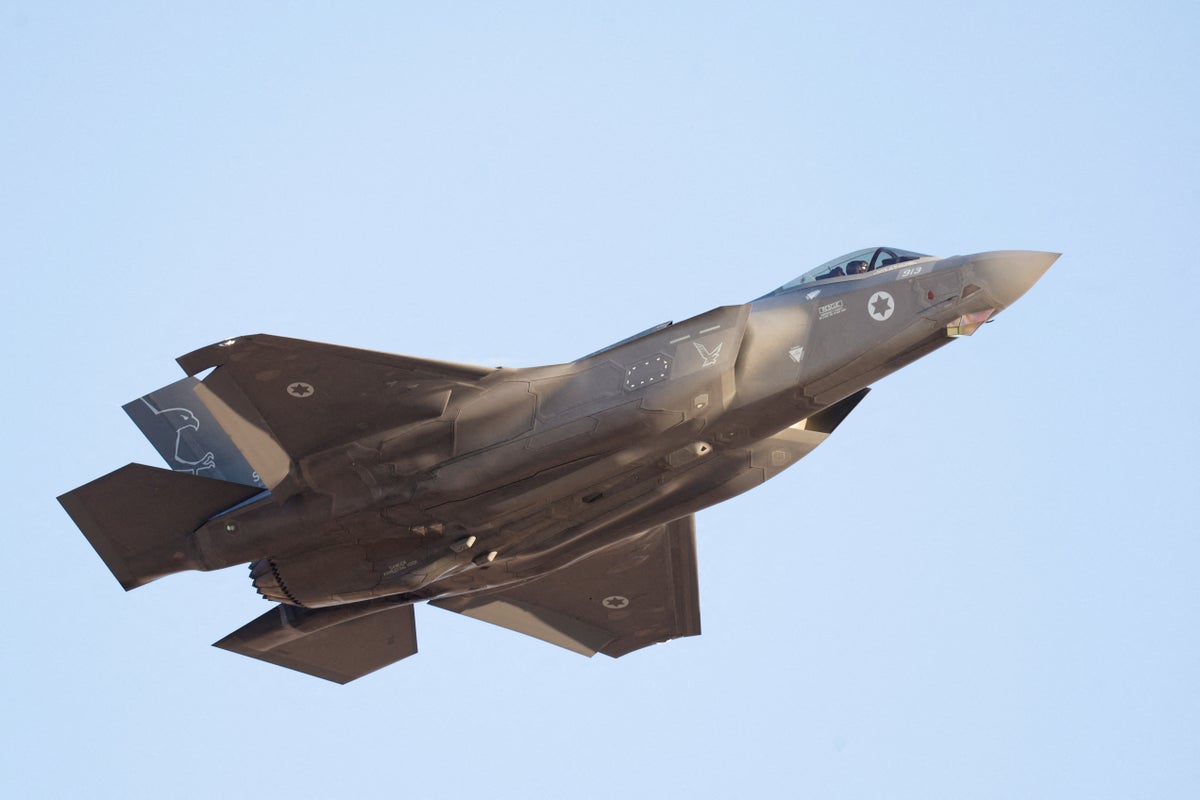
The announced $119 billion procurement plan by the Israeli Ministry of Defense represents a shift from tactical maintenance to a long-term structural overhaul of air superiority. This capital allocation is not a singular purchase but a multi-decade strategic hedge designed to solve two specific operational bottlenecks: the degradation of long-range strike capacity and the rising cost of integrated electronic warfare. By splitting the acquisition between Lockheed Martin’s F-35 Lightning II and Boeing’s F-15IA (the Israeli variant of the F-15EX), the Israeli Air Force (IAF) is utilizing a "High-Low-Tech" hybrid model to maintain regional dominance while managing the diminishing returns of stealth technology in contested environments.
The Dual-Platform Logic of Air Supremacy
A common misconception in defense analysis is that the F-35 and F-15 compete for the same mission profile. In reality, their integration addresses a fundamental physics problem in modern aerial warfare: the inverse relationship between low-observable (stealth) characteristics and payload capacity.
The Penetration Function (F-35)
The F-35 functions as the "quarterback" of the battlefield. Its value is derived not from its kinetic output, but from its sensor fusion and networking capabilities.
- Sensor Fusion: The aircraft aggregates data from across the electromagnetic spectrum, providing a real-time, 360-degree tactical map.
- A2/AD Negation: Stealth is required to operate within Anti-Access/Area Denial (A2/AD) bubbles, specifically against modern S-300 and S-400 surface-to-air missile batteries.
- First-Look Capability: The objective is to identify and neutralize threats before the aircraft is detected, a requirement for operations in deeply buried or highly defended Iranian nuclear sites.
The Kinetic Multiplier (F-15IA)
Once the F-35 has suppressed enemy air defenses or identified high-value targets, the F-15IA provides the necessary "mass."
- Payload Volume: The F-15IA can carry up to 29,500 pounds of munitions, including heavy bunker-busters and long-range stand-off missiles that do not fit inside the internal weapon bays of an F-35.
- Electronic Warfare (EW): The Boeing platform acts as a high-powered EW node, capable of projecting jamming signals that protect less stealthy assets.
- Operational Longevity: The F-15 airframe is rated for 20,000 flight hours, significantly higher than the F-35, providing a lower lifecycle cost for routine patrols and secondary theater operations.
The 119 Billion Dollar Capital Allocation Framework
The headline figure of $119 billion is frequently misunderstood as an upfront cash payment. In reality, this is a structured financing operation involving United States Foreign Military Financing (FMF), long-term debt instruments, and domestic Israeli industrial offsets.
The Debt-to-Capability Ratio
The financing of this package relies heavily on the 10-year Memorandum of Understanding (MOU) between the U.S. and Israel. Because the delivery of these aircraft will take place over the next decade, the Israeli government is effectively "buying now and paying later" through FMF credits. This creates a specific financial risk: the erosion of purchasing power. If inflation in the aerospace sector outpaces the fixed annual increases in U.S. aid, the IAF may be forced to reduce the total number of airframes or scale back on the custom "Israeli-only" avionics suites that differentiate these jets from standard U.S. models.
Industrial Offsets and Reciprocity
A significant portion of this $119 billion circulates back into the Israeli economy. Under the terms of these agreements, Lockheed Martin and Boeing often engage in "Buy Back" programs.
- Wing Production: Israel Aerospace Industries (IAI) produces wings for the F-35.
- Helmet Technology: Elbit Systems provides the advanced Display Systems for F-35 pilots.
- Local Maintenance: Establishing domestic depots for engine overhauls reduces the "Mean Time To Repair" (MTTR) and ensures operational independence during prolonged conflicts.
The Geopolitical Cost Function
The timing of this procurement is a response to the shifting "Cost of Conflict" in the Middle East. As regional adversaries upgrade their drone swarms and ballistic missile precision, the IAF faces a diminishing margin of error.
The Iranian Nuclear Hedge
The F-15IA acquisition is specifically tailored for a potential strike on hardened targets. The aircraft’s ability to carry the GBU-72 Advanced 5,000lb Penetrator is the primary deterrent against underground enrichment facilities. Without the F-15IA, the IAF would be forced to rely on multiple F-35 sorties to achieve the same structural damage on a single target, increasing the probability of pilot loss and mission failure.
The Multi-Front Variable
Israel’s defense strategy must now account for simultaneous friction in Gaza, Lebanon, Syria, and the Red Sea. This creates a "readiness tax." High-intensity use of fifth-generation aircraft like the F-35 for low-intensity missions (e.g., intercepting cheap drones) is economically unsustainable. Each flight hour of an F-35 costs roughly $35,000 to $42,000. By diversifying the fleet, the IAF can allocate the most cost-effective platform to the specific threat level, optimizing the "Cost Per Kill" ratio.
Engineering the Israeli Edge: Customization vs. Standardization
The "I" in F-15IA and the unique "Adir" designation for the F-35 signify a departure from the "Off-the-Shelf" procurement model. Israel requires deep-level access to the source code of these platforms, a request that creates friction with the Pentagon but remains a non-negotiable requirement for the MOD.
- Native C4I Integration: Israel integrates its own Command, Control, Communications, Computers, and Intelligence (C4I) systems. This allows an F-35 to pass target data directly to a ground-based Iron Dome battery or a Navy Corvette without going through a central U.S.-managed cloud.
- Electronic Warfare Autonomy: The IAF uses its own EW suites because regional threats evolve faster than the global software update cycle of the F-35’s Block 4 program. If the IAF cannot update its jamming profiles in 24 hours, the aircraft's survivability drops.
- Weapon Independence: The ability to mount Rafael-produced missiles (like the Python-5 or Spice bombs) ensures that the IAF is not solely dependent on U.S. supply chains for munitions during a surge in combat operations.
The Hidden Constraints: Personnel and Infrastructure
Investing $119 billion in hardware ignores the secondary costs of human capital and physical infrastructure.
- The Pilot Bottleneck: Doubling the fleet size requires a proportional increase in elite pilot training. The washout rate for IAF flight school remains high, creating a personnel ceiling that could leave these expensive airframes underutilized.
- Hardened Basing: Fifth-generation aircraft require climate-controlled hangars for their radar-absorbent coatings. The construction of these facilities across Israel’s airbases adds billions in "invisible" costs not typically captured in the initial procurement headline.
- Data Sovereignty: The F-35’s ALIS (Autonomic Logistics Information System) communicates back to the U.S. for maintenance data. Israel has historically pushed for a "disconnected" version of this system to prevent any external actor from remotely disabling the fleet or harvesting mission data.
Strategic Forecast: The Shift Toward Autonomous Augmentation
The $119 billion plan is likely the last major manned fighter procurement in Israeli history. As the delivery of these jets spans the 2030s, the focus will shift toward "Loyal Wingman" technology—unmanned platforms that fly alongside the F-35 and F-15IA.
The strategic play is to use these manned jets as "Command Nodes" for swarms of cheaper, autonomous drones. In this model, the F-35 identifies the target, the F-15IA carries the heavy munitions, and the autonomous drones provide the final terminal strike or act as decoys to deplete enemy SAM reserves.
Decision-makers should view this $119 billion outlay as the purchase of a foundational infrastructure. The airframes themselves are the "hardware" that will host the real weapon of the next decade: AI-driven, networked battle management software. The IAF is not just buying planes; it is buying the ability to process more combat data than its enemies can produce.
The immediate move for regional competitors will be an acceleration of asymmetric defenses—primarily cyber and electronic interference aimed at the data links between these platforms. Consequently, the next phase of Israeli defense spending will likely pivot toward hardening the "Digital Backbone" that connects these F-35s and F-15s, as a disconnected fighter in a modern theater is nothing more than a very expensive target.