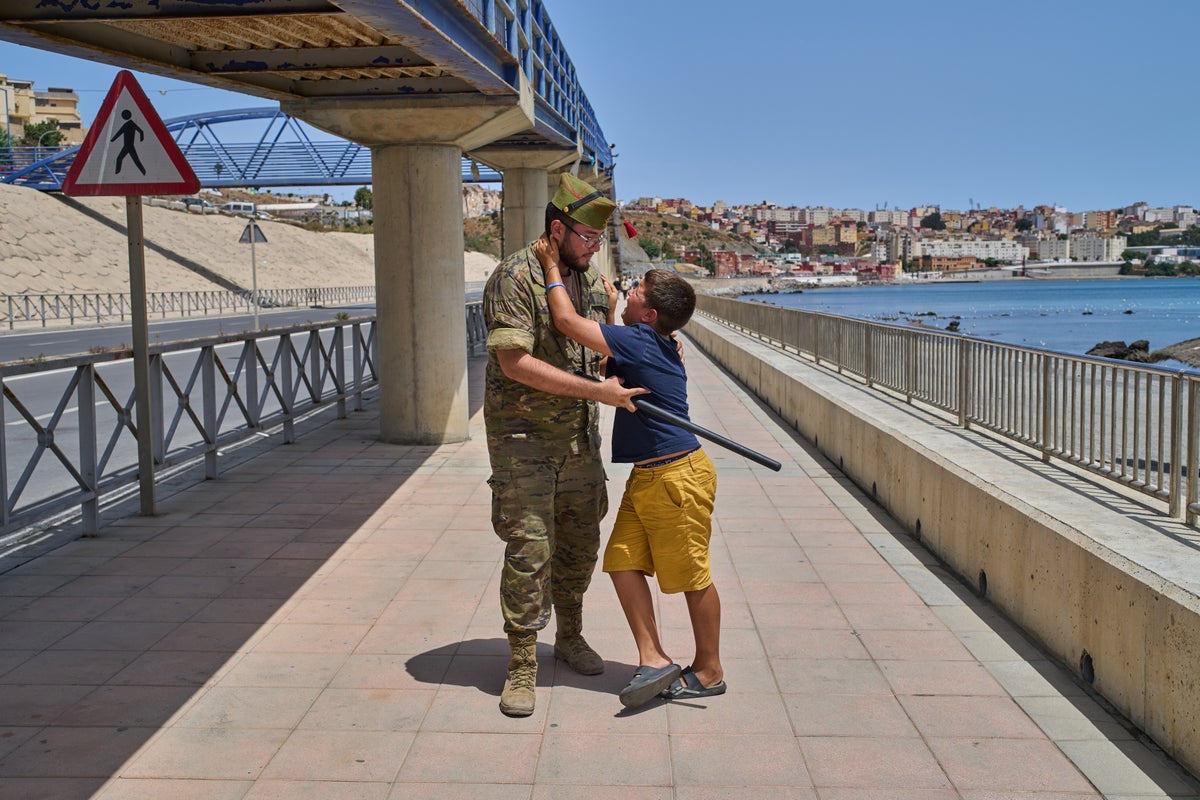
The operational bottleneck at the Spanish border enclave of Ceuta represents a systemic failure of multi-tier bureaucratic coordination rather than an isolated humanitarian anomaly. When minors cross international boundaries without legal representation or immediate guardianship, standard processing queues collapse under the weight of conflicting regional mandates. Observers frequently misinterpret these events through an emotional lens, viewing individual instances—such as a minor pleading with military personnel—as spontaneous anomalies. In practice, these moments are the predictable output of a legal framework stressed past its structural capacity.
Analyzing the mechanics of this crisis requires examining the statutory friction between national immigration protocols, bilateral readmission agreements, and regional administrative obligations.
The Jurisdictional Matrix of Border Enclaves
Ceuta operates under a distinct geopolitical and legal reality. As a Spanish autonomous city situated on the North African coast, it functions as an external land border of the European Union. This status creates a complex friction point between three distinct sovereign and institutional layers:
- National sovereignty laws governing territorial entry and national security enforcement.
- European Union migration pacts dictating fundamental rights, asylum processing timelines, and collective expulsion prohibitions.
- Bilateral administrative arrangements between Spain and Morocco concerning expedited repatriation channels for unaccompanied minors.
The primary operational failure occurs at the intersection of national security enforcement and child protection mandates. Spanish military units deployed to the perimeter are trained for tactical deterrence and territorial defense, not social triage or minor intake. When hundreds of individuals, including unaccompanied minors, breach the physical barrier, frontline personnel face an acute role conflict. They are tasked with executing border control while simultaneously bound by international conventions that prohibit the immediate, unexamined expulsion of minors.
This operational ambiguity generates a structural delay. The military cannot instantly repatriate minors due to legal prohibitions against summary returns, yet local civic infrastructure in Ceuta lacks the bed capacity, legal guardians, and administrative staff required to absorb sudden surges. The resulting backlog leaves vulnerable individuals in a legal vacuum directly adjacent to the international fence line.
The Cost Function of Unregulated Minor Transit
To understand why traditional deterrence strategies fail in enclaves like Ceuta, analysts must evaluate the cost function driving minor migration patterns. The decision to cross an international border independently is an extreme risk calculation executed by families or older peers under severe economic or social duress.
Traditional state responses rely almost exclusively on raising the cost of entry through physical barriers, increased patrols, and rapid repatriation threats. However, economic theory dictates that when the baseline conditions in the country of origin involve extreme deprivation or lack of educational mobility, the perceived cost of remaining stagnant approaches infinity. Consequently, incremental increases in border friction yield diminishing returns in deterrence.
The financial and operational costs are instead shifted entirely onto the destination state's secondary systems:
- Judicial Backlog: Every unaccompanied minor triggers a mandatory multi-step legal assessment to determine best interests, verify age through medical or documentary means, and establish contact with consular authorities. Courts in autonomous cities operate with fixed headcounts, meaning a sudden influx paralyzes the local docket.
- Social Infrastructure Strain: Residential care facilities designed for a baseline capacity are forced to operate at multiples of that threshold, degrading care quality and escalating security expenses.
- Diplomatic Friction: Repatriation mechanisms depend heavily on bilateral cooperation matrices. When diplomatic channels between Madrid and Rabat experience friction, readmission protocols freeze entirely, trapping minors in administrative limbo indefinitely.
The Failure Modes of Bilateral Readmission
The mechanism intended to resolve rapid-entry scenarios is the bilateral readmission agreement. In theory, these pacts allow for the swift return of individuals who crossed irregularly, provided specific procedural safeguards are met. In practice, the execution of these agreements regarding minors breaks down due to divergent legal definitions and evidentiary requirements.
Spanish domestic law and international treaties require positive identification and formal tracing of family units in the country of origin before any repatriation can be legally executed. This process is designed to prevent unlawful abandonment and ensure that the receiving state has designated a responsible guardian.
Moroccan authorities, conversely, require concrete proof of nationality and active consular verification before issuing travel documents or accepting returns. When minors arrive without identification documents—a frequent occurrence due to loss, theft, or deliberate discarding during transit—the verification protocol stalls.
This creates a high-friction loop:
- The minor enters Ceuta and is detained or sheltered by local authorities.
- Spanish authorities initiate identification requests through diplomatic channels.
- The lack of documentation or slow bureaucratic response prevents immediate verification.
- Statutory time limits for temporary administrative custody expire, forcing the local system to integrate the minor into the national foster framework.
- The intended repatriation mechanism becomes economically and administratively inviable due to the time elapsed.
Strategic Realignment for Border Management
Resolving the structural vulnerabilities exposed by incidents in Ceuta requires shifting focus from reactive border enforcement to proactive regional coordination and capacity redistribution. Continuing to rely on tactical military deployments at the perimeter treats the symptom while leaving the systemic drivers intact.
European and Spanish authorities must establish decentralized processing hubs outside the immediate physical enclaves to prevent localized resource collapse. By decoupling the initial border breach response from the permanent intake infrastructure, authorities can route unaccompanied minors directly to mainland reception facilities designed for long-term evaluation. This eliminates the bottleneck where military personnel and local municipal services are forced to manage legal and humanitarian operations they are structurally unequipped to handle.
Concurrently, diplomatic frameworks with transit nations must move beyond simple readmission quotas toward co-invested regional development and education initiatives. If the marginal utility of remaining in the country of origin rises through targeted economic intervention, the volume of high-risk independent crossings decreases at the source.
Establish operational pre-clearance protocols with consular offices stationed directly inside border regions to compress the identification phase from months to days, thereby restoring functionality to bilateral return mechanisms while preserving statutory protections for minors.

.png?itok=1mb05mKJ)

