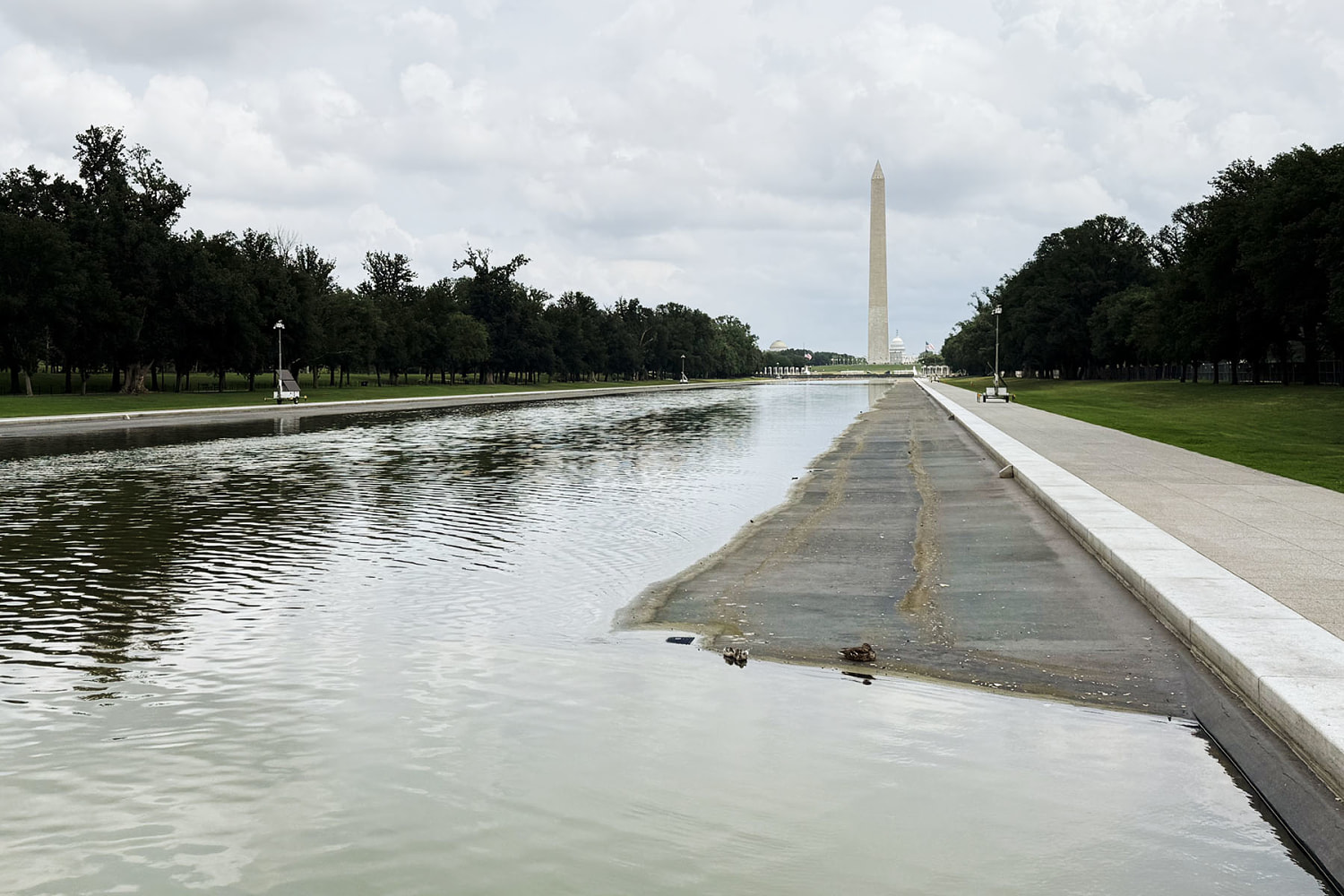
The indictment of former Olympic canoeist David Hearn for the alleged destruction of the Lincoln Memorial Reflecting Pool’s lining represents a critical intersection where failed infrastructure maintenance meets aggressive state-sanctioned narrative construction. By analyzing the technical failure of the pool’s sealant and the subsequent legal response, it becomes clear that the government is attempting to criminalize the observation of its own operational incompetence.
The Material Failure Mechanism
The core issue rests on a fundamental disconnect between the intended durability of the pool’s renovation and the observed reality of its rapid degradation. The renovation, executed under administration mandates for the nation’s 250th anniversary, utilized an "American flag blue" sealant. This material has displayed significant, well-documented mechanical failure. Meanwhile, you can explore related events here: The Anatomy of Extreme Heat Waves Why Fire Risk Escalates Exponentially Not Linearly.
The mechanism of degradation is predictable:
- Application Stress: Inefficient or rushed installation of the liner allows for pockets of air or moisture to form between the substrate and the coating.
- Chemical Interaction: The use of hydrogen peroxide to mitigate algae blooms creates an oxidizing environment. This accelerates the hydrolysis of the polymer-based sealants.
- Mechanical Separation: As the bond strength between the liner and the pool floor weakens, the coating loses its structural adhesion. Once the coating begins to delaminate, the physical act of water movement or simple contact is sufficient to cause further detachment.
Hearn, who possesses professional experience in waterproofing materials, observed floating debris—a direct symptom of this degradation. The prosecution characterizes this as "forcefully and violently" tearing the liner, yet this description ignores the physical state of the material at the time of the incident. If the coating was already in a state of advanced delamination, minimal contact would result in the detachment of large surface areas. The government is essentially conflating the act of touching a failing structure with the act of initiating that failure. To see the bigger picture, we recommend the detailed analysis by Associated Press.
The Cost Function of Prosecutorial Strategy
From a legal and administrative standpoint, the government faces a high-stakes verification problem. When a multi-million-dollar infrastructure project displays public signs of decay, the political cost of admitting negligence is substantial. The strategy here follows a distinct pattern:
- Criminalization of Observation: By prosecuting individuals who interact with or document the damage, the administration shifts the liability from the failures of the engineering team to the alleged malice of the "vandal."
- Evidence Destruction: The decision to drain the pool—and subsequently discard the very liner that constitutes the primary evidence—creates an irrecoverable loss of material data. This undermines the ability of the defense to perform a forensic analysis of the adhesive failure.
- Narrative Control: By securing an indictment, the state creates an initial news cycle that labels the incident as "vandalism." This framing dominates public perception, regardless of the eventual outcome of the case.
Information Asymmetry and Due Process
The government’s case suffers from a profound lack of technical accuracy. Forensic assessment of property destruction requires distinguishing between intentional damage and the remediation of existing, uncontrolled hazards.
The following variables dictate the validity of the government's claim:
- Adhesion Baseline: What was the bond strength of the liner to the concrete before the incident?
- Environmental Impact: What was the concentration of chemical agents in the pool, and did this directly cause the degradation observed?
- Intent: Was there a motive to destroy public property, or was the defendant investigating a material failure within his field of expertise?
The prosecution’s narrative relies on the assumption that the lining was intact and required significant force to remove. If the lining was already peeling—as testified to by witnesses and photographic evidence—the prosecution’s case against Hearn lacks the necessary foundation for a felony property destruction charge.
Strategic Implications
The legal team representing the defense has correctly identified the path forward: the filing of a motion to dismiss based on the destruction of exculpatory evidence. Because the state has drained the pool and altered the crime scene, it has permanently obstructed any attempt to verify the condition of the liner independently.
The strategic move for the defense is to force the court to address the "Chain of Custody" and "Spoliation of Evidence" doctrines. By shifting the burden back to the prosecution to prove that the liner was not already failing, they turn the government’s own lack of material preservation against the indictment. For the public and observers, the focus should remain on the physical state of the infrastructure itself, rather than the political framing provided by the indictment. If the material was failing, the arrest is not an act of justice, but a performance of state deflection.
https://www.youtube.com/watch?v=HPV_Souwrmg
This video provides context regarding the federal prosecutor's initial public claims and the government's framing of the incident as a violent act of property destruction.