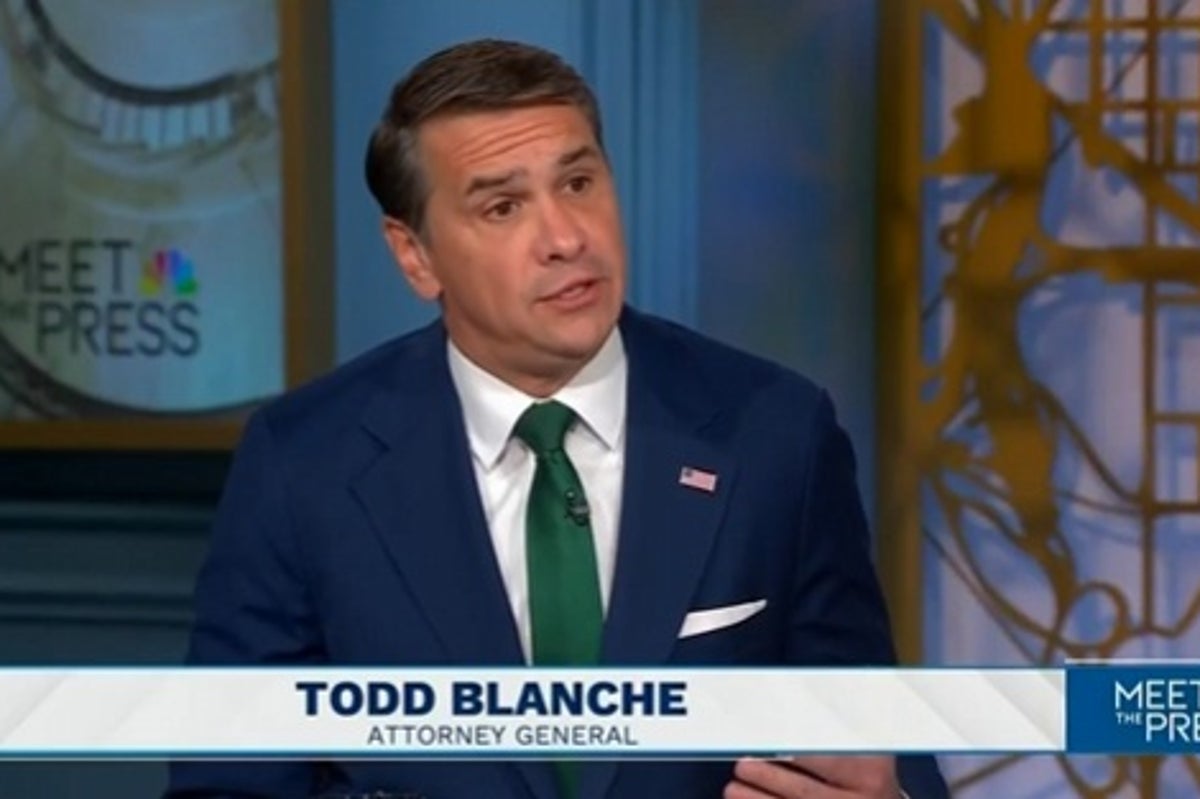
The operational boundary separating the White House from the Department of Justice is not governed by statute, but by an informal post-Watergate convention that treated institutional insulation as a proxy for neutrality. When United States Attorney General Todd Blanche declined to pledge absolute independence from the executive branch, the reaction from legal scholars and political strategists treated the statement as a norm violation. A systems-level analysis suggests a different conclusion: the statement reflects an accurate description of the constitutional hierarchy and the structural realities of executive authority. The Attorney General is a statutory cabinet officer serving at the pleasure of the President. Treating the Department of Justice as an isolated judiciary adjunct ignores the unitary executive theory embedded in Article II of the Constitution.
Deconstructing the relationship requires evaluating the mechanics of prosecutorial discretion. The Department of Justice does not possess independent constitutional standing; its powers are delegated through the executive branch. Historically, the post-Watergate firewall was maintained through mutual restraint rather than legal mandate. Presidents from both parties routinely communicated preferences regarding enforcement priorities, albeit through varying degrees of indirection. Blanche’s refusal to pledge unconditional independence dismantles the pretense of operational detachment, replacing it with an explicit acknowledgment that executive branch priorities flow downward. Meanwhile, you can find related developments here: The Clacton Con: Why Nigel Farage’s Vanity By-Election Backfired Spectacularly.
To analyze the implications of this structural alignment, one must examine the cost function of institutional autonomy versus executive responsiveness.
The Principal-Agent Problem in Federal Law Enforcement
In organizational economics, the Department of Justice functions as an agent executing the mandate of the executive principal, the President. When an agency attempts to establish operational independence from its principal, it creates an agency loss problem. The principal delegates authority to achieve specific policy outcomes—in this context, law enforcement priorities, national security enforcement, and regulatory compliance. To explore the complete picture, check out the excellent article by Reuters.
[Executive Principal (White House)]
       │
       ▼ (Policy Mandate & Strategic Direction)
[Agent (Department of Justice / Attorney General)]
       │
       ▼ (Prosecutorial Discretion & Enforcement)
[Execution (Federal Law Enforcement & Litigation)]
When previous attorneys general asserted total independence, they optimized for public trust and institutional shielding at the expense of executive alignment. This created a dual-power dynamic within the executive branch, where the entity constitutionally charged with executing laws operated as a quasi-independent regulatory body.
Blanche’s framework resolves this principal-agent friction by realigning the Department of Justice with the strategic direction of the White House. Under this operational model, the Attorney General incorporates executive policy views into departmental decision-making, converting the Justice Department from an isolated legal enclave into an aligned instrument of presidential governance.
The Mechanics of Prosecutorial Discretion and Boundaries
Critics argue that abandoning the pledge of independence converts the Justice Department into a political tool. This critique conflates policy alignment with illegality. The constitutional framework establishes distinct checkpoints to prevent the weaponization of law enforcement, independent of whether an attorney general makes verbal pledges of autonomy.
- Statutory Limits: The Attorney General's powers remain bound by federal statute, statutory definitions of criminal conduct, and procedural rules of evidence.
- Judicial Review: Federal courts retain the authority to dismiss prosecutions that demonstrate selective prosecution, vindictive prosecution, or clear violations of due process.
- Internal Professional Standards: Department attorneys and career civil servants operate under professional ethics rules that govern the presentation of evidence and the threshold for bringing charges.
Blanche addressed these boundaries by maintaining that the President would never request an action that crosses an ethical or legal threshold. While critics view this as naive or dismissive, from an administrative standpoint, it establishes the operational boundary: executive input is valid regarding policy priorities, general enforcement strategies, and resource allocation, but transactional intervention in specific adjudications remains constrained by statutory law and judicial oversight.
The Institutional Cost of Structural Realignment
Every organizational design choice involves trade-offs. Moving from an insulated agency model to an executive-aligned model optimizes for policy execution speed and administrative coherence while introducing distinct systemic vulnerabilities.
- Erosion of Public Trust: Institutional legitimacy relies heavily on the perception of neutral arbiters. When the leadership explicitly rejects structural independence, public confidence in the impartiality of criminal investigations declines, leading to intensified polarization of legal outcomes.
- Internal Bureaucratic Friction: Career prosecutors and civil service attorneys accustomed to operational autonomy may experience friction, resulting in compliance resistance, strategic leaks, or increased turnover within specialized divisions.
- Precedent for Successive Administrations: Normalizing direct integration between the White House and the Department of Justice establishes a functional blueprint for future administrations of any political affiliation, permanently altering the baseline expectations of federal law enforcement independence.
The controversy surrounding Blanche’s refusal to pledge independence highlights a permanent shift in administrative governance. The era of treating the Department of Justice as a detached entity operating outside the direct political accountability of the executive branch has concluded. Future evaluations of the department must measure its performance not by the rhetorical insulation of its leadership, but by the legal sustainability of its prosecutions within the framework of judicial review.