The Operational Mechanics of Wildfire Escalation
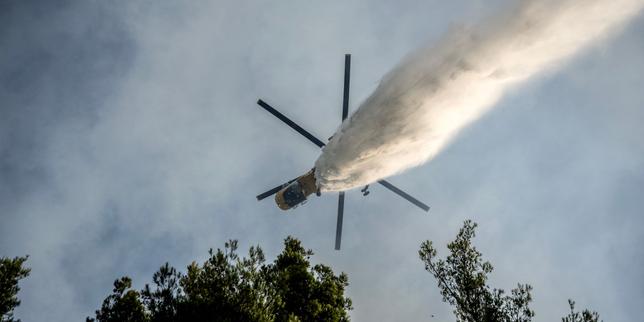
Aerial resource deployment during catastrophic wildfire events depends on strict mathematical tolerances between payload capacity, turnaround velocity, and atmospheric stability. When structural limits are breached, systemic failures ripple across the entire response matrix. The concurrent deployment of suppression aircraft under extreme thermal updrafts creates compounding risk vectors that standard incident management frameworks frequently fail to isolate.
Operational efficiency in high-temperature environments degrades along predictable physical gradients. Thermal lift reduces rotor efficiency, forcing aircraft to operate closer to stall margins while carrying variable water payloads. Simultaneously, smoke density impairs visual flight rules, restricting safe ingress and egress vectors over mountainous terrain. Meanwhile, you can explore related events here: The Chasm Between Paper Rights and Daily Survival for Pakistan Minorities.
Standard reporting mechanisms treat mid-air incidents and extreme wildfire progression as isolated anomalies. This approach obscures the underlying systemic pressures. The intersection of severe weather phenomena and high-frequency sorties creates a high-density operational bottleneck where margin of error approaches zero.
The Three Variables Governing Suppression Failure
Managing large-scale regional blazes requires balancing three interdependent operational constraints. When any single constraint reaches a critical threshold, the entire suppression architecture destabilizes. To understand the full picture, we recommend the recent analysis by NPR.
Thermodynamic Load and Atmospheric Instability
High ambient temperatures paired with prolonged drought conditions alter local air density. Rotor-wing and fixed-wing aircraft experience reduced lift generation precisely when thermal turbulence increases. This inverse relationship between required lift and available atmospheric density creates severe piloting hazards during low-altitude water drops.
Resource Saturation and Turnaround Latency
As active fire perimeters expand, incident commanders face an exponential increase in discrete ignition fronts. The physical limits of regional water sources—such as reservoirs, bays, and mobile tactical tanks—dictate the maximum turnaround frequency for suppression assets. When the travel time between the water source and the fire zone exceeds the rate of fire front propagation, resource saturation occurs.
Coordination Friction in Multi-Agency Airspace
Operating multiple aerial assets simultaneously requires rigid airspace separation protocols. When smoke plumes obscure visibility and ground-to-air communication channels experience congestion, the risk of spatial disorientation increases exponentially. The absence of automated collision avoidance systems optimized for low-level, high-smoke environments forces reliance on visual line-sight execution under extreme stress.
Systemic Vulnerabilities in Mediterranean Topography
Greece presents a unique topographical profile that exacerbates wildfire containment challenges. Rugged peninsular terrain combined with narrow valleys funnels high-velocity winds, creating unpredictable wind shears that accelerate fire spread rates beyond standard predictive models.
[Atmospheric Thermal Updrafts] + [Topographical Wind Funneling]
       ↓
[Reduced Rotor Lift & Visibility]
       ↓
[Compressed Tactical Margin]
       ↓
[Systemic Operational Bottleneck]
Ground-level access routes in these regions are frequently narrow, winding, and unpaved. This physical limitation shifts the primary burden of initial attack onto aerial intervention. When aerial assets are grounded or constrained by safety regulations following operational incidents, regional containment capabilities drop immediately.
Strategic Realignment for High-Intensity Suppression
Mitigating future catastrophic failures demands a shift from reactive asset deployment to predictive capacity modeling. Tactical adjustments must focus on three operational pivots.
First, transition from visual-only low-level flight protocols to sensor-augmented spatial tracking arrays that operate independently of smoke density. Second, establish decentralized staging zones to reduce turnaround latency and prevent fleet bunching over congested airspace. Third, implement hard operational thresholds where thermal lift deficits mandate the immediate grounding of vulnerable rotor-wing assets in favor of high-altitude fixed-wing drops or direct ground containment.
Resource allocation must mirror supply chain risk management principles. Over-reliance on concentrated aerial fleets during peak meteorological anomalies creates single points of failure. True resilience requires structural redundancy, automated deconfliction protocols, and realistic assessment parameters that prioritize crew preservation over unsustainable containment targets.