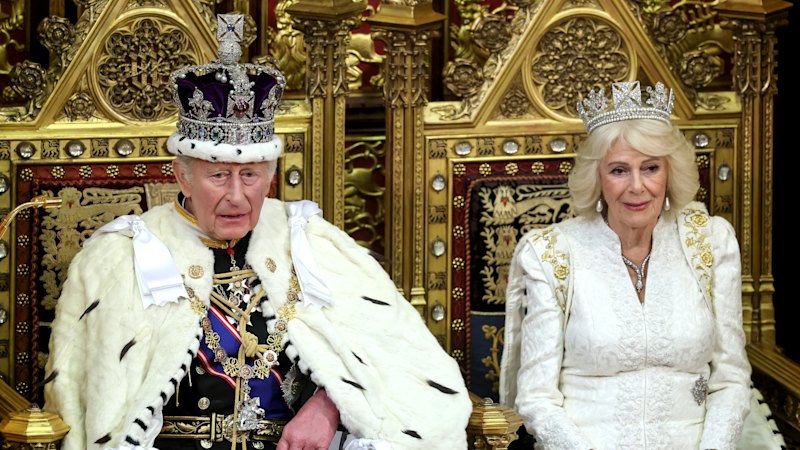
The stability of a constitutional monarchy relies on a binary equilibrium: the Crown provides symbolic continuity while the executive branch absorbs the volatility of policy implementation and public sentiment. When the executive branch—currently the Labour government—suffers a rapid degradation in its polling and internal cohesion, this equilibrium shifts. We are witnessing a structural decoupling where the monarchy maintains institutional calm while the Labour party enters a phase of entropy, creating a vacuum for a new challenger to consolidate power through populism or technocratic reform.
The Entropy of the Labour Mandate
The current crisis facing the Labour government is not a result of a single policy failure but a systemic breakdown in the transition from opposition to governance. This can be analyzed through three primary failure points: If you liked this article, you should read: this related article.
- The Competency Gap: There is a quantifiable delta between the rhetoric of "national renewal" and the logistical reality of ministerial output. High-frequency economic data and legislative bottlenecks indicate a failure to convert a large parliamentary majority into actionable policy.
- Internal Factional Friction: The party is struggling with the "Winner’s Paradox." A large majority brings together disparate ideological wings that were unified only by the goal of winning. Once in power, the friction between the fiscal hawks and the social reformists creates a drag on executive decision-making.
- The Communication Deficit: The inability to control the narrative regarding early-term "scandals" or policy U-turns suggests a breakdown in the centralized messaging apparatus.
The Monarch as the Institutional Anchor
While the political executive fluctuates, the Crown operates on a multi-generational time horizon. The "calm" attributed to the King is not merely a personality trait but a functional requirement of the office. The Monarch’s role during a political crisis is to act as a "Fixed Asset" in the constitutional ledger.
The relationship between the King and a struggling Prime Minister is governed by the Bagehotian rights: the right to be consulted, the right to encourage, and the right to warn. When a government lurches into crisis, the intensity of these private consultations increases. However, the King’s public-facing neutrality serves to de-risk the state itself. By remaining detached from the day-to-day policy failures of the Labour party, the Monarchy prevents the political crisis from becoming a constitutional one. This separation ensures that even if the government collapses, the state remains operational. For another look on this development, see the recent update from TIME.
Anatomy of the Emerging Challenger
The most significant development in this period of instability is the emergence of a viable challenger. This is not merely a change in personnel within the opposition but a shift in the political "Product-Market Fit." The challenger—whether from the right-leaning Reform UK or a rejuvenated Conservative core—is utilizing a specific strategy to exploit Labour’s vulnerabilities.
The Challenger’s Value Proposition
The challenger is positioning themselves against the "managed decline" narrative. Their strategy involves:
- Simplification of Complex Problems: Converting systemic issues like immigration and energy costs into binary choices. This reduces the cognitive load on a frustrated electorate.
- Direct-to-Consumer Politics: Bypassing traditional media filters through digital platforms to build a direct mandate.
- Targeting the 'Left Behind' Demographics: Focusing on the geographical areas where the Labour majority is widest but shallowest—regions where economic stagnation persists despite the change in government.
This challenger does not need to present a comprehensive 500-page manifesto. They only need to demonstrate a perceived "Vitality Index" that contrasts with the perceived "Stagnation Index" of the current government.
The Cost Function of Political Instability
Instability is not just a political problem; it is an economic one. The "Uncertainty Premium" is now being priced into UK markets. When a government appears unable to manage its own internal affairs, foreign direct investment (FDI) plateaus. Investors require a predictable regulatory environment.
The Labour government’s crisis increases the "Risk Coefficient" for long-term infrastructure projects. If the market believes the government might be short-lived or paralyzed by infighting, capital flight becomes a rational response. This creates a feedback loop: political instability leads to economic stagnation, which further fuels political instability.
Mapping the Strategic Pivot
To arrest this decline, the Labour leadership must move from a defensive posture to a structural realignment. This requires a "Hard Reset" of the cabinet and a narrowing of the policy focus to three high-impact areas:
- Fiscal Consolidation: Proving to the markets that the government can manage the national debt without suppressing growth.
- Infrastructure Acceleration: Breaking the planning deadlocks that prevent immediate, visible progress on housing and energy.
- Internal Discipline: Re-establishing the authority of the center to prevent the leaks and factionalism that signal weakness to the electorate.
The King’s role will continue to be one of quiet observation. His stability provides the government with the "Constitutional Cover" necessary to make these difficult pivots. However, the window for this realignment is closing. If the challenger successfully frames the next eighteen months as a period of wasted opportunity, the structural decoupling between the Crown and the Executive will lead to a fundamental reshuffling of the British political order.
The most effective strategy for the incumbent is to stop reacting to the challenger's provocations and start delivering on the core metrics of governance: inflation control, public service wait times, and real-wage growth. Failure to move these needles makes the challenger’s rise not just likely, but inevitable. The King stays calm because he is the institution; the Prime Minister must act because he is merely its temporary occupant.