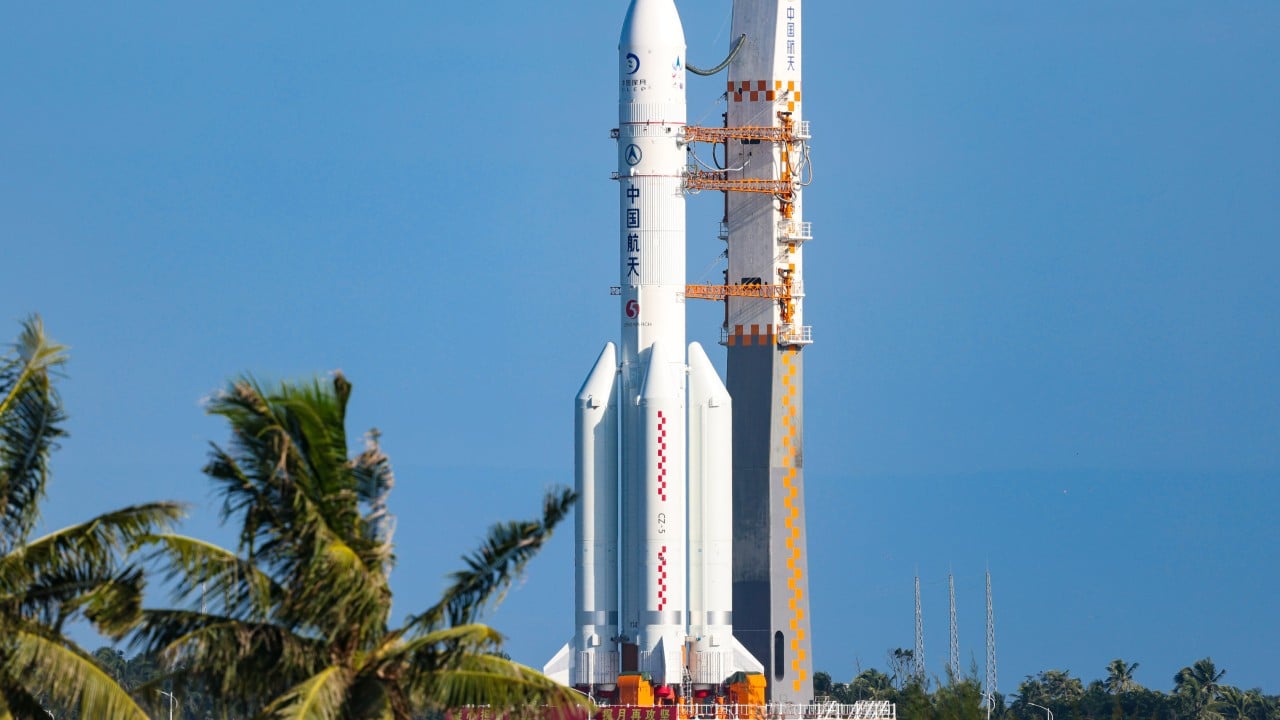
Strategic planning for aerospace infrastructure depends less on uninterrupted execution and more on how systems absorb temporal friction. When launch schedules slip due to technical anomalies or vehicle redesigns, public commentary often fixates on schedule variance as a binary indicator of project health. This superficial metric masks the deeper institutional mechanics at play, particularly within state-directed aerospace hubs like the Wenchang Spacecraft Launch Site on Hainan Island. Analyzing Wenchang requires discarding simplistic delay tracking in favor of evaluating fixed infrastructure capacity, supply chain logistics, and coastal environmental constraints.
Wenchang operates under a distinct operational mandate compared to inland facilities like Jiuquan or Xichang. Its coastal location on Hainan provides a low-latitude advantage, maximizing Earth rotational velocity to increase payload capacity for heavy-lift vehicles such as the Long March 5 and the upcoming Long March 10. Yet, this geographical advantage introduces severe operational variables that dictate schedule adjustments.
Typhoon exposure creates recurring operational blackouts. Facility hardening protocols demand fixed windows for securing ground support equipment, umbilical towers, and mobile launch platforms. When a lunar mission or deep-space probe faces a schedule push, analysts frequently misattribute the variance entirely to onboard vehicle anomalies. In practice, the constraint vector is multi-dimensional, combining launch window celestial mechanics, maritime safety clearing zones in the South China Sea, and local meteorological shutdowns.
The Infrastructure Bottleneck Equation
Evaluating the throughput of a spaceport requires looking at pad turnaround time rather than just static launch frequency. Wenchang utilizes shared launch pads for distinct vehicle classes, creating a scheduling dependency that restricts parallel processing.
When a heavy-lift vehicle experiences a delay during pre-launch checks, it occupies the integration and testing facilities longer than projected. This creates a queuing backlog for subsequent missions. Unlike industrial manufacturing lines where inventory can be buffered, rocket integration facilities operate under strict safety tolerances that limit spatial density. You cannot stage hypergolic propellants or cryogenic stages in close proximity without violating safety radiuses.
The physical separation between the Wenchang assembly building and the coastal pads requires a slow rail transport system. This transport mechanism exposes assembled rockets to high humidity, salt fog, and wind shear. Engineers must balance the efficiency of rolled-out stacking against the risk of environmental degradation. A schedule delay often reflects a deliberate decision to revert a vehicle to the assembly building to inspect thermal protection systems or avionics seals compromised by Hainan coastal conditions.
Geopolitical And Economic Scaling Mechanics
The acceleration of China lunar exploration program, specifically the Chang e series and crewed lunar landing preparations, places unique pressure on Wenchang administrative apparatus. The facility is transitioning from an experimental launch center to a high-cadence commercial and state-run operational hub.
This transition exposes tension between rigid military oversight and commercial schedule demands. State-directed programs prioritize mission success over temporal efficiency, absorbing budget variances to guarantee payload survival. Conversely, commercial operators seeking to utilize Wenchang newly constructed commercial launch pads require predictable turnaround metrics to satisfy capital investors.
The economic model of Wenchang relies on agglomeration effects. By clustering manufacturing, testing, and launch operations within Hainan free-trade zone parameters, policymakers intended to reduce transit friction for heavy components transported by specialized maritime vessels. When port logistics or specialized heavy-lift cargo ships face routing delays, the entire timeline shifts upstream. The launch delay is merely the visible symptom of an upstream maritime logistics constraint.
Maritime Safety Clearances And Global Airspace Coordination
A frequently overlooked variable in launch cadence analysis is the negotiation of drop zones for discarded rocket boosters and fairings. Wenchang trajectories project eastward and southeastward over the South China Sea and international waters.
Executing these trajectories requires advanced coordination with international maritime organizations and neighboring nations to clear shipping lanes and aviation corridors. Geopolitical friction in the region introduces diplomatic latency into the launch clearance process. Even if a vehicle is fueled and technically ready on the pad, an unresolved maritime safety notice can force a hold. The administrative overhead of securing these zones scales non-linearly with launch frequency. As mission profiles shift from uncrewed orbital tests to complex lunar injection maneuvers, the required safety footprint expands, magnifying the impact of any diplomatic or logistical friction.
Strategic Capital Allocation For Future Heavy Lift
To maintain momentum despite technical setbacks, operational adjustments must focus on decoupling pad operations from vehicle assembly. Constructing dedicated, independent pads for reusable vertical landing vehicles will reduce the cross-contamination of schedules between legacy expendable architectures and next-generation reusable systems.
Investment must target automated pre-launch diagnostic systems that minimize human presence in hazardous coastal environments during high-wind conditions. By shifting from time-based maintenance schedules to condition-based telemetry monitoring, ground crews can reduce unnecessary destacking operations.
Future throughput will depend on establishing localized component manufacturing rather than relying on mainland maritime transport for major structural elements. Eliminating the sea-freight variable from the supply chain insulates the launch site from external logistical bottlenecks. The trajectory of Wenchang is defined by its capacity to engineer resilience into its physical and administrative infrastructure, turning environmental and logistical vulnerabilities into managed variables rather than mission-stopping events.