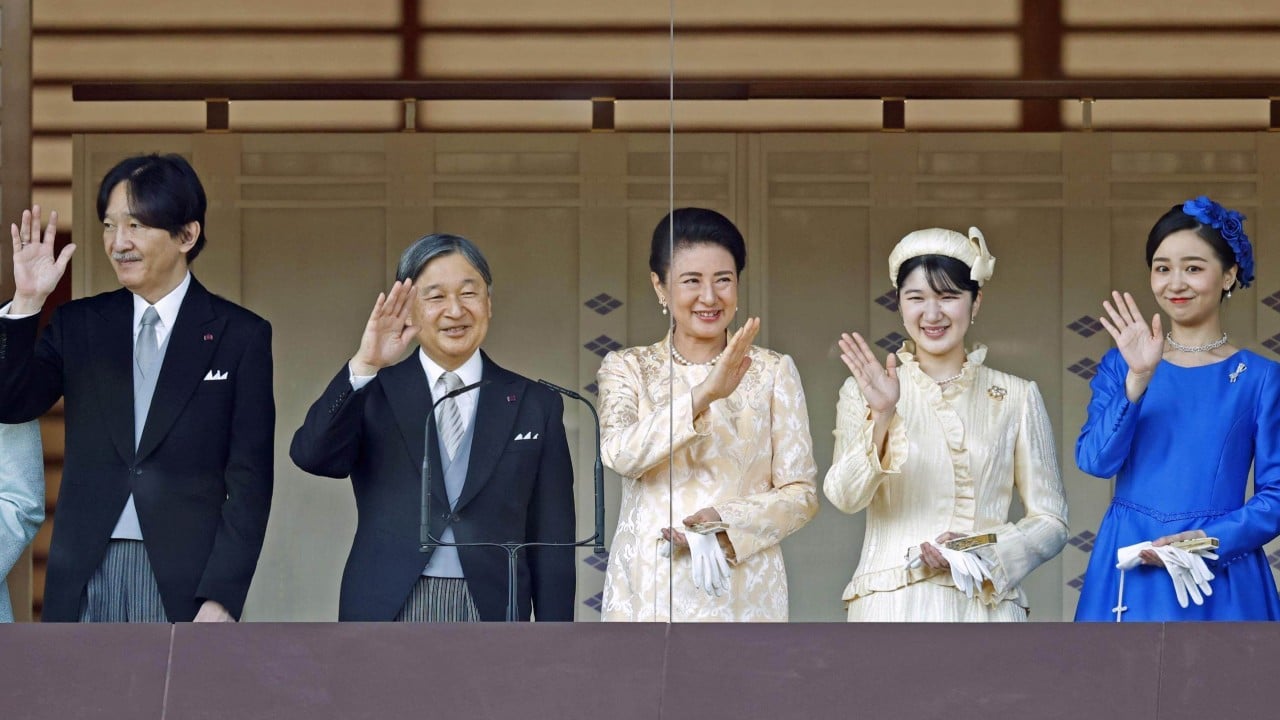
Japan’s revised Imperial House Law attempts to solve a terminal demographic math problem using two conservative administrative patches rather than altering the underlying patrilineal succession rule. By allowing female imperial family members to retain their royal status after marriage and permitting the adoption of male descendants from former collateral branches, the legislation arrests immediate institutional shrinkage without resolving the single-point-of-failure risk inherent in male-only primogeniture.
For decades, the Imperial Household Agency has operated under an acute human-capital deficit. Under the 1947 Imperial House Law, the pool of eligible heirs and working royals contracts exponentially with each generation because women forfeit their status upon marrying commoners, while strict patrilineal rules bar matrilineal descendants from the Chrysanthemum Throne. With the majority of the current imperial family consisting of aging adults and unmarried women, the institution faced an operational collapse in public duties alongside a looming succession cliff centered on a single young male heir, Prince Hisahito. Rather than expanding succession eligibility to female descendants—a move backed by consistent domestic polling but blocked by traditionalist factions within the ruling Liberal Democratic Party—lawmakers opted for a structural workaround designed to stabilize headcount while preserving the unbroken male line.
The Two Mechanisms of Headcount Stabilization
To prevent the administrative hollowing-out of the monarchy, the revised framework introduces two distinct legal levers. Both mechanisms target the symptom of declining numbers without touching Article 1 of the Imperial House Law, which restricts succession strictly to male-line males.
Post-Marital Status Retention for Female Royals
Under the previous statutory regime, marriage to a non-royal triggered automatic expulsion from the imperial register, stripping the individual of state stipends, security details, and official duties. The revision grants female members the option to retain their imperial rank and public responsibilities post-marriage. Crucially, this status is non-transferable: neither the commoner husband nor any resulting children acquire imperial status. The state essentially converts these women into lifetime institutional contractors, preserving their capacity to perform diplomatic, ceremonial, and philanthropic duties without altering the genealogical boundaries of the throne.Collateral Male Adoption from Former Cadet Branches
The second mechanism authorizes the imperial family to adopt male descendants from the eleven collateral branches (kyu-miyake) stripped of royal status during the 1947 post-war reforms. For nearly eighty years, these families have lived as ordinary Japanese citizens, entirely detached from state governance and royal protocol. The revised law establishes a legal pathway to re-integrate biological males from these bloodlines into existing imperial households. Unlike the first mechanism, which solely addresses ceremonial workload, collateral adoption is engineered to expand the pool of eligible male-line heirs, providing a theoretical backup to the direct lineage.
Operational Bottlenecks and Constitutional Friction
While the legislation appears balanced on paper, executing these two mechanisms introduces severe legal, financial, and sociological friction. Institutional design cannot ignore the human incentives of the participants involved.
The first bottleneck lies in the legal status of non-royal spouses and children under the female retention model. Creating a household where a princess holds sovereign-adjacent public duties while her spouse and children remain private citizens governed by ordinary civil law creates an unprecedented jurisdictional split. Private citizens possess constitutional rights to free speech, political participation, and unrestricted employment—rights explicitly denied to imperial family members, who lack voting privileges and family surnames. If a princess’s commoner husband engages in private business ventures or political commentary, the resulting conflicts of interest could compromise the constitutionally mandated political neutrality of the Emperor. Policing the financial and professional lives of private citizens to protect the public standing of their royal spouses requires an intrusive, legally tenuous regulatory apparatus.
The second bottleneck concerns the viability of collateral adoption. The individuals targeted for adoption are adult and adolescent males raised in modern, egalitarian, private-sector environments. Accepting adoption into the imperial family requires surrendering fundamental civil liberties: the right to vote, the right to choose a career, the right to reside freely, and the right to personal privacy. In exchange, the adoptee assumes a lifetime of rigid ceremonial obligation under intense media scrutiny. Because the law cannot conscript private citizens into the monarchy, the entire mechanism relies on voluntary compliance. Without willing candidates—or if candidates withdraw after confronting the reality of palace restrictions—the adoption clause remains a dead letter.
Third, the legislation triggers immediate fiscal and organizational strain within the Imperial Household Agency. Retaining married princesses requires establishing new bureaucratic sub-offices (miyake equivalents), allocating permanent state budgets for their residences and staff, and expanding security operations. Taxpayers, already sensitive to state expenditures during periods of economic stagnation and demographic decline, must absorb the recurring overhead of newly constituted royal households whose members remain barred from the line of succession.
The Succession Risk Profile Remains Unchanged
A rigorous distinction must be drawn between ceremonial capacity and dynastic continuity. The revised law addresses the former while offering only a fragile hedge for the latter.
Even if every eligible female royal chooses to retain her status after marriage, the total number of individuals eligible to ascend the throne remains static unless collateral adoption succeeds at scale. The mathematical probability of dynastic extinction is dictated entirely by the number of male births within the qualified patrilineal pool. Under the pre-revision baseline, the survival of the 2,600-year-old institution rested on a single generational node: Prince Hisahito’s ability to marry and produce a male child.
Relying on collateral branches to mitigate this single-point-of-failure risk introduces acute legitimacy hazards. Public acceptance of the modern Japanese monarchy rests heavily on familiarity and the symbolic intimacy cultivated by the immediate imperial family since the postwar era. Elevating a private citizen—who shares a common ancestor with the current Emperor from over six centuries ago—directly into the line of succession risks alienating a domestic public that overwhelmingly favors direct female-line succession. Institutional legitimacy is not purely a function of statutory legality; it requires sustained public consent. If the populace views an adopted heir as an artificial construct engineered by political elites to bypass gender equality, the symbolic authority of the throne erodes.
Second-Order Consequences for Governance and Public Perception
Implementing this dual-track system sets off predictable chain reactions across Japanese political and social spheres.
First, it institutionalizes a two-tier hierarchy within the palace. Female royals who remain in the family will shoulder the bulk of domestic and international ceremonial labor—hosting foreign dignitaries, chairing disaster relief foundations, and representing the state abroad—while remaining permanently excluded from the institution's highest office. This formalizes gender-based labor extraction within a state-funded body, creating continuous friction with Japan’s broader corporate and diplomatic commitments to gender parity.
Second, the status of children born to retained princesses will generate an inevitable next-generation crisis. Within twenty years, these children will reach adulthood as commoners raised inside palace compounds, intimately connected to the sovereign yet legally barred from royal duties. As the retained princesses age and retire, the exact same ceremonial labor shortage will re-emerge, forcing lawmakers back into the same legislative deadlock. The revised law buys roughly two to three decades of operational stability, functioning as a bridge rather than a permanent architecture.
Third, the vetting process for collateral adoptees will politicize the monarchy. Selecting which private citizen enters the line of succession requires executive and legislative oversight, transforming what was historically an automatic biological inheritance into a political appointment. Opposition parties and media organizations will scrutinize the personal histories, financial records, and ideological leanings of prospective adoptees, dragging the imperial institution directly into partisan warfare.
Strategic Imperatives for Institutional Execution
Because the legislative framework is now fixed, the survival and stability of the imperial system depend entirely on execution by the Imperial Household Agency and the Cabinet Secretariat. Administrators must immediately implement three operational safeguards to prevent the revised law from collapsing under its own contradictions:
- Codify strict ethical firewalls for non-royal spouses. Before any princess exercises the retention option, the government must establish clear, legally binding compliance guidelines governing the employment, asset management, and public statements of commoner husbands. Ambiguity will invite scandal; rigid pre-nuptial administrative agreements are essential to insulate the throne from private-sector conflicts of interest.
- Decouple ceremonial workload from dynastic eligibility. The Imperial Household Agency must radically prune the calendar of minor ceremonial patronages, ribbon-cuttings, and provincial tours. Preserving headcount is futile if the administrative demand for royal appearances remains pegged to mid-twentieth-century levels. Reducing baseline operational output prevents burnout among retained female royals and reduces the fiscal footprint of newly maintained households.
- Establish transparent, non-partisan vetting criteria for collateral adoption. If the adoption mechanism is activated, candidate selection must be insulated from ruling-party factionalism through an independent advisory council composed of constitutional scholars, senior diplomats, and former Supreme Court justices. Without a transparent, meritocratic screening protocol, any adopted heir will enter the palace with a fatal deficit of public trust.


