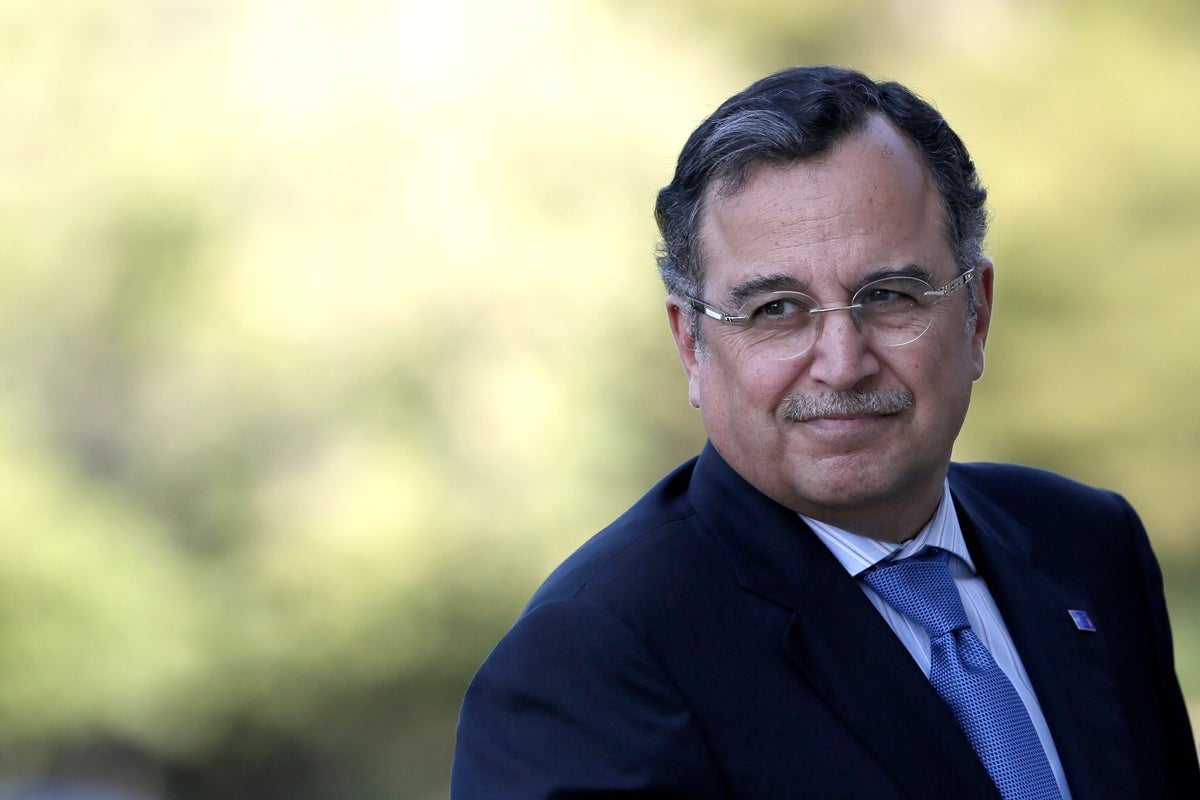
The appointment of Nabil Fahmy as the Secretary-General of the Arab League represents a pivot from traditional consensus-seeking diplomacy toward a model of technical-strategic realism. The Arab League has historically struggled with a structural disconnect between its administrative mandate and the diverging geopolitical interests of its 22 member states. Fahmy, a former Egyptian Foreign Minister and veteran diplomat, enters this vacuum not as a mere figurehead but as a potential architect of institutional reform. The central thesis of his tenure will likely focus on the transition from a "reactive forum" to a "proactive bloc" capable of navigating a multipolar global order where regional stability is no longer guaranteed by external hegemony.
The Tripartite Crisis of the Arab League
To understand the stakes of this leadership change, one must define the three specific institutional failures that have rendered the League increasingly marginal in global affairs.
- The Sovereignty Bottleneck: The Arab League’s Charter, established in 1945, prioritizes absolute sovereignty. This creates a paralysis where any significant collective action is vetoed by dissenting minorities. Fahmy’s primary challenge is not to eliminate this bottleneck—which is politically impossible—but to bypass it through "coalitions of the willing" or issue-specific sub-groupings.
- The Capability-Expectation Gap: The League is often tasked with mediating complex civil wars (e.g., Syria, Libya, Yemen) without the military, financial, or legal mechanisms to enforce its resolutions. This gap erodes its credibility on the international stage.
- Economic Fragmentation: Despite the Greater Arab Free Trade Area (GAFTA), intra-regional trade remains anemic compared to trade with the EU, China, and the United States. The League has failed to synchronize regulatory frameworks, leaving member states to compete rather than cooperate in global markets.
Fahmy’s Strategic Framework: The Realist Pivot
Nabil Fahmy’s professional background suggests a departure from the pan-Arab idealism of the mid-20th century. His approach is likely to be characterized by three specific operational shifts.
Diplomatic Diversification
Fahmy understands that the "American era" in the Middle East has transitioned into a complex landscape of competing influences involving Russia, China, and the European Union. His tenure will likely emphasize a "multi-vector" foreign policy for the League. This involves formalizing high-level strategic dialogues with the Shanghai Cooperation Organisation (SCO) and the BRICS+ bloc, ensuring that Arab interests are represented in the drafting of new global trade and security architectures.
Functionalism over Ideology
The most effective way to revitalize a stagnant international organization is to focus on low-politics, high-impact functional cooperation. Fahmy is expected to prioritize:
- Water Security and Resource Management: Given the existential threat of water scarcity in the MENA region, the League may seek to establish a regional water council with binding technical standards.
- Energy Integration: Moving beyond oil exports to create an integrated regional power grid, facilitating the transfer of renewable energy from high-yield zones like Saudi Arabia and Morocco to energy-deficient members.
- Cybersecurity Protocols: Establishing a unified framework for data protection and cyber-defense to protect regional financial systems from state and non-state actors.
Institutional Re-engineering
The Secretary-General’s office has traditionally functioned as a high-level secretariat. Fahmy’s appointment signals a move toward a more empowered executive role. This requires a modernization of the League’s internal bureaucracy, shifting away from patronage-based appointments toward a meritocratic civil service model. If Fahmy can reform the League’s budgetary processes and make funding contingent on specific performance metrics, he can transform the organization into a reliable partner for international development banks.
The Geopolitical Cost Function of Success
Any advancement under Fahmy’s leadership will incur specific political and diplomatic costs. The most significant variable is the relationship between the League and non-Arab regional powers—specifically Iran, Turkey, and Israel.
The "Cost of Inclusion" refers to the diplomatic capital spent attempting to integrate these powers into a regional security framework. If Fahmy pursues a hardline Arab-centrism, he risks further polarization. If he pursues a "Neighborhood Policy," he may alienate nationalist factions within the member states. The strategy will likely be one of "Selective Engagement," where the League acts as a unified negotiator on specific issues like maritime borders or counter-terrorism, rather than attempting a grand regional bargain that the current geopolitical climate cannot support.
Security Architecture and the "Arab Force" Concept
The perennial discussion of a "Joint Arab Force" has long been dismissed as a logistical impossibility. However, under Fahmy, the concept may evolve into a "Modular Security Framework."
Instead of a standing army, this model focuses on:
- Intelligence Interoperability: Creating a centralized clearinghouse for counter-terrorism data.
- Logistical Pre-positioning: Establishing regional hubs for humanitarian aid and disaster response, which can be scaled into security infrastructure if necessary.
- Standardized Training: Using the Egyptian and Saudi military academies as the basis for a unified officer training curriculum.
This approach addresses the primary obstacle to a joint force: trust. By building cooperation at the technical and logistical levels, Fahmy can create a foundation for more advanced security integration in the future.
Economic Interdependence as a Stabilization Mechanism
The League’s survival depends on its ability to prove its economic utility. The "Wealth-Security Nexus" suggests that regional stability is directly correlated with the degree of economic interdependence between neighbors.
Fahmy’s leadership will likely champion the "Arab Digital Market." By harmonizing digital regulations, the League can lower the barrier to entry for tech startups across the region, allowing a firm in Cairo to scale seamlessly into the Gulf and the Maghreb. This is not merely an economic initiative; it is a demographic one. With a massive youth population entering the workforce, the failure to create a unified digital economy is a primary driver of future social unrest.
Navigating the Egypt-Saudi Power Dynamic
A critical, often unstated, challenge for any Secretary-General is managing the influence of Cairo and Riyadh. As an Egyptian national, Fahmy must maintain the support of his home country while acknowledging that the financial and political center of gravity has shifted toward the Gulf.
The "Dual-Anchor Strategy" involves positioning the League as the bridge between Egyptian human capital and military weight and Saudi financial resources and vision-driven leadership. If Fahmy can successfully align Egypt’s "State Capital" model with the "Vision 2030" frameworks of the Gulf states, the Arab League can function as a multiplier for regional projects rather than a battleground for influence.
Identifying the Bottlenecks to Reform
Despite Fahmy's credentials, several systemic risks could derail his agenda.
- The Funding Gap: Several member states are in arrears, and the League’s budget is minuscule compared to its mandate. Without a reliable revenue stream—perhaps a micro-tax on intra-regional cross-border transactions—Fahmy will be forced to rely on the largesse of a few wealthy donors, compromising his neutrality.
- The Legitimacy Deficit: The Arab League is often perceived by the "Arab Street" as a club for elites that is disconnected from the daily struggles of the population. If Fahmy’s reforms remain purely bureaucratic and do not translate into tangible improvements in mobility, employment, or security, the League will continue to lose relevance.
- External Spoilers: Global powers often find a fragmented Arab world easier to manage. Any move toward genuine unity will face quiet resistance from external actors who benefit from bilateral arrangements that favor their specific interests.
The Strategic Path Forward
The success of Nabil Fahmy’s tenure will be measured not by the number of resolutions passed, but by the degree to which he can professionalize the Arab League’s output. This requires a shift from "High Diplomacy"—which often results in empty rhetoric—to "Precision Governance."
The first 100 days must focus on an "Audit of Capabilities," identifying which departments within the League are functional and which are redundant. This must be followed by the establishment of a "Strategic Foresight Unit" tasked with modeling regional risks 10 to 20 years into the future, specifically focusing on the energy transition and climate-driven migration.
Ultimately, Fahmy’s role is to manage the decline of the old Arab order while seeding the ground for a new one. This involves a cold, calculated assessment of what is possible within the constraints of member state interests. The goal is a "Resilient Arab Core"—a group of stable, economically integrated states that can act as a stabilizer for the more volatile periphery. This realism is the only viable path for an organization that has spent too long chasing the ghosts of a unity that never existed.