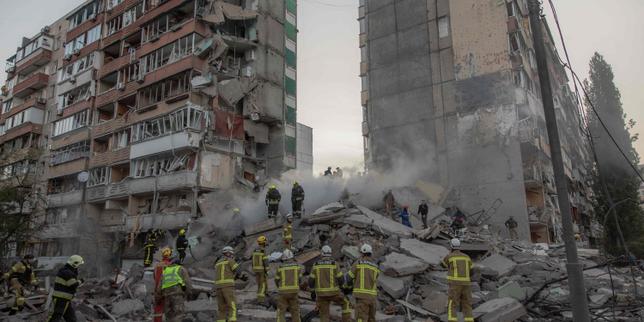
The recent large-scale aerial bombardment of Kiev represents a fundamental shift from psychological warfare to a resource-attrition model designed to collapse integrated air defense systems (IADS). Modern urban siege dynamics in the 2020s are no longer defined by the mere destruction of physical infrastructure; instead, they function as a high-stakes calculus of interceptor-to-target ratios. When a saturation attack occurs, the primary objective is the forced depletion of expensive, limited-supply surface-to-air missiles (SAMs) using low-cost autonomous munitions.
The Attrition Asymmetry Framework
The Russian Federation’s current aerial doctrine relies on a multi-layered saturation tactic. By analyzing the composition of the flight paths over Kiev, we identify three distinct operational layers that create a "cost-sink" for the defender.
- The Kinetic Decoy Layer: Deployment of "Geran-3" or similar low-observable, slow-moving loitering munitions. These units cost approximately $20,000 to $50,000 per unit but require an interceptor that often costs between $500,000 and $2 million.
- The Electronic Suppression Layer: Integration of Kh-31P anti-radiation missiles designed to home in on the radar signatures of the Patriot or IRIS-T batteries as they engage the first layer.
- The Precision Strike Layer: Hypersonic Kinzhal or Iskander-M ballistic missiles timed to impact when the defense grid is saturated or reloading.
This creates a Negative Defense Coefficient. If the defender ignores the first layer, the accumulated damage to the power grid causes systemic civil failure. If the defender engages the first layer, they risk running out of interceptors before the third layer arrives. The strategic goal of the attacker is not necessarily to hit a specific building, but to force the defender to "empty their magazines" on worthless plastic and lawnmower engines.
Interceptor Economics and Logic Gates
The defense of a capital city like Kiev operates on a binary logic gate: Intercept or Absorb. The decision-making process for an automated fire-control system must categorize incoming threats in milliseconds.
- Priority 1: Ballistic Threats. High-velocity targets that cannot be intercepted by Gepard-style anti-aircraft guns. These must be met with PAC-3 MSE or similar kinetic hit-to-kill interceptors.
- Priority 2: Cruise Missiles. Aerodynamic targets like the Kalibr. These are vulnerable to medium-range systems but possess enough maneuverability to bypass simple point defenses.
- Priority 3: Loitering Munitions. These are "bulk" threats.
The bottleneck for Kiev is the Recharge Rate vs. Arrival Rate. If the arrival rate of drones exceeds the slew-and-fire rate of the SAM batteries, a "leakage" occurs. Current data suggests that Russian planners are utilizing "swarm-clustering," where 15 to 20 drones enter a single 10-degree radar sector simultaneously. This forces the radar to lock onto multiple targets, creating a processing overhead that can delay the launch of the second or third interceptor, allowing at least one drone to penetrate the inner perimeter.
Structural Vulnerabilities in District-Level Heating
The targeting of Kiev in May 2026 focuses heavily on the "Total Energy Loop." While global attention focuses on electricity, the real structural vulnerability lies in the centralized heating networks. Unlike electrical grids, which can be rerouted through transformers and secondary lines, centralized steam and hot water pipes are rigid.
The destruction of a Thermal Power Plant (TPP) during a night attack does two things:
- It induces a rapid thermal drop in residential high-rises, which, even in spring, causes structural contraction and plumbing failures.
- It removes the "buffer" capacity of the grid, making it harder to restart the system after a subsequent surge or strike.
This is a Cascading Failure Model. The attack on Kiev's energy nodes is a precursor to a wider logistical collapse. When energy fails, water pumps fail; when water pumps fail, sewage systems back up; when sewage fails, the city becomes biologically uninhabitable regardless of the military presence on the ground.
The Sensor-to-Shooter Latency Gap
One of the most critical elements missed in standard reporting is the role of A-50U Mainstay airborne early warning aircraft operating over Russian territory. These platforms provide real-time telemetry to the missile cruise units while they are mid-flight.
Modern cruise missiles are no longer "fire and forget" in the traditional sense. They are "network-corrected." If the Kiev defense grid moves a mobile SAM launcher to a new position to hide its signature, the A-50U detects the movement and sends a course correction to the incoming Kh-101 missile via satellite link. This reduces the Circular Error Probable (CEP) to less than 5 meters.
The counter-strategy involves the use of passive sensors—infrared and acoustic detectors—that do not emit a signal for anti-radiation missiles to track. However, these sensors have shorter ranges and require a much higher density of deployment to be effective. Kiev’s current defense is shifting toward a "Silent Grid" approach, where the main radars remain off until acoustic sensors in the suburbs trigger a localized engagement window.
Mathematical Realities of Modern Air Defense
To understand the scale of the Kiev night attacks, one must apply the Lanchester Square Law, which relates the strengths of opposing forces. In aerial combat, the "combat power" of the attacker is proportional to the square of the number of munitions deployed.
$$P_a \propto N^2$$
If the Russian aerospace forces double the number of drones in a single wave, the complexity of the defense task quadruples. This is because each additional drone requires not just a missile, but radar tracking time, identification (IFF) cycles, and post-impact assessment. The defender is always at a mathematical disadvantage in a saturation environment because they must achieve a 100% intercept rate to ensure safety, whereas the attacker only needs a 5-10% "leakage" rate to achieve strategic disruption.
Operational Recommendations for Defense Hardening
To counter the current Russian trajectory of saturation-attrition, the defense of major urban centers must move away from high-cost missile reliance and toward Directed Energy and Kinetic Volume.
- Electronic Warfare (EW) Bubbles: Implementing GPS-spoofing and signal jamming at the neighborhood level to "blind" loitering munitions, forcing them into unguided flight paths where they can be engaged by cheaper flak guns.
- Decoy Proliferation: For every real Patriot battery, the defense must deploy five high-fidelity thermal and radar decoys. This forces the Russian "Layer 2" (anti-radiation missiles) to waste limited assets on plywood and heaters.
- Distributed Power: Moving away from centralized TPPs toward modular, containerized gas-turbine generators. This breaks the "Total Energy Loop" vulnerability and makes the grid resilient to single-point-of-failure strikes.
The conflict over Kiev’s airspace has moved beyond a battle of wills; it is now a battle of industrial throughput. The actor that can produce the most "units of destruction" or "units of interception" at the lowest marginal cost will ultimately dictate the terms of the urban environment. Future engagements will likely see an increase in autonomous AI-driven turret systems capable of tracking 50+ targets simultaneously without human intervention, as the human reaction time is becoming the primary bottleneck in the defense of the capital.
The immediate strategic priority must be the transition to high-rate-of-fire kinetic systems (30mm and 35mm programmable airburst ammunition) to preserve the high-end PAC-3 stocks for the inevitable arrival of the next generation of hypersonic threats. Failure to decouple the defense of the energy grid from the defense against ballistic missiles will lead to a total depletion of western-supplied interceptors by the next winter cycle.


:max_bytes(150000):strip_icc():focal(819x186:821x188)/Murdaugh-Family-e90854a716884d608fb6fd925e18d840.jpg)
