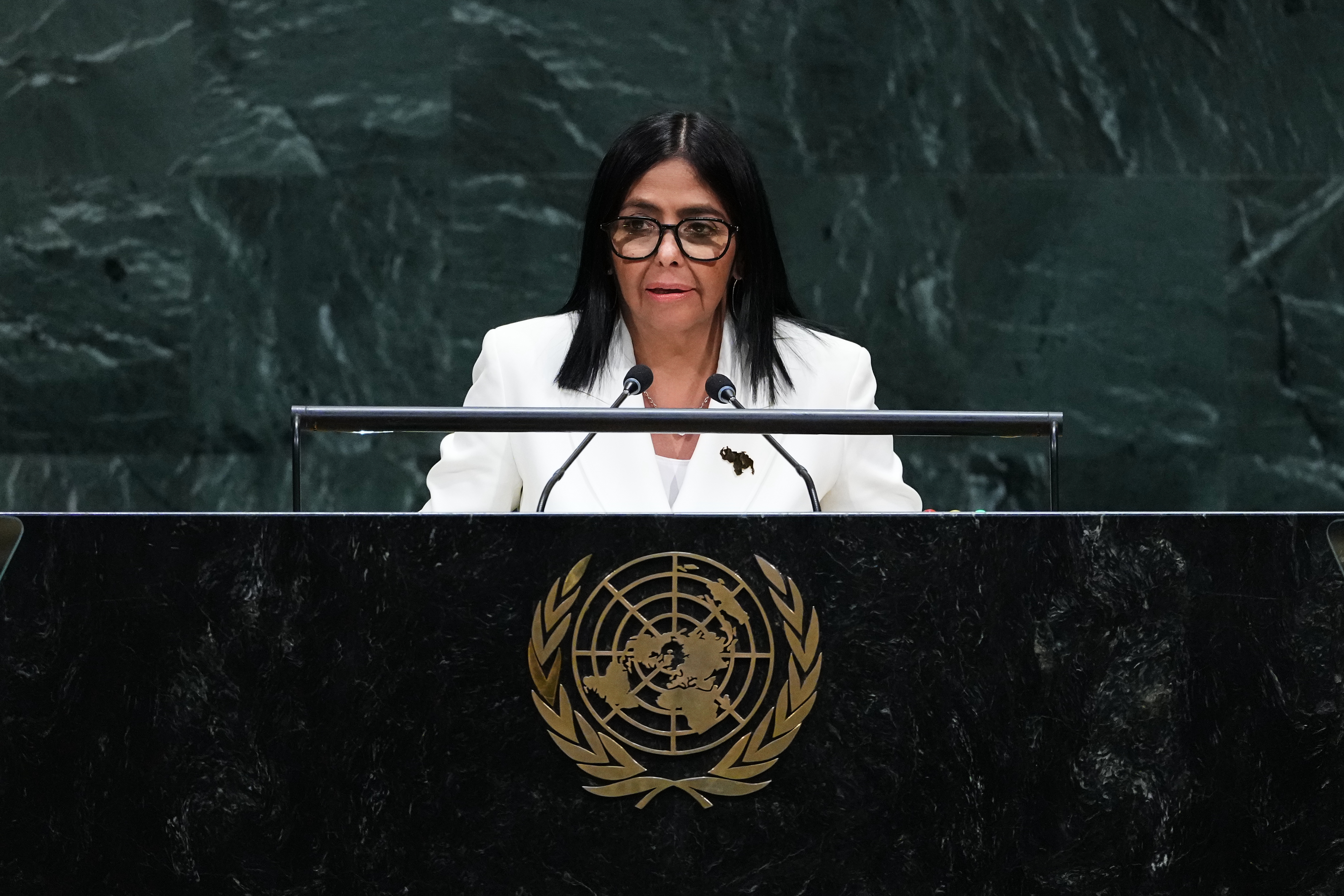
When an acting head of state uses the United Nations General Assembly to promise elections at the "right moment," the statement is not a diplomatic platitude; it is a deliberate mechanism of temporal arbitrage designed to extract international legitimacy while retaining domestic coercive control. Standard political reporting treats such declarations as ambiguous stalling tactics or hopeful signs of democratic transition. Both interpretations miss the structural reality of authoritarian and hybrid-regime survival. In Venezuela, the timing of an electoral event is the primary endogenous variable controlled by the executive branch to manage external sanctions, fracture domestic opposition coalitions, and consolidate state apparatus loyalty.
To understand the operational utility of the "right moment" doctrine, analysts must separate public diplomatic signaling from internal regime survival metrics. The phrase functions as an undefined option contract. By refusing to attach a calendar date or objective institutional benchmarks to the electoral promise, the acting leadership retains unilateral authority to define when conditions are met. This shifts the burden of proof onto international observers and domestic challengers, forcing them to negotiate over the definition of readiness rather than the mechanics of power transfer. Don't miss our recent post on this related article.
The Architecture of Strategic Ambiguity
In political science and game theory, commitments without deadlines or verifiable enforcement mechanisms are classified as cheap talk unless they alter the payoff matrix of the players involved. A speech at the United Nations General Assembly alters that payoff matrix by introducing an international audience cost—not for the speaker, who faces minimal domestic penalty for delaying a vote, but for foreign policymakers who must justify maintaining punitive economic measures against a government ostensibly committed to a democratic path.
This diplomatic maneuver operates through three distinct structural mechanisms: If you want more about the context of this, The Guardian provides an informative summary.
- Sanctions Relief Decoupling: Foreign economic restrictions, particularly those targeting sovereign debt and state-owned energy enterprises, are typically tied to concrete democratic milestones. By framing elections as an inevitability contingent upon broader economic and political stabilization, the acting leadership attempts to invert the sequence of concessions. The implicit demand becomes the lifting of external financial blockades prior to the scheduling of a vote, arguing that free elections cannot occur under conditions of economic asphyxiation.
- Opposition Asymmetric Exhaustion: Political movements operating under constrained civic space rely on mobilization cycles to maintain relevance and funding. A fixed election date allows an opposition coalition to concentrate resources, select unified leadership, and build voter turnout infrastructure toward a singular crescendo. An indefinite timeline forces the opposition into a state of permanent, low-grade mobilization. This drains financial reserves, exacerbates internal ideological fissures between maximalist and moderate factions, and induces voter fatigue long before a ballot is printed.
- Institutional Gatekeeping: The phrase "right moment" presupposes the existence of a neutral arbiter capable of diagnosing institutional health. In practice, the state apparatus retains sole diagnostic authority. Issues ranging from electoral registry updates and judicial disqualifications of opposition candidates to the lifting of media censorship are converted from legal rights into discretionary administrative phases. Each phase can be paused indefinitely under the pretext of technical necessity.
Known Facts Versus Analytical Hypotheses
Rigorous assessment requires separating documented political behavior from strategic projection.
It is an established fact that Venezuela’s executive branch exercises dominant influence over the National Electoral Council (CNE) and the Supreme Tribunal of Justice (TSJ). Historical precedent demonstrates that electoral calendars in Caracas have repeatedly been compressed or expanded to align with shifts in global oil prices, domestic inflation spikes, and fragmentation within the opposition. Furthermore, appearances by interim or acting leaders at the UN General Assembly historically serve to secure diplomatic credentials, protect overseas state assets from legal seizure, and neutralize regional isolation efforts.
What remains a working hypothesis is the exact internal threshold the current acting leadership uses to define the "right moment." Without access to private deliberations within the ruling party and the high command of the Bolivarian National Armed Forces (FANB), observers cannot confirm whether the delay is primarily intended to engineer a guaranteed electoral victory through structural advantages, or to negotiate exit guarantees and immunity agreements for senior officials before a competitive vote takes place. Both hypotheses are consistent with the observed behavior, and they are not mutually exclusive.
The Domestic Cost Function of Delay
Holding power without a fresh electoral mandate is not cost-free, even in a system with weakened democratic checks. The decision to defer elections imposes compounding operational costs on the acting administration, creating a dynamic optimization problem where the regime must balance the risk of losing a vote against the risk of systemic collapse caused by prolonged illegitimacy.
The first major cost is economic governance paralysis. Foreign direct investment, particularly in capital-intensive sectors like heavy crude extraction and natural gas infrastructure, requires multi-year legal certainty. International energy firms and sovereign lenders assess political risk based on the constitutional durability of the counterparty. An acting administration operating on an indefinite timeline cannot easily issue binding long-term concessions, as a future government—or a re-legitimized international coalition—could declare those contracts null and void. This restricts the state to short-term, high-discount-rate transactions with non-Western intermediaries, severely limiting fiscal revenue.
The second cost involves elite cohesion management. Authoritarian and transitional coalitions are held together by the predictable distribution of rents and state offices. An acting leadership structure is inherently viewed by internal factions as provisional. Without an election to ratify a permanent hierarchy, rival power brokers within the ruling apparatus face incentives to hedge their bets, hoard resources, or engage in factional infighting to position themselves for the eventual succession. Delaying the vote extends the period of internal uncertainty, requiring the acting leader to expend greater political capital and patronage just to maintain basic bureaucratic compliance.
The International Diplomatic Arena
Delivering this message at the United Nations rather than a domestic rally is a deliberate choice of venue. The UN General Assembly operates on the principle of sovereign equality, providing a platform where de facto control of territory and state institutions translates directly into diplomatic recognition.
When an acting leader addresses the Assembly, the primary target is not the domestic electorate, which is largely insulated from diplomatic rhetoric by immediate economic concerns, nor is it the most hawkish foreign governments that refuse to recognize the administration's legitimacy. The target is the broad middle tier of international actors: regional neighbors, non-aligned states, and multilateral financial institutions.
For neighboring countries dealing with the downstream externalities of Venezuelan instability—specifically migration flows, cross-border illicit economies, and regional security threats—stability often takes precedence over immediate democratization. A promise of future elections gives these regional actors the diplomatic cover needed to normalize bilateral relations, reopen consulates, and engage in pragmatic border management without appearing to endorse indefinite autocracy. Once regional normalization takes hold, the multilateral pressure required to force rapid electoral concessions dissipates.
Evaluating Institutional Readiness Metrics
If external actors accept the premise that elections require specific preconditions, they enter a conceptual trap unless those preconditions are rigorously quantified. In functional democracies, electoral readiness is a baseline administrative state. In transitional or contested environments, the ruling apparatus often weaponizes the concept of "conditions" to manufacture delays.
To counter this, political risk analysts evaluate electoral viability not through executive promises, but through observable shifts in four institutional bottlenecks:
- Voter Registry Accessibility: The speed and transparency with which millions of diaspora voters and newly eligible young citizens are added to the electoral roll. A failure to open consular registration abroad or deploy mobile registration units domestically indicates an intent to restrict the electorate rather than prepare for a vote.
- Candidate Eligibility Restoration: The formal lifting of administrative bans (inhabilitaciones) imposed by the Comptroller General on leading opposition figures. An election scheduled without the participation of the opposition’s primary vote-getters is a plebiscite designed to ratify the status quo, not a competitive transfer mechanism.
- Electoral Observation Mandates: The issuance of formal, unrestricted invitations to technical observation missions from bodies such as the European Union or the United Nations Electoral Assistance Division at least six months prior to the vote. Last-minute invitations to politically aligned observer groups signal an intent to obscure procedural irregularities.
- Media and Campaign Parity: The restoration of broadcast licenses, the unblocking of independent digital news portals, and the cessation of arbitrary detentions targeting campaign logistics personnel. Without the ability to communicate a platform or organize poll watchers, an opposition party cannot convert latent public support into verified votes.
Limitations of External Leverage
A frequent error in foreign policy analysis is assuming that external actors possess the precise levers needed to force a regime to hold a free election against its survival instincts. Sanctions, diplomatic isolation, and conditional aid are blunt instruments.
Economic sanctions increase the cost of governing, which in theory should force the leadership to the negotiating table. In practice, severe economic contraction often increases the population's dependence on state-distributed food subsidies and public sector employment, thereby strengthening the regime's instruments of social control while driving the most politically active segments of the middle class to emigrate. Furthermore, targeted sanctions against individual officials create a "burn the boats" dynamic: if senior military and political figures face asset freezes and criminal indictments abroad upon leaving office, their rational choice is to resist any electoral outcome that removes their sovereign immunity, regardless of the macroeconomic damage inflicted on the country.
The Strategic Play for External Stakeholders
Negotiating over the definition of the "right moment" cedes total control of the timeline to the incumbent acting administration. Foreign policymakers, multilateral institutions, and domestic opposition coalitions must abandon reactive diplomacy based on UN speeches and shift to a strict, time-bound, verifiable reciprocity framework.
- Replace Condition-Based Delays with Calendar-Anchored Milestones: Refuse to recognize any electoral commitment that lacks a binding, constitutionally anchored date. Diplomatic engagement and incremental sanctions relief must not be triggered by promises of future readiness; they must be tied exclusively to completed, irreversible institutional actions—such as the formal publication of the electoral calendar in the official gazette and the judicial reversal of candidate bans.
- Implement Automatic Snap-Back Mechanisms: Any economic or diplomatic concession granted to incentivize electoral preparation must be structured as a temporary license with an automatic expiration date, rather than a permanent policy shift. If the acting administration misses an agreed-upon administrative benchmark—such as failing to accredit international technical observers by a specific cutoff—the economic restrictions must reinstate automatically without requiring new executive approvals or legislative debates.
- Shift Focus to Exit Guarantees Over Punitive Deterrence: Recognize that an acting leadership structure will never voluntarily schedule a competitive election if the foreseeable outcome for its core members is prosecution or exile. Diplomatic tracks must prioritize credible, legally binding transitional justice frameworks and personal security guarantees for the military high command and senior civil officials, decoupling their personal survival from their retention of executive office.