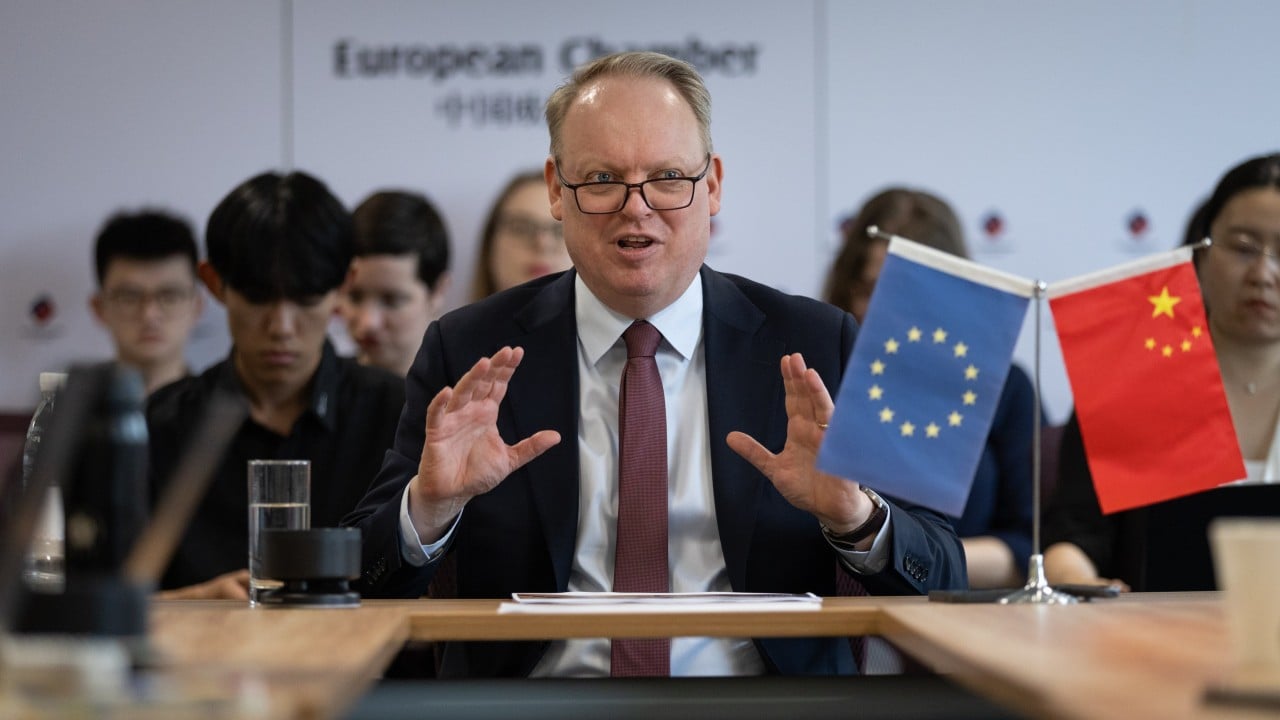
Brussels faces a systemic choice between becoming a passive theater of operations for the United States and China or asserting itself as a primary economic pole. The current European strategy—characterized by reactive anti-subsidy investigations and fragmented national security screenings—fails to address the fundamental shift from globalized trade to "security-first" economics. If the European Union (EU) does not transition from a regulatory watchdog to a strategic actor, it will succumb to the gravitational pull of the Washington-Beijing rivalry, resulting in the erosion of its industrial base and the loss of technological sovereignty.
The Trilemma of European Economic Security
To understand the current friction between the EU Chamber of Commerce in China and the European Commission, one must analyze the situation through a three-factor model. The EU is currently attempting to balance three irreconcilable objectives:
- Market Access: Maintaining deep integration with the Chinese market, which remains the primary growth engine for European chemicals, automotive, and luxury sectors.
- Geopolitical Alignment: Preserving the Transatlantic security alliance with the United States, which increasingly demands export controls and investment restrictions targeting Chinese tech.
- Industrial Integrity: Protecting the Single Market from non-market distortions, specifically the overcapacity generated by Chinese state-led investment in green technologies.
The "passive" role the EU Chamber warns against is the result of failing to prioritize these objectives. When Brussels reacts to US pressure without an independent mechanism for assessing risk, it risks "de-risking" itself into irrelevance.
The Mechanics of Asymmetric Interdependence
The relationship between the EU and China is not a symmetrical trade partnership; it is a complex web of asymmetric dependencies. China’s "Dual Circulation" strategy explicitly seeks to reduce its reliance on foreign technology while increasing the world’s reliance on Chinese supply chains.
The Dependency Vector: Critical Raw Materials
Europe’s transition to a carbon-neutral economy is fundamentally tied to Chinese processing capabilities. China controls roughly 90% of the global supply of rare earth elements and a significant majority of lithium-ion battery components. This creates a structural vulnerability: any trade defense measure taken by Brussels (such as EVs tariffs) can be met with export restrictions on the precursors required to build those same technologies in Europe.
The Revenue Vector: The China Exposure
For Germany’s DAX-40 companies, China often accounts for 20% to 40% of global revenue. This creates a "corporate lobby bottleneck." While the European Commission may want to take a harder line on trade distortions, the largest European employers are effectively hostages to their own Chinese balance sheets. This internal tension prevents the EU from presenting a unified front, allowing Beijing to employ "divide and conquer" tactics among member states.
Quantifying the Cost of Neutrality
"Neutrality" in a trade war is a misnomer; it is effectively a policy of managed decline. The cost function of European passivity can be broken down into three specific economic drains.
The Innovation Leakage
As US export controls (such as the 2022 and 2023 CHIPS Act updates) tighten, China is forced to localize its supply chains. European firms operating in China are pressured to "indigenize" their R&D to avoid US components. This leads to a bifurcation of technology standards. European companies end up maintaining two separate R&D stacks: one for the West and one for China. The result is a massive duplication of costs and a loss of global scale.
Subsidized Overcapacity and Price Suppression
China’s state-directed credit system allocates capital based on strategic goals rather than market demand. This has led to massive overcapacity in solar panels, wind turbines, and electric vehicles.
$S_c > D_l \rightarrow X_e$
Where $S_c$ is Chinese supply, $D_l$ is domestic demand, and $X_e$ is excess export volume.
This excess capacity is dumped into the most open large market—Europe. The mechanism of injury is not just lower sales for European firms; it is the destruction of the investment signal. When prices are artificially suppressed by state-backed competitors, private capital in Europe flees the sector, leading to a permanent loss of industrial capability.
The Framework for Active Autonomy
To move beyond the "passive" stance, Brussels must implement a defensive-offensive framework that moves beyond mere tariff imposition.
1. The Reciprocity Index
The EU currently grants Chinese firms access to its public procurement markets while European firms are largely shut out of Chinese state-led infrastructure projects. A hard reciprocity mandate would tie market access in Europe to verified, transparent access in China. This moves the needle from "protectionism" to "market correction."
2. Diversification of Input Solvency
Rather than simply "de-risking" by reducing trade with China, the EU must actively build "input solvency." This involves state-backed guarantees for mining and processing investments in South America, Africa, and Central Asia. The goal is to break the Chinese monopoly on the mid-stream processing of minerals, which is the actual point of maximum leverage.
3. The European Securitization of Tech
The EU needs a centralized authority to coordinate export controls. Currently, these are handled at the national level (e.g., the Dutch government’s decisions on ASML). This fragmentation allows both the US and China to apply bilateral pressure to individual member states. A unified EU Export Control Office would aggregate the bloc's market power, making it harder for external powers to dictate European trade policy.
The Logic of Selective Decoupling
The term "de-risking" is often used to avoid the more politically sensitive term "decoupling." However, a rigorous analysis suggests that selective decoupling is inevitable. The sectors where the EU must assert dominance are those with high dual-use (civilian and military) potential:
- Semiconductors and Photonics: Reducing reliance on both US IP and Chinese assembly.
- Quantum Computing: Ensuring the standard-setting remains within the Single Market.
- Biotechnology: Protecting genomic data from extraterritorial access.
In these specific domains, the cost of continued integration outweighs the benefits of market access. The risk is not a trade war, but a technological capture that leaves Europe as a "digital colony" of the two superpowers.
The Limitations of the Regulatory State
A significant hurdle to this strategy is the EU's identity as a "regulatory power." Brussels is excellent at writing rules (GDPR, AI Act, Carbon Border Adjustment Mechanism) but poor at fostering the capital accumulation necessary to compete with the US or China.
The US uses "carrots" (massive tax credits via the Inflation Reduction Act), and China uses "directives" (state-owned enterprise mandates). The EU uses "sticks" (regulations and fines). To be an active player, the EU must evolve its fiscal framework to allow for massive, coordinated investment in strategic sectors. Without a "European Industrial Fund" that matches the scale of the US and Chinese efforts, trade defenses are merely delaying the inevitable.
The Geopolitical Arbitrage Opportunity
Despite the risks, the US-China trade war presents a unique arbitrage opportunity for a proactive Europe. As Washington and Beijing restrict each other, the EU can position itself as the "Trusted Third Party."
To execute this, the EU must establish its own "Equivalence Standards." If a product meets European security and sustainability criteria, it should be afforded full market movement, regardless of its origin. This forces both the US and China to compete on European terms. If China wants access to the 450 million high-income consumers in the EU, it must adhere to European transparency standards. If the US wants Europe to align with its export controls, it must offer reciprocal access to its own protected "Buy American" markets.
Strategic Forecast: The Shift to "Fortress Value"
The era of blind globalism is over. The "passive" role the EU Chamber warns about is the natural state of a trade bloc that refuses to acknowledge the weaponization of economics. The next 36 months will be defined by the "Great Realignment."
The EU’s strategic play is the enforcement of a Carbon Border Adjustment Mechanism (CBAM) combined with a Foreign Subsidies Regulation (FSR). These are not just environmental or trade tools; they are the foundation of a "Fortress Value" strategy. By pricing in the externalities of Chinese state capitalism and carbon-heavy production, Europe can re-level the playing field without resorting to the crude protectionism of the 1930s.
The final strategic move for Brussels is the transition from "Member State interests" to "Continental security." This requires the abandonment of the unanimity principle in economic foreign policy. As long as a single member state can veto a trade defense measure due to bilateral pressure from Beijing, the EU will remain a passive observer. The consolidation of trade defense authority into a singular, rapid-response executive function is the only mechanism that can prevent the fragmentation of the European project under the pressure of the Sino-American rivalry.