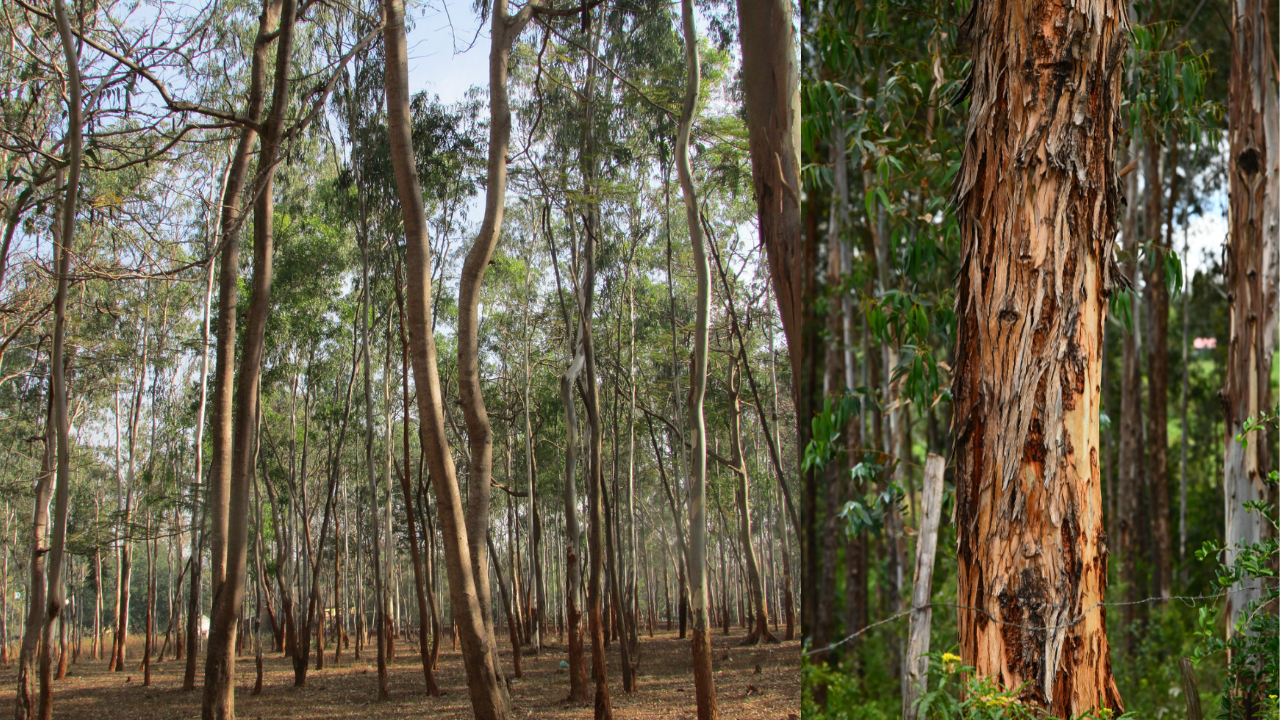
The wood smells like medicine. Walk up into the uplands of Maui or the wet shoulders of the Koʻolau range after a rain, and you will not catch the familiar, clean scent of native koa or the sweet, damp rot of hapuu fern. Instead, your nostrils fill with a sharp, medicinal pungency. Eucalyptus.
It is a smell that burns the back of the throat. It is the smell of cough drops, of vapor rubs, of an immigrant tree that arrived a century and a half ago with good intentions and bad boundaries.
For generations, local carpenters turned their noses up at it. They called it trash wood. They told stories about how it twists as it dries, how it warps under pressure, how it spits nails back out like bad teeth. They watched it swallow entire ridgelines, choking out native canopies while dropping heavy, resinous branches onto hiking trails with terrifying stealth.
Stand beneath a towering Tasmanian blue gum on a humid afternoon. Listen. The forest is strangely quiet. The birds—the rare, fragile honeycreepers that remember a different landscape—do not sing here. There is nothing for them to eat. The leaves are too tough, the nectar too hidden, the chemical defenses of the alien bark too hostile.
Yet, something is shifting in the sawdust.
Consider a small, dusty workshop tucked behind an industrial park in Waialua. The air hums with the high-pitched whine of a thickness planer. A craftsman named Marcus—a hypothetical builder whose hands tell the story of thirty years wrestling local timber—runs a heavy, reddish-brown board through the machine. The blade bites into the grain. Shavings curl into the air, catching the sharp Hawaiian sun.
This board is not koa. It is not ohia.
It is eucalyptus. And it is straight.
For decades, we got the story of these imported forests completely backward. We viewed them strictly as an ecological invasion, a green stain spreading across watersheds that needed to be eradicated or ignored. We forgot a fundamental truth about human ingenuity: materials do not dictate our destiny. Our imagination dictates what materials can become.
The math of the islands is unforgiving. Everything arrives on a barge. Every two-by-four, every sheet of drywall, every steel beam supporting the roofs over our heads has traveled thousands of miles across the Pacific, burning bunker fuel the entire way. The carbon footprint of building a home in the middle of the ocean is staggering.
At the same time, thousands of acres of unmanaged eucalyptus stand rusting on old plantation lands. Planted long ago to fuel sugar mills or stabilize eroding soil after cattle stripped the hills, these trees grew unchecked. They became green monuments to a dead economy.
Then came the structural tests.
Engineers began placing laminated eucalyptus beams under hydraulic presses, cranking the pressure up until steel groaned and timber screamed. What they found surprised the skeptics. When properly harvested, seasoned, and engineered into glued laminated timber, or glulam, this despised alien wood rivals structural steel in its strength-to-weight ratio. It is dense. It is tenacious. It can bear a load that would snap standard Douglas fir like dry twigs.
We are standing at a rare intersection where ecological correction meets economic necessity.
To understand why this matters, you have to look down at the soil.
Rain on a steep Hawaiian slope does not fall gently. It punches. It tears at the red dirt, carrying topsoil down ravines and out into turquoise bays where smothering plumes of mud choke the coral reefs. Native forests are the best shield against this erosion, but bringing back a native canopy takes decades of painstaking, expensive labor.
Eucalyptus buys time.
It is a biological sponge. It drinks water at a voracious rate, stabilizing unstable slopes with a root network that anchors the hillside against flash floods. It acts as an aggressive placeholder. But leaving it wild, unharvested, and choked with dry underbrush creates a ticking time bomb of wildfire risk, especially as the islands grow warmer and drier.
Harvesting these trees is not an act of destruction. It is an act of curation.
Imagine walking through a harvested eucalyptus stand on the Hamakua coast. Where dense, dark monoculture once blocked every ray of sunlight, sudden windows of blue sky open up. The ground, warmed by the sun for the first time in fifty years, wakes up. Dormant seeds buried deep in the earth—native ferns,olapa, kopiko—stir.
When you take the mature trees out of the ecosystem, you remove the heavy water-draw and the chemical leaf-drop that suppressed everything else. You clear the stage. You hand the microphone back to the original cast.
And what happens to the wood you pull out?
It goes into the skeleton of the future.
In urban centers like Honolulu, architects are beginning to rethink what a skyscraper or a community center can look like. Instead of importing carbon-heavy concrete from Asia or the mainland, they are looking up into the hills. They are designing exposed timber frames using locally grown, engineered eucalyptus.
The aesthetic is striking. The grain has a deep, shifting luster—coppery red, amber, and deep chocolate brown. When polished and finished, it carries the weight of the wind and the rain of the mountain where it grew. A family sitting in a living room supported by this timber is not just living inside a house; they are living inside a healed watershed.
There is vulnerability in this transition. No one pretends it is easy.
Processing eucalyptus requires specialized drying kilns to prevent the wood from tearing itself apart as moisture evaporates. The infrastructure on the islands is skeletal at best. Mills are small, capital is scarce, and the inertia of traditional construction habits is hard to break. Builders like what they know. They trust the stamps on imported lumber because those stamps have been there for fifty years.
Convincing a structural engineer to trust a tree that used to be considered firewood takes more than a polite conversation. It takes rigorous testing, transparent data, and a willingness to fail in a lab so we do not fail in the field.
We are stumbling forward through the doubt.
Every time a local carpenter builds a table that doesn't warp, every time an engineer signs off on a glulam beam milled thirty miles from the job site, the invisible architecture of the island economy shifts. We stop being entirely dependent on the next floating metal box arriving at Honolulu Harbor. We start looking inward.
The eucalyptus will never be native. It will never belong to the ancient genealogies of the chant or the deep forest mythology of the islands. It remains an interloper, a guest that stayed too long and grew too large.
Yet, history is rarely pure.
We do not get to rewrite the past. We cannot wave a magic wand and instantly replace every imported organism with pre-contact perfection. We have to live in the messy, complicated present, using the tools and the materials that exist right now, beneath our feet, crying out for purpose.
The sun dips below the ridge behind Waialua, casting long, purple shadows across the valley. The smell of eucalyptus hangs heavy in the cooling air, drifting down from the heights where the old trees wait. They have stood there for generations, silent and heavy with stored sunlight.
The saw blade rests. The sawdust settles on the concrete floor, golden and warm in the fading light.
Out on the water, the horizon is wide and empty, waiting for the next ship that doesn't need to come.